
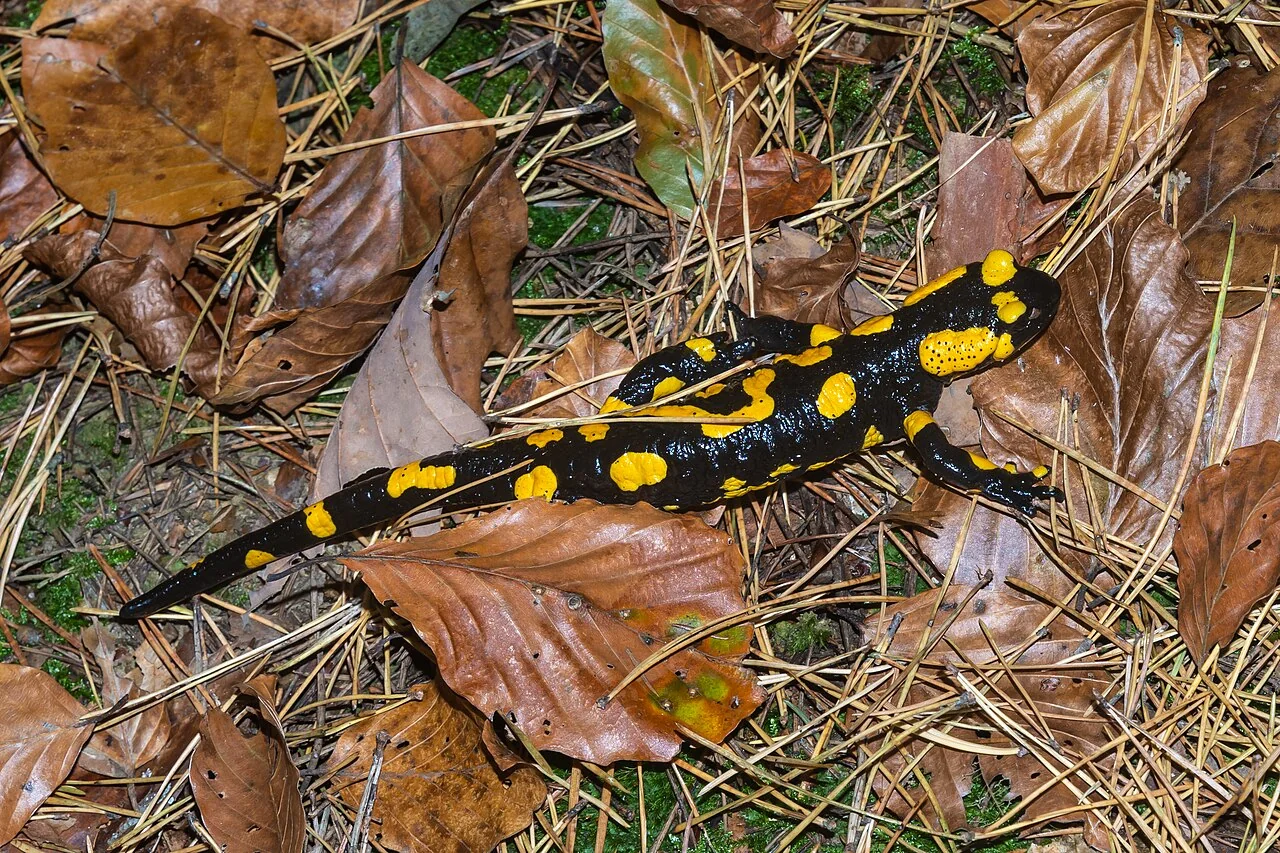
Scientific name
Salamandra salamandra
The fire salamander is a terrestrial amphibian of European wooded habitats. The EAZA and Citizen Conservation guides mainly address Central and Western European forms. [1][2] Their scope is specified here: recommendations are not automatically identical for every population in the complex.
Origin
Widely distributed in Central and Southern Europe; Salzburg Zoo lists deciduous and mixed forests. [3]
- Cool conditions
- Documented origin
- Biosecurity
Documentary overview: identity checked; natural observations and captive practices attributed separately. Undocumented limits remain explicit.
At a glance
| SIZE | 15–20 cm Total length, zoological guideline [3]. |
|---|---|
| LIFESPAN | Several decades Records >40 years reported by EAZA [1]. |
| LIFESTYLE | Terrestrial adult Aquatic larvae, depending on population [2]. |
Adult size
Salzburg Zoo gives a length of 15–20 cm, including body and tail; population and individual differences remain substantial. [3]
Lifespan
The EAZA guide reports captive individuals exceeding 40 years, including observations beyond 50 years. These are published records, not an average life expectancy. [1]
Lifestyle
Terrestrial adult using forest retreats; aquatic larvae in the central forms covered by Citizen Conservation. [1][2]
Housing
ADULT ENVIRONMENT
Cool terrestrial — Differentiated refuges and accessible water [2].
Cool, ventilated terrestrial terrarium with several refuges and an accessible water container. Citizen Conservation emphasises gradients and prevention of uniformly waterlogged substrate. [2]
Care parameters
SUMMER, CC GUIDE
Around or below 20 °C — Central populations, attributed recommendation [2].
LARVAE
Aquatic environment — Setup adapted to their stage [2].
Humidity
Gradient, not saturation — Monitor substrate beneath refuges [2].
Summer temperature
Stay around or below 20 °C in the CC guide [2] Guideline for central populations; anticipate hot spells.
Microclimates
Moist retreats and less moist areas [2] A single air reading does not describe substrate moisture.
Water
Container easily accessible to the adult [2] Larvae require a separately adapted aquatic setup.
Feeding
VARIED INVERTEBRATES
Identified worms and insects; monitor nutrition and remaining prey [2].
Specify biological origin
The EAZA document concerns Salamandra salamandra terrestris, and Citizen Conservation mainly covers terrestris and salamandra. [1][2] This distinction must be retained when reusing a parameter. A black-and-yellow photograph reveals neither population nor lineage. Stated origin, documents and identification must remain linked, without turning a pattern variation into a certain new subspecies.
Adult size, lifespan and lifestyle
Salzburg Zoo gives a length of 15–20 cm, including body and tail; population and individual differences remain substantial. [3]
The EAZA guide reports captive individuals exceeding 40 years, including observations beyond 50 years. These are published records, not an average life expectancy. [1]
Terrestrial adult using forest retreats; aquatic larvae in the central forms covered by Citizen Conservation. [1][2]
Cool forest, not tropical greenhouse
EAZA describes humid forests and refuges that buffer temperature changes. [1] Very hot, saturated conditions are therefore not the functional equivalent of this environment. Room choice and its summer behaviour are decisive. Testing several terrarium points establishes whether a cool retreat truly remains available, even when decorative lighting operates or the room is occupied.
Soil that can be maintained
Citizen Conservation stresses that waste must not accumulate in the substrate and furnishings must remain inspectable. [2] Providing access beneath refuges avoids moving the entire setup for inspection. A beautiful plant carpet does not erase cleaning needs. The moist volume and less moist areas must be observable without forcing the animal out of every hide.
An invertebrate predator
The zoo lists insects and molluscs in the diet. [3] The breeding guide uses earthworms and captive-bred insects among other foods, with adapted nutritional management. [2] A varied diet is prepared from identified prey; it does not mean continuously depositing insects among the furnishings. Remaining prey, their size and each animal's consumption help assess feeding.
Secretive life and skin secretions
Caudata Culture notes the defensive secretions of salamanders in this genus. [4] The project should favour observation in the tank and limit contact to necessary interventions. Neither the hand nor the face should become a prop for a demonstration. An animal remaining still during handling does not prove it is comfortable; preparing a suitable transfer container avoids improvised actions.
From mating to larvae
Reproduction described for central forms includes terrestrial mating and transfer of a spermatophore, followed by release of larvae into water. [2] Caudata Culture also notes populations that give birth to already metamorphosed young. [4] Reproductive strategy must therefore be linked to the population. An adult approaching water does not alone indicate birth, and absence of visible eggs does not exclude reproduction.
Supporting the terrestrial transition
Larvae and adults do not use the same space. [2] Preparing an exit at the appropriate time requires observing transformation rather than counting only days since birth. Juveniles must be able to reach an accessible terrestrial refuge without climbing a smooth wall. Differently sized animals must remain separable, and small-prey availability must be verified before rearing begins.
Biosecurity and lasting commitment
The EAZA guide devotes substantial attention to Bsal, a pathogenic salamander fungus. [1] A new acquisition must therefore have its own equipment and a quarantine procedure defined with a professional; plants and natural materials are not automatically harmless. Do not collect wild salamanders, and check current obligations before keeping them. This profile explains no treatment or forced overwintering: these procedures cannot be inferred from a simple calendar.
Checklist
- Plan for hot summers.
- Identify the stated population.
- Separate new arrivals and equipment.
Observations to record
- Temperature
- Meals
- Ground
- Stage
The app provides individual animal records. Check which features are available for your animal in the released version.
Related guides
Original guides in French
Sources
Document-based overview; not a substitute for veterinary advice.
- EAZA (2021) — Fire Salamander Best Practice Guidelines
Source accessed - Citizen Conservation (2023) — Salamandra salamandra, Central Europe
Source accessed - Zoo Salzburg — Feuersalamander
Source accessed - Caudata Culture — Salamandra
Source accessed