
Scientific name
Pelodryas caerulea
Other names: Litoria caerulea · Ranoidea caerulea
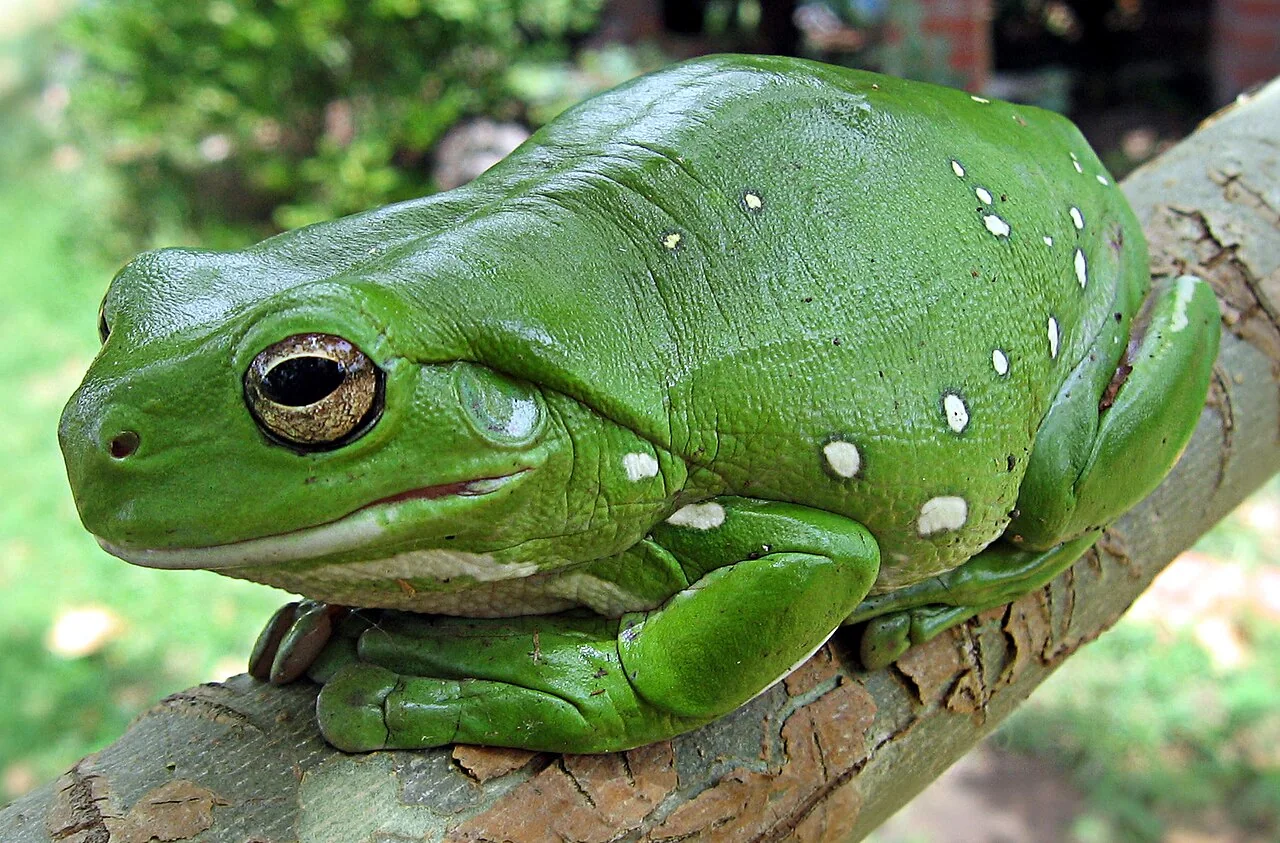
White’s tree frog is an anuran amphibian in the Pelodryadidae family. Pelodryas caerulea is the name adopted by Amphibian Species of the World; Litoria caerulea and Ranoidea caerulea are earlier combinations still used in care sheets. [1]
Origin
Northern and eastern Australia, the Torres Strait islands and southern parts of New Guinea. Populations introduced elsewhere are not part of this native range. [1]
- Arboreal
- Nocturnal
- Insectivorous
At a glance
Northern and eastern Australia, Torres Strait and southern New Guinea. [1] Arboreal and mainly nocturnal. [4]
| ADULT SIZE | Up to ≈ 11 cm Body length in the Australian Museum’s description. [2] |
|---|---|
| LIFESPAN | 10–15 years and more Captive estimate, without an individual guarantee. [3] |
| LIFESTYLE | Arboreal Mainly nocturnal; perches and elevated shelters. [4] |
Adult size
Up to around 11 cm in body length in the Australian Museum’s descriptive text; its summary box displays 12 cm. This discrepancy rules out excessive precision. [2]
Adult weight
No contextualised adult range in the selected guidance. No target weight is therefore proposed; follow individual changes and have body condition assessed.
Lifespan
10–15 years and sometimes longer in captivity according to Tree of Life; an estimate, not an individual guarantee. [3]
Lifestyle
Arboreal and mainly nocturnal; branches, foliage and elevated shelters are useful. [4]
Beginner with guidance
Editorial assessment: the RVC describes it as accessible to a first-time amphibian keeper, provided water, climate and prevention of overfeeding are managed. [4]
Housing
GENUINE ELEVATED ROUTES
Branches + shelters — Usable height, stable supports and access to suitable water. [3][4]
Provide genuinely usable height. Tree of Life cites a minimum of 20 US gallons in a tall format for one individual, without exact dimensions or an age distinction; volume alone therefore does not describe an adequate terrarium. [3]
Care parameters
HEATING SPOT
≈ 30 °C — RVC reference, regulated heating. [4]
COOL AREA
≈ 25 °C — Measure at perch level. [4]
NIGHT
≥ 21 °C — Minimum stated by the RVC. [4]
Humidity
50–70 % — Allow drying between sprayings and maintain good ventilation. [3]
Heating spot · day
≈ 30 °C [4] RVC reference; localised heat, thermostat and guarded source.
Cool zone · day
≈ 25 °C [4] Measure at the level of the perches used.
Night
≥ 21 °C [4] RVC minimum; switch off the light source at night.
Humidity
50–70 % [3] Allow a decrease between mistings and maintain ventilation.
UVB
Low exposure with shade [5] Light cycle close to 12 h; distance and output to be checked.
Feeding
VARIED INVERTEBRATES
Juveniles: daily; adults: 3–4 meals per week in the Tree of Life guidance. Adjust portions to avoid overfeeding. [3]
Habitat by age
A young animal must be able to find its prey and water easily; no table of dimensions by life stage is established by the selected sources. Provide stable supports, shelters and a secure lid. [3][4]
For several adults, Tree of Life cites 46 × 46 × 61 cm or more, but this group reference does not guarantee cohabitation. Observe individual access to perches and meals, and retain a separation option. [3]
Water, substrate and maintenance
Accessible water must be treated to remove mains-water disinfectants and replaced regularly. A dish allows bathing with an easy exit. Avoid a constantly waterlogged base. [3][4]
The RVC suggests damp paper for an easy-to-monitor temporary setup, then suitable moisture-retaining substrate in a lasting enclosure. Remove droppings and dead insects daily; planting does not make maintenance unnecessary. [4]
Feeding and frequency
Offer varied invertebrates suited to the mouth, well fed before being offered. Juveniles receive daily meals; Tree of Life suggests three to four feedings weekly for adults. Adjust the amount to body condition, as this tree frog can easily be overfed. [3]
Calcium and vitamin supplementation accompanies the prey under a plan that considers diet and UVB. Remove leftovers rather than leaving a reserve of insects roaming the terrarium for extended periods. [3]
Handling and living together
This is primarily an animal to observe. Limit handling; if necessary, use powder-free gloves moistened with appropriate water. Human skin, lotions and household products must not contaminate the animal or its water. [3]
Reproduction and cycle
In the wild, eggs form floating clusters in temporary waters; development passes through an aquatic tadpole before metamorphosis. The Australian Museum describes reproduction during the Australian spring and summer. [2]
This observation justifies neither automatic cooling nor an artificial rainy season. A breeding project requires separate larval housing and water management; this care profile does not provide a tadpole-rearing protocol.
Warning signs and records
Persistent loss of appetite, weight loss, skin lesions or difficulty moving warrant specialist veterinary advice. Obesity can also be a problem. [3] Record meals actually swallowed, occasional comparable weights, nocturnal activity, water renewals and terrarium minimums/maximums. Records serve to describe changes, not to diagnose disease from a colour.
Checklist
- Install stable perches and accessible shelters.
- Prepare suitable water and daily maintenance.
- Check night-time conditions, UVB and food portions.
Observations to record
- Meals eaten
- Weight and body condition
- Nocturnal activity
- Water and cleaning
- Temperatures and humidity
The app provides individual animal records. Check which features are available for your animal in the released version.
Related guides
Related guides
Original guides in French
Sources
Document-based overview; not a substitute for veterinary advice.
- AMNH — Amphibian Species of the World : Pelodryas caerulea
Source accessed - Australian Museum — Green Tree Frog
Source accessed - Tree of Life Exotic Pet Medical Center — White’s Tree Frog Care
Source accessed - Royal Veterinary College — White’s Tree Frog Care, révision décembre 2024
Source accessed - Royal Veterinary College — White’s Tree Frog Care, révision novembre 2023
Source accessed