
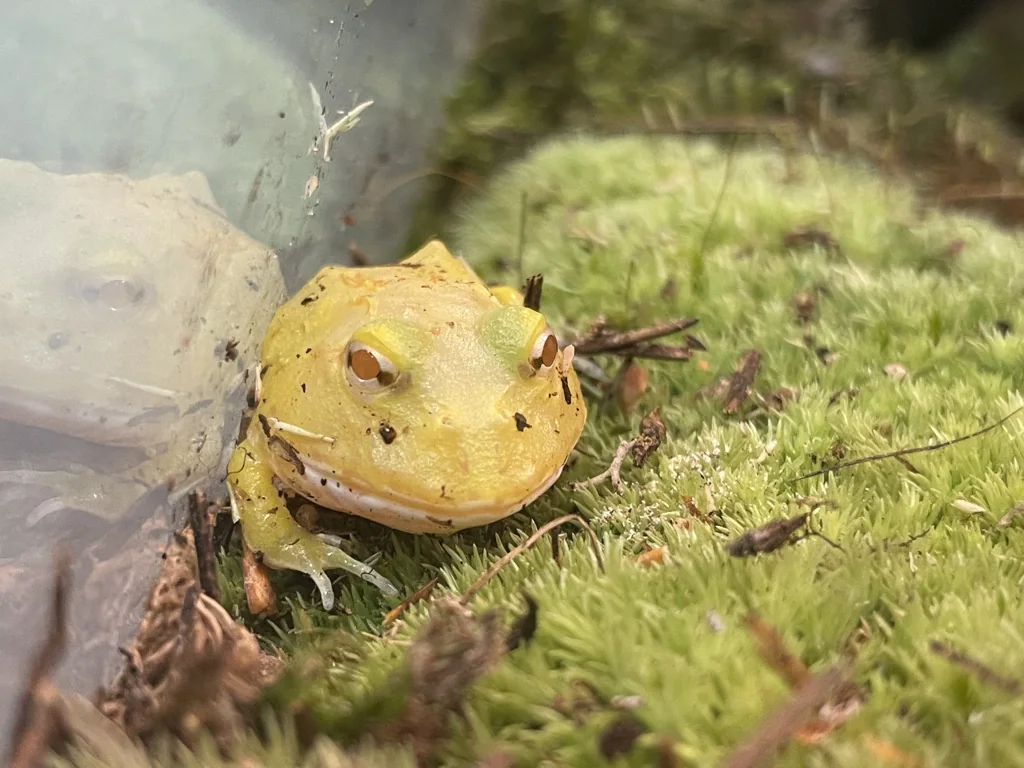
Scientific name
Ceratophrys cranwelli
Ceratophrys cranwelli is an anuran in the Ceratophryidae family. The trade name ‘Pacman’ covers several Ceratophrys: check identity before transferring a care sheet, particularly one for C. ornata. [1][3]
Origin
Gran Chaco: parts of Argentina, Paraguay, Bolivia and Brazil. The landscape combines dry forests, savannas and temporary wetlands; the natural cycle follows rainfall. [2]
- Burrower
- Nocturnal
- Ambush hunting
At a glance
South American Gran Chaco, in environments shaped by seasonal rainfall. Terrestrial, burrowing and an ambush predator. [2]
| ADULT SIZE | 8–13 cm Body length. [2] |
|---|---|
| LIFESPAN | 6–10 years: genus Captive Ceratophrys spp. estimate; the Smithsonian does not quantify captivity specifically for Cranwell’s horned frog. [2][3] |
| LIFESTYLE | Burrower Nocturnal, ambush hunting. [2] |
Adult size
8–13 cm in length according to the Smithsonian. In the study by Long and colleagues, adults aged 12–14 months averaged around 8,5 cm for males and 9 cm for females, from snout to vent. [2][4]
Adult weight
Study of 30 captive individuals aged 12–14 months: males 108,7 ± 21,75 g and females 115,4 ± 21,61 g, means ± standard deviation. These values describe this group and are not ideal weights. [4]
Lifespan
The Smithsonian states 1–4 years in the wild and longer in captivity without a precise species-specific figure. Tree of Life suggests 6–10 years or more for captive Ceratophrys collectively: a genus-level estimate, not a guarantee for every Cranwell’s horned frog. [2][3]
Lifestyle
Terrestrial, burrowing, mainly nocturnal and an ambush predator. Risk of cannibalism. [2]
Experienced keeper
Editorial assessment: recognising a problem in an animal with low activity, managing water and substrate, and adjusting meals require attentive monitoring. [3][5]
Housing
INDIVIDUAL SPACE
Ground for burrowing — Individual housing: risk of cannibalism. [2]
Individual housing. Tree of Life and Swiftail cite 10 US gallons as a minimum for an adult, without floor dimensions and with enlargement for large females. No age-based scale is validated here; volume alone is insufficient. [3][5]
Care parameters
AIR · DAY
≈ 24–28 °C — Clinical Ceratophrys spp. reference including C. cranwelli. [3]
WARMER AREA
≈ 28–29 °C — Regulated heating, with a retreat area. [3]
NIGHT · ACTIVE HUSBANDRY
≈ 22–24 °C — Genus-level clinical reference. [3]
Humidity
60–80 % — Clinical captive reference; moist substrate without saturation. [3][5]
Ambient conditions · day
≈ 24–28 °C [3] Clinical Ceratophrys spp. care sheet including C. cranwelli; a gradient, not a uniform temperature.
Warmer area
≈ 28–29 °C [3] Regulated source; retain a retreat area and check the substrate.
Night
≈ 22–24 °C [3] Rounded conversion of 72–75 °F; active husbandry.
Humidity
60–80 % [3][5] Moist, ventilated substrate, never waterlogged.
UVB
Low exposure with shelters [3][5] Possible benefit, to be adapted to the animal and enclosure.
Feeding
MEALS ADAPTED TO AGE
Juveniles: daily; adults: 2–3 meals per week according to Tree of Life, to be adjusted to body condition. [3]
Habitat and substrate by age
The setup prioritises usable land area and hides. A juvenile must be able to reach its water and prey without competition. The sources do not allow reliable dimensions for every age; plan enlargement rather than a small permanent container.
Tree of Life recommends a layer that allows burrowing, around 8–10 cm in its genus-level guidance. Keep the material moist without standing water, remove soiling and avoid elements easily swallowed during meals. [3]
Water and maintenance
Provide a shallow dish where the animal can bathe and get out. Water must be suitable for amphibians; change it daily and monitor ground cleanliness. [3] The frog often stays buried: do not dig it up to produce activity or take a photograph. [5]
Feeding and frequency
Vary appropriately sized invertebrates, well fed before being offered. Tree of Life suggests a daily meal for juveniles, then two to three per week for adults; Swiftail states every two to three days for adults. These similar references still need adjustment to size and body condition. [3][5]
Combine calcium and vitamins in a suitable plan; do not confuse a large appetite with a need for large meals. Monitor accidental substrate ingestion and body condition rather than pursuing rapid growth. [3][5]
Cohabitation and handling
The presence of another frog can trigger an attack and ingestion: keep separately. [2] For an essential transfer, support the body with moistened powder-free gloves, limiting the duration. This is not an animal intended for frequent handling. [3][5]
Reproduction and seasonality
In the Gran Chaco, eggs are laid in temporary pools linked to rainfall; tadpoles are carnivorous and sometimes cannibalistic. A buried phase naturally accompanies the unfavourable season. [2]
These observations do not prescribe artificial aestivation. Do not automatically start drying, cooling or fasting: a sick animal can also bury itself and stop eating. Larval needs and reproduction require a separate protocol.
Warning signs and records
An abnormally red belly or limbs, lesions, swelling, sustained appetite loss or movement difficulties require specialist advice. [5] Long’s study establishes clinical references for a sample; its temperatures and analyses constitute neither a demonstrated domestic optimum nor a remote diagnosis. [4] Record food intake, droppings, position in the soil, parameters and comparable weights.
A floor-area reference for an adult
In addition to a volume expressed in litres, Bebesaurus suggests a 60 × 40 × 40 cm terrarium for one adult. This is an identified breeder reference, to be adapted to the individual, not universal validation of a minimum. [6]
The same breeder describes ground that allows burrowing and a shallow water container. These elements supplement the dimensional reference; they do not replace the parameters and precautions already detailed in this profile. [6]
Checklist
- Plan an individual habitat and clean burrowing ground.
- Measure heat and humidity at the animal’s level.
- Arrange suitable meals and renewed water.
Observations to record
- Meals actually eaten
- Weight and body condition
- Droppings and skin
- Burrowing and activity
- Water and parameters
The app provides individual animal records. Check which features are available for your animal in the released version.
Related guides
Original guides in French
Sources
Document-based overview; not a substitute for veterinary advice.
- AMNH — Amphibian Species of the World : Ceratophrys cranwelli
Source accessed - Smithsonian National Zoo — Cranwell’s horned frog
Source accessed - Tree of Life Exotic Pet Medical Center — Pacman Frog Care
Source accessed - Long et al. (2023) — Reference intervals for hematology, plasma biochemistry, and bone mineral density in captive Ceratophrys cranwelli
Source accessed - Swiftail / Wintergreen Vet Services — Pacman Frog Care Sheet (2025)
Source accessed - Bebesaurus — Ceratophrys cranwelli
Source accessed