
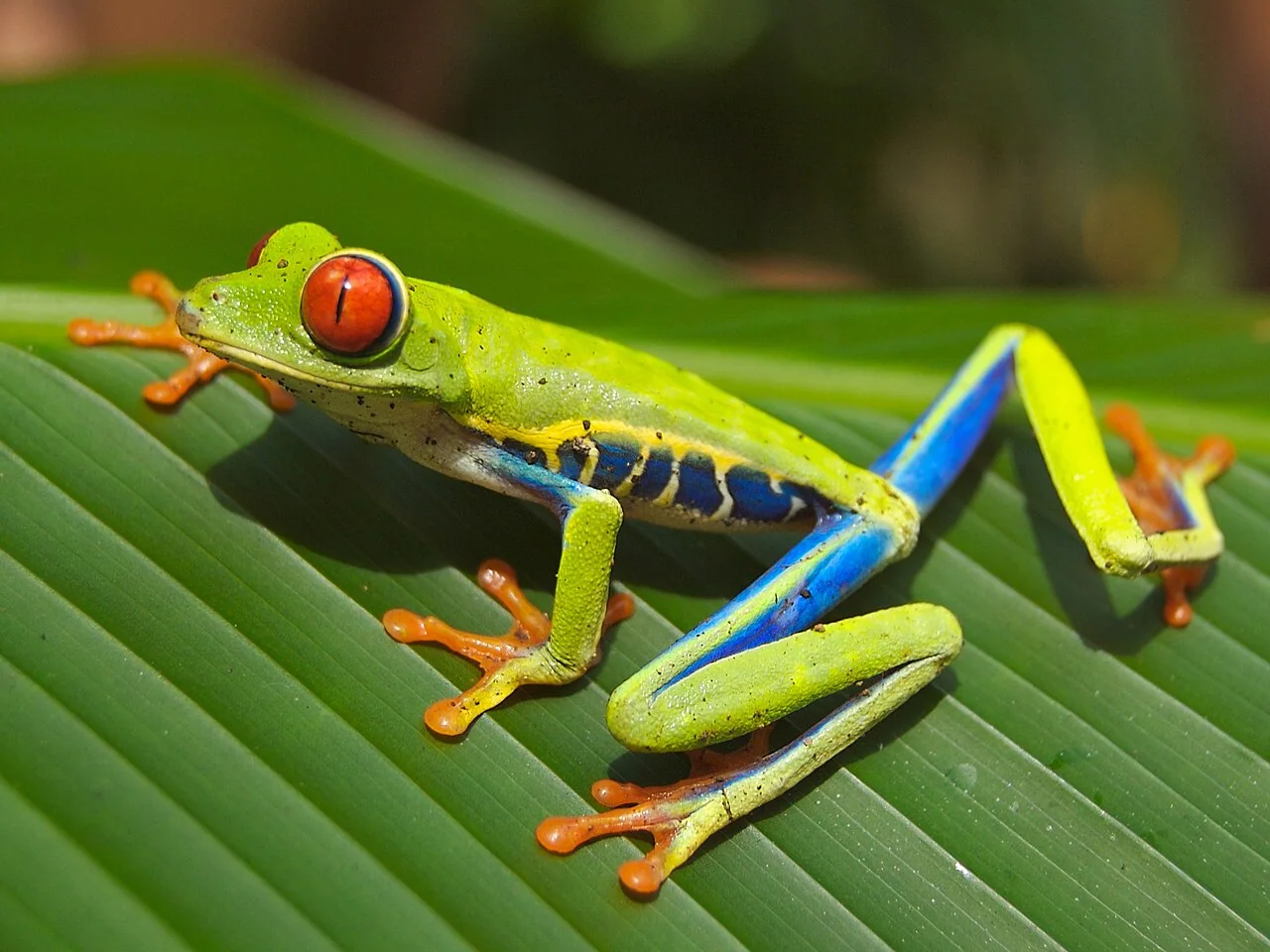
Scientific name
Agalychnis callidryas
Agalychnis callidryas is the Neotropical red-eyed tree frog. It should not be confused with Australian tree frogs bearing a similar common name. [1]
Origin
Central America and northwestern Colombia. [1]
- Arboreal
- Nocturnal
- Tropical forest
At a glance
| ADULT SIZE | ≈ 5–7,5 cm Females generally larger. [2] |
|---|---|
| LIFESPAN | 5–10 years and more Tree of Life captive estimate. [3] |
| LIFESTYLE | Nocturnal and arboreal Resting in foliage during the day. [2][3] |
Adult size
Around 5–7,5 cm in body length; females are generally larger. [2]
Lifespan
5–10 years or more in captivity according to Tree of Life; lifespan varies with conditions and individuals. [3]
Lifestyle
Housing
A TALL TERRARIUM
≈ 46 × 46 × 61 cm — Clinical minimum for one individual: width × depth × height; vegetation, drainage and ventilation. [3]
Tree of Life suggests a minimum of around 46 × 46 × 61 cm for one individual, with branches, plant cover, drainage and ventilation. [3]
Care parameters
AMBIENT AIR · DAY
≈ 24–28 °C — Chicago Exotics reference, not a surface temperature. [2]
NIGHT
≥ 22 °C — Minimum stated in this clinical care sheet. [2]
Humidity
70–90 % — Tree of Life reference, with ventilation and drainage. [3]
Daytime ambient air
≈ 24–28 °C. [2] Conversion of 76–82 °F; this is not a surface temperature under a lamp.
Night
Minimum ≈ 22 °C in the Chicago Exotics care sheet. [2] Regulated heating and independent checking.
Humidity
70–90 % according to Tree of Life. [3] Ventilate; the ground must not become stagnant water.
Feeding
AN INSECTIVOROUS DIET
Crickets, roaches and other suitable invertebrates; monitor the amount eaten to avoid overfeeding. [2]
Feeding
Insectivorous, it receives crickets, roaches and other suitable invertebrates among its foods. Chicago Exotics notes a risk of overfeeding. [2]
Foliage and quiet
Plant cover offers resting places. Water must be suitable for amphibians and regularly replaced; handling remains occasional to protect the skin. [3]
Useful records
Observe perch use after lights out and record prey accepted. Take temperatures in several accessible areas and humidity before and after spraying. Keep misting times and the water-preparation method: an isolated percentage describes neither ventilation nor substrate condition.
Resting leaves and juvenile development
The care sheet describes daytime rest on the undersides of leaves and adhesive toe discs. Genuinely accessible foliage therefore serves as a resting support, not merely decoration. [4]
Eggs are laid on leaves above water, into which the tadpoles fall after hatching. Laying, hatching and aquatic development are separate stages to date; no universal duration is calculated here. [4]
Dietary supplements: distinguish the situations
The Chicago Exotics care sheet provides for calcium and vitamin supplements on food. [2]
Scope: captivity; Chicago Exotics protocol for Agalychnis callidryas. Consider diet composition and the enclosure; no universal dosage is set by this synthesis.
Checklist
- Check hides in the foliage.
- Check elevated probes.
- Prepare suitable water.
Observations to record
- Meals
- Humidity
- Temperatures
- Nocturnal activity
The app provides individual animal records. Check which features are available for your animal in the released version.
Related guides
Original guides in French
Sources
Document-based overview; not a substitute for veterinary advice.
- AMNH — Amphibian Species of the World : Agalychnis callidryas
Source accessed - Red Eyed Tree Frog Care (Agalychnis callidryas)
Source accessed - Tree of Life Exotic Pet Medical Center — Red-eyed tree frog care
Source accessed - Bebesaurus — Agalychnis callidryas
Source accessed