
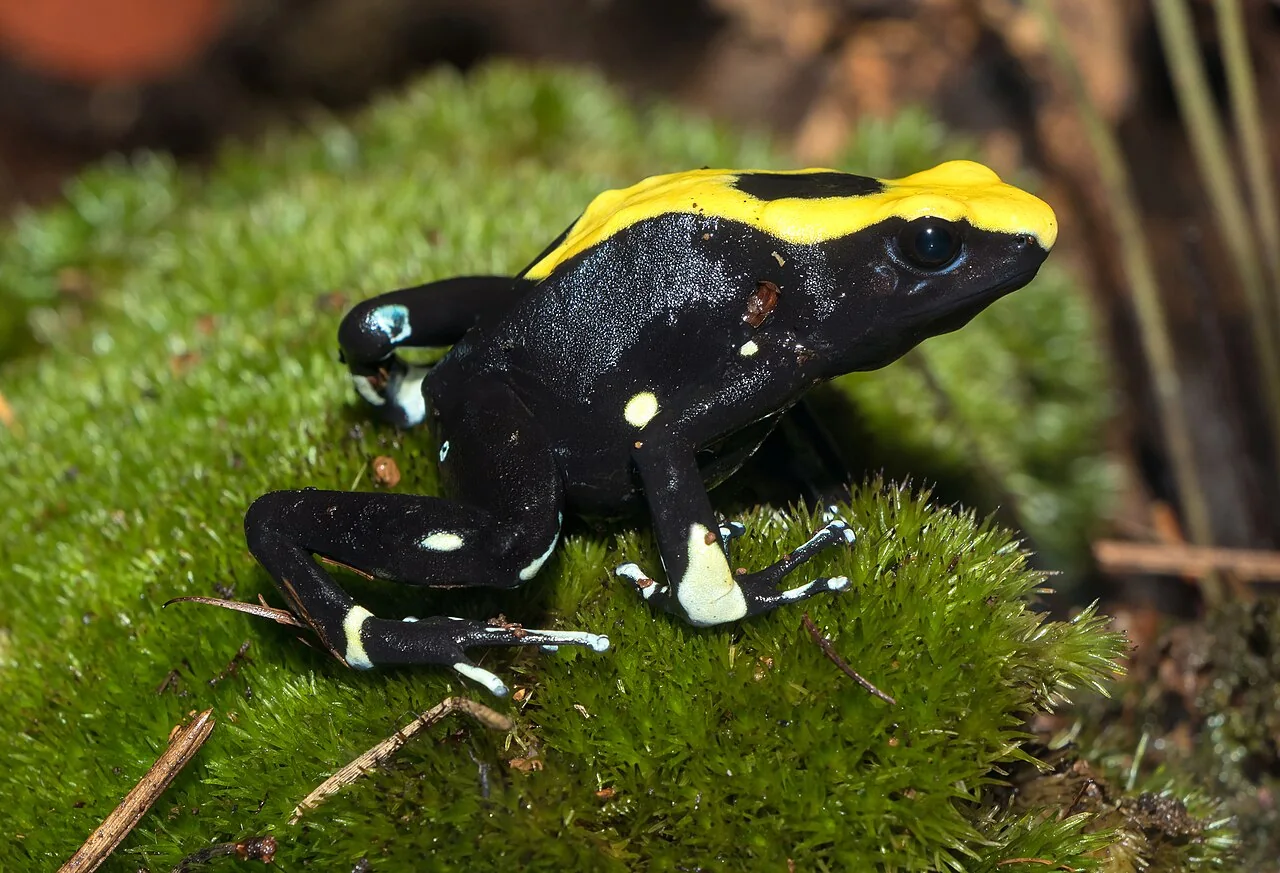
Scientific name
Dendrobates tinctorius
Other names: Dendrobates azureus
Dendrobates tinctorius is an anuran in the Dendrobatidae family. The name Dendrobates azureus is placed in synonymy in the AMNH reference consulted; colour variations therefore do not automatically represent distinct species. [1]
Origin
Lowland forests of Guyana, Suriname, French Guiana and neighbouring Brazilian areas. [1] The field observations used here mainly come from populations in French Guiana. [4]
- Diurnal
- Insectivorous
- Forest litter
At a glance
Lowland forests of the Guiana Shield and neighbouring Brazilian regions. [1] Diurnal, it uses the ground and elevated surfaces. [4][5]
| ADULT SIZE | 4–5 cm Length stated by the MNHN. [2] |
|---|---|
| LIFESPAN | Up to 15 years Possible captive lifespan, not an average. [2] |
| LIFESTYLE | Diurnal Diurnal, on the ground and in forest microhabitats. [4][5] |
Adult size
4–5 cm in length in the Muséum national d’Histoire naturelle profile. The value describes an approximate scale, not every geographical form. [2]
Adult weight
3–5 g according to the MNHN, without a breakdown by sex or geographical form on the page. This is a descriptive reference, not a target to reach. [2]
Lifespan
Up to 15 years in captivity according to the MNHN; this is a possible lifespan, not an average. [2]
Lifestyle
Diurnal; it explores the forest floor, shelters and elevated surfaces too. Territorial interactions are not limited to males. [4][5]
Experienced keeper
Editorial assessment: regular small prey, suitable water, a ventilated humid climate and social interactions require close monitoring. [3][4]
Housing
A FOREST VIVARIUM
Planted and drained — Chicago cites 61 × 31 × 41 cm in its shared guidance; more floor area is desirable. [3]
Chicago Exotics cites around 61 × 31 × 41 cm as the smallest terrarium in a shared care sheet including D. tinctorius. This is not a demonstrated minimum for every age or group; more floor area and shelters are desirable. [3]
Care parameters
AIR · DAY
≈ 21–26 °C — Shared clinical guidance including D. tinctorius. [3]
NIGHT · FAMILY-LEVEL REFERENCE
≈ 20–21 °C — Tree of Life guidance on dendrobatids; not an optimum specific to every population. [5]
Humidity
≥ 75 % — Shared clinical reference; avoid saturated substrate and ensure drainage. [3]
Air · day
≈ 21–26 °C [3] Shared clinical reference; avoid an intense heating zone.
Night
≈ 20–21 °C: family-level reference [5] Tree of Life covers several dendrobatids; check the enclosure before any reduction.
Humidity
At least 75 % [3] Chicago reference, with drainage and ventilation; not flooded ground.
UVB
Low exposure and covered areas [3][5] Potential benefit discussed; no universal lamp percentage.
Feeding
VERY SMALL PREY
Wingless fruit flies, springtails and small crickets; plan suitable supplementation. [3]
Habitat by life stage
A recently metamorphosed frog has different feeding needs and dimensions from an aquatic tadpole. The selected captive sources do not give validated dimensions for every stage: do not convert an adult size into a larval tank by proportional calculation.
For terrestrial care, provide litter, plants, hides and air circulation. Drainage separated from the substrate by a barrier helps avoid saturation; detritivores in a bioactive setup do not replace waste removal. [5]
Water, substrate and light
The skin participates in exchanges with the environment: use water free from chlorine and chloramine, and substrate without harmful additives. Avoid any deep water without an exit; replace water and monitor accumulation beneath the drainage. [3][5]
Light the enclosure on a day/night rhythm and provide shelters. A plant LED is not a UVB lamp; the choice of UV and supplementation must remain coherent. Family-level references do not demonstrate a precise optimum for every population. [5]
Feeding and frequency
Cultured fruit flies, springtails and very small crickets allow varied small prey. Chicago recommends daily feeding for juveniles, then every other day for adults outside breeding; a laying female may need adjustment. [3]
Plan reliable prey cultures and suitable calcium and vitamin supplementation. Observe what each individual eats: the number poured into the vivarium alone does not track nutritional intake. [3]
Cohabitation and handling
Chicago favours pairs for D. tinctorius rather than groups. Even a pair needs observation. In the field, Rojas and Pašukonis described chasing and fighting in both sexes: bright colour or small size does not mean an absence of aggression. [3][4]
Avoid handling. For a necessary transfer, prefer a clean container; moistened powder-free gloves limit skin contamination. [3][5]
Reproduction and cycle
Eggs are laid out of water, then the tadpoles are generally carried by the male to small water reservoirs. Larvae can be cannibalistic. This cycle described in the wild is not the same as that of a tree frog laying directly in open water. [4]
Do not impose a dry season, a temperature reduction or a tadpole density on the basis of this synthesis alone. Breeding requires a separate protocol documented for the group concerned.
Warning signs and records
Loss of appetite, weight loss, apparent dehydration or skin lesions require specialist assessment. [5] Monitor consumption, activity, interactions, comparable photos and vivarium measurements. Weighing must remain useful and limit handling; an isolated figure is not enough to conclude that health is good.
Checklist
- Stabilise drainage, ventilation and humidity before arrival.
- Plan a reserve of small cultured prey.
- Be able to separate individuals if conflict occurs.
Observations to record
- Prey eaten
- Activity and interactions
- Body condition
- Humidity and temperatures
- Water, cleaning and clutches
The app provides individual animal records. Check which features are available for your animal in the released version.
Related guides
Original guides in French
Sources
Document-based overview; not a substitute for veterinary advice.
- AMNH — Amphibian Species of the World : Dendrobates tinctorius
Source accessed - MNHN — The poison arrow frog
Source accessed - Chicago Exotics — Dart Frog Care, Dr Susan Horton
Source accessed - Rojas et Pašukonis (2019) — From habitat use to social behavior, PeerJ 7:e7648
Source accessed - Tree of Life Exotic Pet Medical Center — Poison Dart Frog Care
Source accessed