
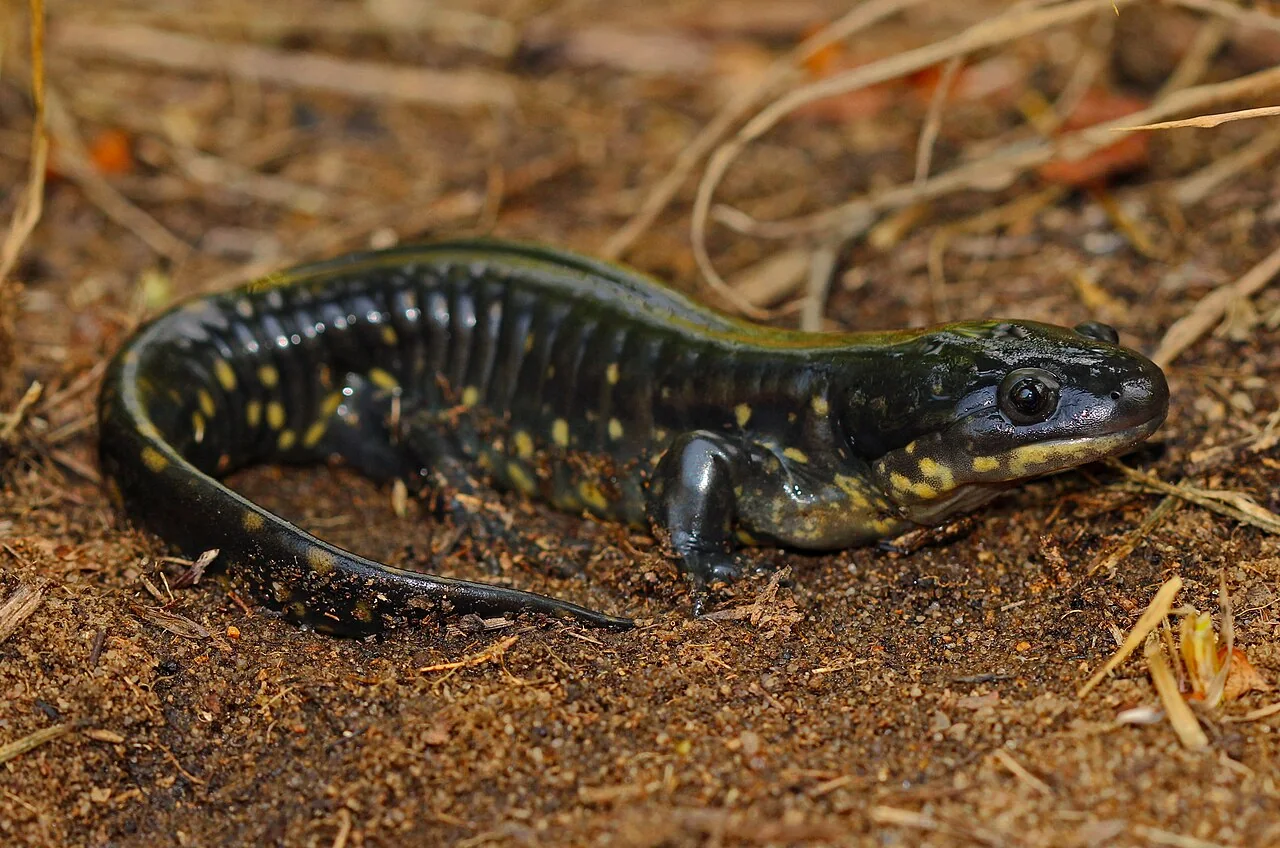
Scientific name
Ambystoma tigrinum
Ambystoma tigrinum here refers to the eastern tiger salamander, distinct from the western A. mavortium. The New York Department of Environmental Conservation assessment notes this separation. [1] Metamorphosed adults live mainly in the soil, while larvae develop in water.
Origin
Eastern North America, with contrasting regional populations and habitats. In Missouri, woodland, savanna, grassland and wetlands near ponds are used. [1][2]
- Burrowable soil
- Species to confirm
- Nocturnal life
Documentary overview: identity checked; natural observations and captive practices attributed separately. Undocumented limits remain explicit.
At a glance
| SIZE | ≈18–21 cm Typical total length in Missouri [2]. |
|---|---|
| LIFESPAN | More than 20 years reported Captivity, not an average [2]. |
| LIFESTYLE | Burrowing adult Aquatic larvae [2]. |
Adult size
Approximately 18–21 cm total length for adults described in Missouri; individuals reaching approximately 33 cm are reported as exceptional. [2]
Lifespan
The Missouri Department of Conservation reports more than 20 years in captivity; this observation does not describe an average for all animals. [2]
Lifestyle
Terrestrial and burrowing after metamorphosis, mainly active at night; aquatic reproduction and larval development. [2]
Housing
METAMORPHOSED ADULT
Deep soil and refuges — Terrestrial terrarium, not a permanent aquarium [2][4].
Horizontal terrarium with burrowable soil, stable retreats and differentiated moisture. The Caudata Culture sheet covers both tiger salamanders: its guidelines are attributed to this group. [4]
Care parameters
AIR DURING ACTIVITY
≈18–22 °C — Caudata Culture group guide [4].
WATER
Depending on stage — Aquatic larvae and reproduction [2].
Humidity
Gradient within the soil — Moist and less moist areas; no universal percentage [4].
Air during the active period
Approximately 18–22 °C, Caudata Culture guide [4] Advice shared between tigrinum and mavortium, not an experimental result specific to a population.
Ground
Moist in areas, not saturated [4] Usable depth and the ability to dig matter as much as floor area.
Life stage
Aquatic larva or metamorphosed animal [2] Identify the stage before choosing housing.
Feeding
VARIED INVERTEBRATES
Identified resources, adapted portions; the wild-food list is not a diet plan [3].
Clarify the name on documents
Older usage of A. tigrinum included several forms now treated differently. [1] A ‘tiger salamander’ invoice therefore does not always specify the species. Retaining photographs and stated origin allows later verification. Colours alone can be misleading, particularly in a juvenile. The record must not present uncertain identification as genetically confirmed identity.
Adult size, lifespan and lifestyle
Approximately 18–21 cm total length for adults described in Missouri; individuals reaching approximately 33 cm are reported as exceptional. [2]
The Missouri Department of Conservation reports more than 20 years in captivity; this observation does not describe an average for all animals. [2]
Terrestrial and burrowing after metamorphosis, mainly active at night; aquatic reproduction and larval development. [2]
The burrow is part of the habitat
The Missouri natural-history service describes a species capable of digging its own tunnels as well as using those of other animals. [2] Furnishings consisting only of a few stones on a thin substrate layer remove this opportunity. Heavy items must rest on a stable structure so digging does not tip them over. Providing inspectable refuges preserves this function without requiring the whole tank to be dug through.
Moisture without flooded soil
Caudata Culture recommends moisture-retaining substrate and differences between areas, while advising against excessively acidic materials. [4] In practice, inspecting below the soil surface distinguishes a dry crust from a saturated base. Water must not accumulate unseen beneath a shelter. The moistest area must remain accessible but must not become the only place where the animal can hide.
Feeding a close-range predator
Virginia's wildlife account describes a diet including worms, insects, slugs and snails. [3] This natural list does not prescribe collecting prey from a treated garden or reproducing every observed opportunistic meal. For a captive animal, organise several identified captive-bred food resources and observe what is accepted. A large mouth opening alone does not establish that a bulky prey item is suitable.
Larval water and terrestrial exit
The cycle documented in Missouri includes gilled larvae that later transform into terrestrial juveniles. [2] The setup must anticipate this transition with easily reached land access, rather than waiting until the animal cannot use its old tank. Dates observed in an American state do not become an automatic deadline for European captive breeding; size, stage and behaviour must still be observed directly.
Seasonal reproduction
Virginia describes breeding migrations on rainy nights, followed by deposition and transfer of a spermatophore in water. Eggs adhere to twigs among other supports. [3] The process involves an aquatic environment and larval rearing separate from the terrestrial terrarium. Before breeding, plan containers, prey and separation by size; an abundant clutch does not mean rearing is already organised.
Observe without constantly digging up
Hidden and nocturnal activity is normal in this salamander's natural history. [2] Monitoring can combine visits to feeding points, the condition of accessible shelters and spaced measurements under comparable conditions. A prolonged absence of sightings must be distinguished from an actually observed food refusal. Declining condition, a lesion or lasting behavioural change warrants professional assessment rather than random temperature adjustment.
Origin and conservation
The New York report highlights the importance of breeding ponds and associated terrestrial habitats. [1] Preserving water alone without surrounding soil does not protect the whole cycle. For a captive project, request documented origin, check local rules and do not collect from the wild. Keeping equipment and new arrivals separate limits unintended transfers between setups; no treatment or overwintering schedule is prescribed here.
Checklist
- Confirm tigrinum or mavortium.
- Stabilise furnishings above the soil.
- Anticipate larval metamorphosis.
Observations to record
- Stage
- Meals
- Ground
- Activity
The app provides individual animal records. Check which features are available for your animal in the released version.
Related guides
Original guides in French
Sources
Document-based overview; not a substitute for veterinary advice.
- New York DEC (2025) — Eastern tiger salamander assessment
Source accessed - Missouri Department of Conservation — Eastern Tiger Salamander
Source accessed - Virginia Department of Wildlife Resources — Eastern tiger salamander
Source accessed - Caudata Culture — Tiger salamanders
Source accessed