
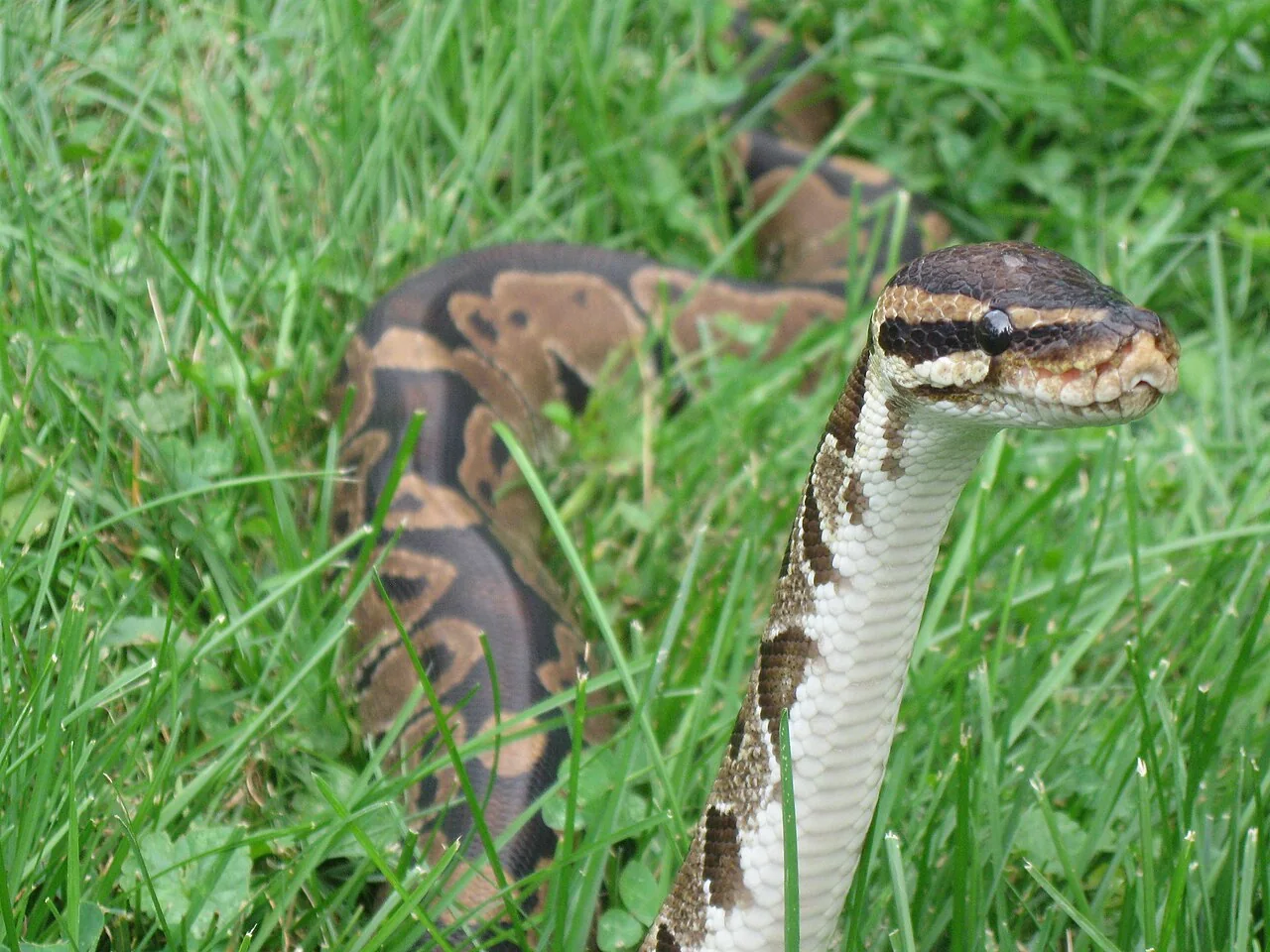
Scientific name
Python regius
Python regius is a distinct species; colours selected in captivity do not constitute new species. [1][2]
Origin
West and Central Africa, particularly Ghana, Togo and Benin. [1]
- Crepuscular
- Constrictor
- Hides
At a glance
| ADULT SIZE | ≈ 100–183 cm Whole-body length; females are generally larger. [3] |
|---|---|
| LIFESPAN | 20 years or more Captive estimate. [3] |
| LIFESTYLE | Solitary, a climber Branches and shelters on the ground. [2][3] |
Adult size
Approximately 100–183 cm in length according to Marwell; females are generally larger. [3]
Adult weight
Marwell gives up to 1 200 g for adult males and 2 000 g for adult females. These are descriptive zoo references, not weights to reach or diagnostic limits. [3]
Lifespan
Marwell gives 20 years or more in captivity; this estimate does not guarantee an individual lifespan. [3]
Lifestyle
Solitary, mainly active as the light fades; it also uses branches. [2][3]
Beginner with guidance
Environmental conditions, shelters and feeding refusals require a methodical approach and guidance. Editorial assessment. [2]
| Enclosure | For a 120 cm python: at least 120 × 40 × 40 cm. [2] RSPCA minimum example, not a size that applies to every adult. |
|---|---|
| Warm spot | 30–32 °C during the day. [2] Measure at the snake’s level; guarded heating and a thermostat. |
| Cool area | 24–26 °C during the day. [2] A separate area, accessible at all times. |
| Humidity | 50–60 % at the cool end. [2] A temporary rise towards 80 %, followed by a decrease; not continuously waterlogged substrate. [2] |
| Juvenile meals | Every 5–7 days; juvenile: approximately once a week. [5] Chicago Exotics references; review portion size and timing according to body condition. |
| Adult meals | Every 7–14 days according to Chicago Exotics. [5] Monitor body condition: this schedule alone does not define a ration. |
| Prey size | A thawed rodent no wider than the middle of the body according to Chicago Exotics. [5] The RSPCA allows slightly wider prey. No universal chart in grams is adopted here. [2] |
Housing
ROOM TO STRETCH OUT AND HIDE
Enclosure length ≥ snake length — Width and height ≥ one third of the snake’s length, according to the RSPCA. [2]
According to the RSPCA, the enclosure length should be at least the snake’s length, with width and height each at least one third of that. Its minimum example for a 120 cm python is 120 × 40 × 40 cm (L × W × H), to be enlarged as the snake grows. [2]
Care parameters
WARM SPOT · DAY
30–32 °C — RSPCA framework. [2]
COOL AREA · DAY
24–26 °C — RSPCA framework. [2]
NIGHT
Heating without light if needed — RSPCA framework. [2]
Humidity
50–60 % — Measure at the cool end. [2]
Daytime warm spot
30–32 °C. [2] Measure at the level occupied by the snake, using a thermostat and an independent thermometer.
Daytime cool area
24–26 °C. [2] Maintain a choice between the two ends.
Humidity
50–60 %, rising temporarily towards 80 %. [2] Distinguish a measured change from continuously waterlogged substrate.
Night
Nighttime heating without light if needed. [2] Turn off the lighting and record the nighttime minimum.
Feeding
RODENTS SUITED TO THE ANIMAL’S SIZE
Thawed rodents: young animals every 5–7 days, juveniles weekly, adults every 7–14 days according to Chicago Exotics. The schedule also depends on portion size and body condition. [5]
How should a ball python enclosure be arranged?
The RVC recommends individual housing with good ventilation and shelters at both ends of the gradient. Guard heaters and choose substrate that is easy to maintain while limiting the ingestion of particles. [4]
The python uses burrows and can climb; branches therefore do not remove its need for shelters on the ground. Its daytime inactivity does not show that a small space is sufficient. [3]
Lighting and UVB
The RVC recommends low UVB exposure for 12 hours, at a distance appropriate to the equipment, with monitoring of lamp ageing. [4] The RSPCA specifies a gradient from UVI 1 to zero in shade, reduced to a maximum of 0,7 for certain morphs such as albinos. [2]
What does a ball python eat, and how often?
A water container that allows immersion, with water replaced daily. [4] Thawed rodents: young animals every 5–6 days, adults every 7–14 days according to condition. The RSPCA describes prey slightly wider than the body. [2]
These intervals provide a basis for discussing an individual schedule. In the log, distinguish a meal offered, actually swallowed or refused; no date alone proves that another ration is needed.
Breeding: understand the cycle
The female lays eggs and then coils around them. Marwell generally reports 6–10 eggs and hatching after approximately two months; these observations are not an incubation recipe. [3]
Prepare a breeding project separately from everyday husbandry: parental identification, body condition, housing for the young and professional monitoring. No reproductive cooling is prescribed in this profile.
Health and behaviour
Curling into a ball is defensive. [3] Unusual refusal, weight loss, abnormal breathing or retained eye caps: consult a veterinarian. Do not induce brumation. [2] The RVC recommends an annual examination. [4]
Daily monitoring
Measure environmental conditions at the same locations, and record water changes, droppings, sheds and changes in behaviour. For weights, keep the unit, date and context of the last meal so that observations can be compared meaningfully.
The temperatures in the overview follow the RSPCA; the RVC proposes a different setup, without combining the two protocols. [2][4]
Checklist
- Check closures.
- Identify each probe and its location.
- Photograph accessible shelters.
Observations to record
- Meals
- Weight
- Sheds
- Temperatures
The app provides individual animal records. Check which features are available for your animal in the released version.
Related guides
Related guides
Original guides in French
Sources
Document-based overview; not a substitute for veterinary advice.
- The Reptile Database — Python regius
Source accessed - RSPCA — How to care for a royal python
Source accessed - Marwell Zoo — Royal python
Source accessed - Royal Veterinary College — Royal python care
Source accessed - Chicago Exotics Animal Hospital — Ball Python Care
Source accessed