
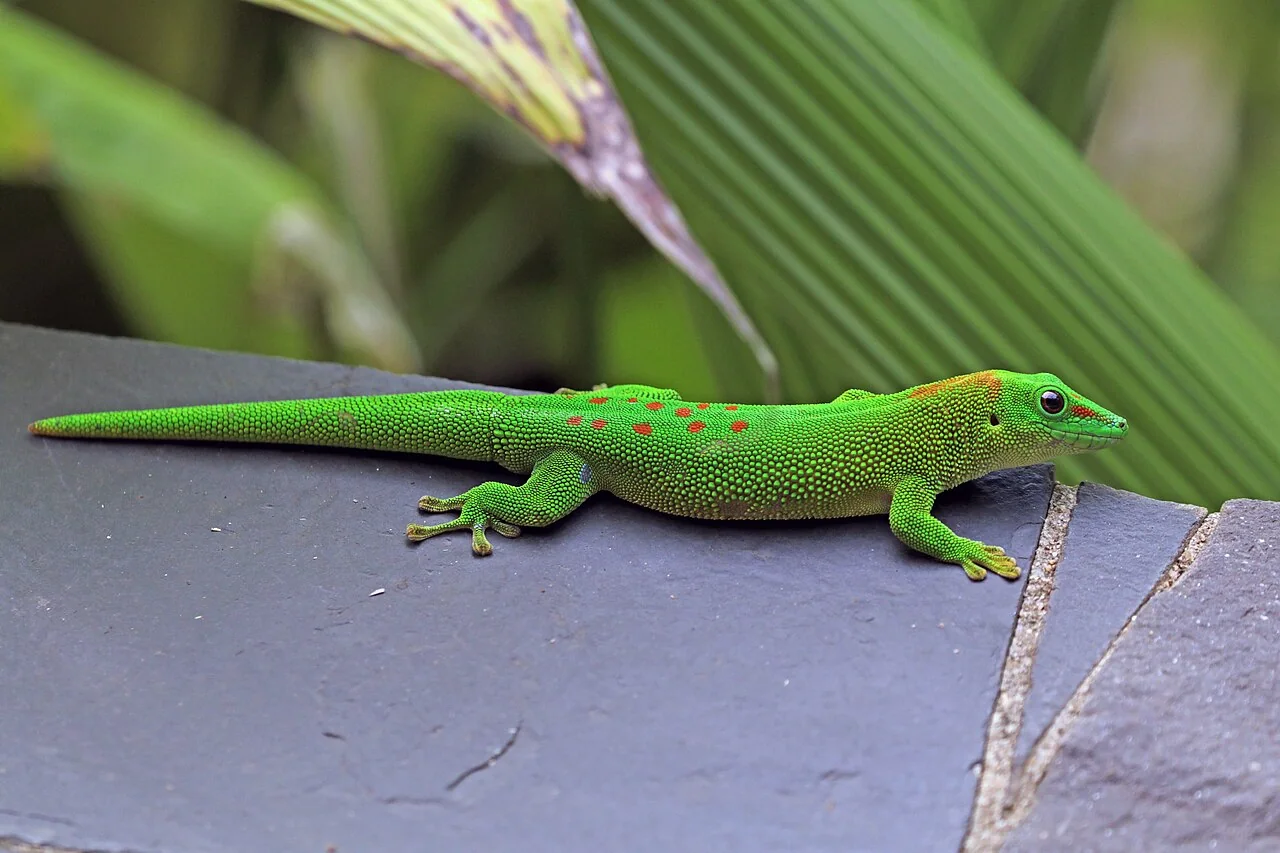
Scientific name
Phelsuma grandis
Phelsuma grandis has adhesive lamellae beneath its toes and uses arboreal supports. Its daytime activity allows movement, resting and exposure to light to be observed [1].
Origin
Northern Madagascar and nearby islands, including Nosy Komba; introduced populations occur elsewhere [2].
- Arboreal
- Diurnal
- Madagascar
At a glance
| ADULT SIZE | Up to ≈ 25 cm Up to approximately 25 cm according to the Smithsonian; the length measurement convention is not stated [1]. |
|---|---|
| LIFESPAN | Up to 15 years Up to 15 years in a zoo according to the Smithsonian [1]. |
| LIFESTYLE | Arboreal and diurnal Diurnal, using trees and palms among other habitats [1]. |
Adult size
Up to approximately 25 cm according to the Smithsonian; the length measurement convention is not stated [1].
Lifespan
Up to 15 years in a zoo according to the Smithsonian [1].
Lifestyle
Diurnal, using trees and palms among other habitats [1].
Housing
HEIGHT AND FOLIAGE
Varied elevated supports — Its way of life supports a setup with height, varied supports and plant cover. This inference from natural history establishes neither minimum dimensions nor equipment settings [1].
Its way of life supports a setup with height, varied supports and plant cover. This inference from natural history establishes neither minimum dimensions nor equipment settings [1].
Care parameters
TEMPERATURES AND UV
To be clarified — To be clarified before the animal arrives The two sources selected here do not provide a complete husbandry protocol specific to Phelsuma grandis.
Humidity
To be documented — The profile gives no humidity value. This still needs to be documented before setting up the enclosure.
Temperatures and UV
To be clarified before the animal arrives The two sources selected here do not provide a complete husbandry protocol specific to Phelsuma grandis.
Identification
Phelsuma grandis [2] The Smithsonian still uses the former name Phelsuma madagascariensis grandis; the taxonomy here follows Reptile Database.
Night — the breeder’s reference
Benjamin Morath suggests 20–22 °C at night for Phelsuma grandis. [4] Scope: captivity; experience published by Benjamin Morath. A reported limit is not a target or an established physiological threshold.
Feeding
A NATURAL DIET TO PUT IN CONTEXT
The Smithsonian describes a diet consisting mainly of arthropods, occasionally supplemented with fruit. It also mentions water collected from leaves. These observations alone do not define a balanced ration or a supplementation programme [1].
Feeding
The Smithsonian describes a diet consisting mainly of arthropods, occasionally supplemented with fruit. It also mentions water collected from leaves. These observations alone do not define a balanced ration or a supplementation programme [1].
Behaviour and precautions
Conflicts between individuals are possible. Never release a captive animal: introductions of these geckos can affect local species [1].
Monitoring and preparation
Before acquiring an animal, supplement this natural-history profile with a specific husbandry plan. In the log, distinguish what is observed from what is assumed: the time of activity, prey eaten, a shed observed or a meal merely offered. This distinction makes monitoring more useful.
Enclosure setup and monitoring interactions
The DGHT care sheet describes a bright, ventilated enclosure with vegetation, supports and bamboo. Heat sources must be guarded. The 100 × 60 × 100 cm dimensions cited by the author concern a pair in his protocol; they do not guarantee successful cohabitation. [3]
The author reports that conflicts can develop even between previously compatible partners. Be prepared to separate them; young animals are raised separately because adults may eat them. [3]
Checklist
- Confirm the scientific name.
- Have the husbandry plan clarified.
- Secure every opening.
Observations to record
- Meals
- Activity
- Sheds
- Weight
The app provides individual animal records. Check which features are available for your animal in the released version.
Related guides
Original guides in French
Sources
Document-based overview; not a substitute for veterinary advice.
- Smithsonian’s National Zoo — Madagascar giant day gecko
Source accessed - The Reptile Database — Phelsuma grandis
Source accessed - DGHT Suisse — Phelsuma grandis, Johannes Haller
Source accessed - Wissenswertes über Phelsuma grandis
Source accessed