
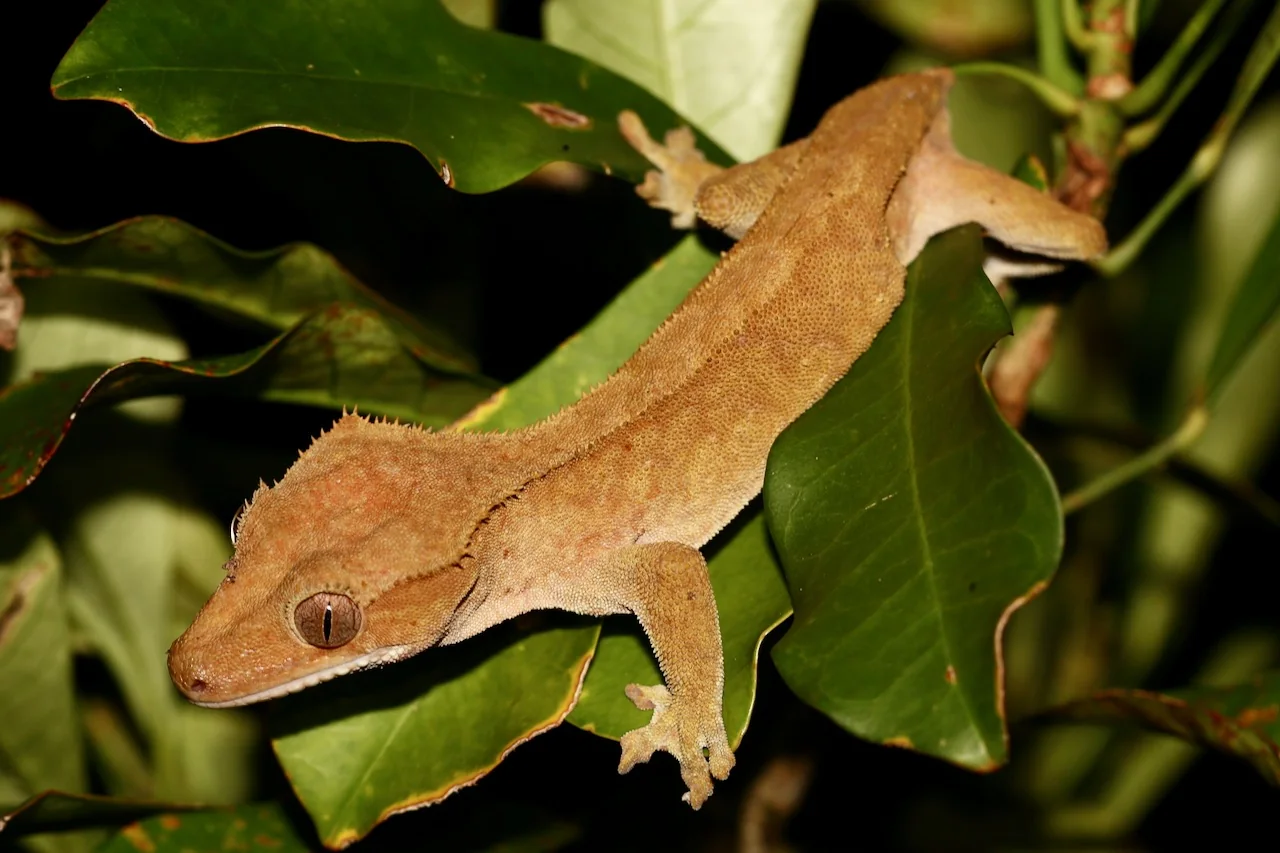
Scientific name
Correlophus ciliatus
Other names: Rhacodactylus ciliatus
Correlophus ciliatus belongs to the Diplodactylidae. Rhacodactylus ciliatus is its former scientific name: here it refers to the same species, not a different gecko. [3]
Origin
New Caledonia; forests where the animal uses vegetation and trees. [3][4]
- Arboreal
- Crepuscular and nocturnal
- Omnivorous
- Individual housing
At a glance
| ADULT SIZE | 15–25 cm Including the tail [4]. |
|---|---|
| LIFESPAN | 15–20 years Captive reference [1]. |
| LIFESTYLE | In trees Mainly nocturnal [4]. |
Adult size
15–25 cm, including the tail, according to Calgary Zoo. [4]
Adult weight
Calgary gives 42–45 g without specifying sex, age or sample. This is a descriptive reference, not a target weight for every adult. [4]
Lifespan
15–20 years in captivity. [1]
Lifestyle
Arboreal and mainly nocturnal; adhesive toes and jumping allow it to use vertical space. [4]
Beginner with guidance
Editorial assessment: accessible with guidance, a prepared vertical habitat and regular monitoring of feeding. Its small size does not remove the need to control environmental conditions. [1][2]
Housing
A VERTICAL HABITAT
45 × 45 × 60 cm — RSPCA minimum; width × depth × height [1].
RSPCA minimum: 45 × 45 × 60 cm, width × depth × height, for one adult housed alone. [1]
Care parameters
WARM SPOT · DAY
26–28 °C — RSPCA reference [1].
COOL AREA · DAY
20–24 °C — Maintain a gradient [1].
Humidity
40–50 % — Temporary increase after misting [1].
Daytime heating
Warm 26–28 °C; cool 20–24 °C [1] Separate measurements; thermostat.
Night
18–20 °C [1] Darkness.
UVB and daily cycle
UVI 0,7 in the warm area → 0 in shade; 12 h/12 h [1] Measure at the gecko’s height.
Humidity
40–50 %, rising temporarily towards 80 % [1] Allow drying between mistings.
Feeding
AN APPROPRIATE DIET
Formulated food and suitable insects; feeding schedules depend on life stage [2].
Provide usable routes
Branches, foliage and cork provide supports and places to retreat. The substrate can combine coir, suitable soil and leaves. Add a shallow dish of clean water as well as water droplets, and provide ventilation. [1]
Feed according to life stage
Chicago Exotics suggests a formulated powder every other day for juveniles, with insects weekly; for adults, two servings of each category per week. Adjust this schedule to growth and the chosen formulation. [2]
Prepare the powder according to its label; vary suitable insects and feed them before offering them. Fruit purée alone does not provide this diet. Complete powders already supply micronutrients: coordinate any supplements with their composition and the lighting, rather than combining products at random. Remove uneaten prey, which can injure the gecko. [2]
Understand behaviour
The absence of movable eyelids explains why it cleans its eyes with its tongue. Vocalisations are part of its behaviour; on their own, they do not establish a diagnosis. Calgary also describes defensive tail loss, which is common in wild adults. [4]
The tail does not grow back. Allow the animal to acclimatise, offer your hand without grabbing it and avoid pulling on the tail. [2] Individual housing makes observation easier and prevents conflicts. [1]
Breeding: observe without inducing it
The species usually lays two eggs. [4] Chicago describes a laying box containing moist material that allows digging. [2] No universal age or weight is adopted here: prepare to house the young and have the female assessed before planning to breed.
Daily monitoring
Retained shed, loss of adhesion, weight loss or deformities require veterinary advice. [1] Compare weight measurements with size and body shape rather than an isolated figure. [5]
In the log, distinguish food offered from food eaten, and record misting and the measurements actually taken. Record sheds, stools and changes in behaviour with their dates; these observations make changes over time understandable during a consultation.
Checklist
Observations to record
- Food offered and eaten
- Weight and body shape
- Temperatures and humidity
- Sheds, stools and behaviour
The app provides individual animal records. Check which features are available for your animal in the released version.
Related guides
Related guides
Original guides in French
Sources
Document-based overview; not a substitute for veterinary advice.
- RSPCA — Caring for your Crested Gecko
Source accessed - Chicago Exotics Animal Hospital — Crested Gecko Care
Source accessed - The Reptile Database — Correlophus ciliatus
Source accessed - Wilder Institute / Calgary Zoo — Crested Geckos
Source accessed - Merck Veterinary Manual — Clinical Procedures for Reptiles
Source accessed