
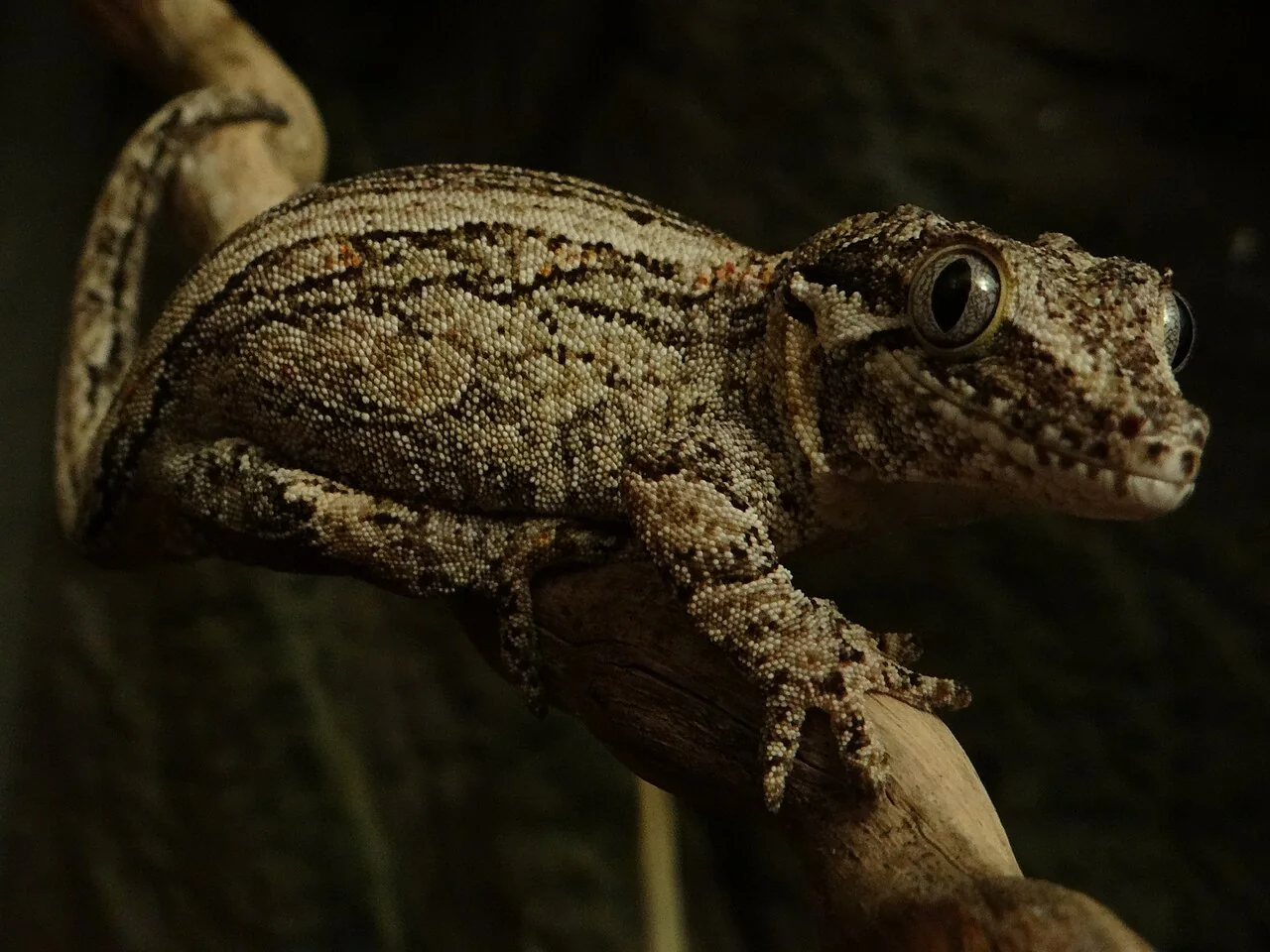
Scientific name
Rhacodactylus auriculatus
The name gargoyle gecko refers to the bumps on its head. This nocturnal lizard uses vegetation and has a prehensile tail; Cincinnati Zoo describes its ability to regenerate a lost tail [2].
Origin
Southern Grande Terre, New Caledonia [1].
- Nocturnal
- New Caledonia
- Climber
At a glance
| ADULT SIZE | Up to ≈ 23 cm Up to approximately 23 cm according to Cincinnati Zoo; the measurement convention is not specified [2]. |
|---|---|
| LIFESPAN | 10 to 15 years 10–15 years according to Cincinnati Zoo, with individual variation [2]. |
| LIFESTYLE | Active at night Nocturnal; found in forest and shrub habitats [2]. |
Adult size
Up to approximately 23 cm according to Cincinnati Zoo; the measurement convention is not specified [2].
Lifespan
10–15 years according to Cincinnati Zoo, with individual variation [2].
Lifestyle
Nocturnal; found in forest and shrub habitats [2].
Housing
SUPPORTS AT DIFFERENT LEVELS
Routes at low and high levels — Chicago Exotics describes a species that also uses lower levels: provide accessible supports, shelters and usable horizontal space, as well as opportunities to climb [1].
Chicago Exotics describes a species that also uses lower levels: provide accessible supports, shelters and usable horizontal space, as well as opportunities to climb [1].
Care parameters
AMBIENT · DAY
≈ 22–26 °C — Rounded conversion of 72–78 °F in the Aurora care sheet. Measure inside the enclosure, not just in the room; retain cooler places to retreat. [3]
LIGHTING
Low UVB + shade — Chicago Exotics recommendation; no numerical UV index is specified here. [1]
Humidity
Reference: 60–70 % — Chicago Exotics; monitor changes and maintain effective ventilation. [1]
Ambient temperature · day
Approximately 22–26 °C [3] Rounded conversion of 72–78 °F in the Aurora care sheet. Measure inside the enclosure, not just in the room; retain cooler places to retreat.
Relative humidity
60–70 % as a reference [1] Chicago Exotics reference. Monitor changes with a hygrometer and maintain ventilation; do not keep all the furnishings soaking wet.
UVB lighting
Low intensity, with shaded areas [1] The reference recommends low UVB exposure without specifying a UV index for this care sheet. Choose equipment and its distance according to measurements and the relevant instructions.
Feeding
COMPLETE FOOD AND INSECTS
Aurora recommends a complete formulated diet for fruit-eating geckos, prepared according to its instructions, with suitable insects as a supplement. Remove uneaten prepared food after 24 hours; do not automatically add supplements to an already complete food. [3]
Feeding
Aurora recommends a complete formulated diet for fruit-eating geckos, prepared according to its instructions, with suitable insects as a supplement. Remove uneaten prepared food after 24 hours; do not automatically add supplements to an already complete food. [3]
Behaviour and precautions
The ability to regenerate the tail does not justify pulling it. Prefer nighttime observation to repeated handling; prepare for transport with a secure container.
Daily monitoring
Record accepted and refused feeds, weight measurements and the usual times the animal emerges. Adding a note whenever the layout changes allows behaviour before and after to be compared without automatically attributing a feeding refusal to a single cause.
Shelters and food that the animal can actually reach
Branches, hides and plants should provide supports at different levels. Chicago Exotics describes a gecko that makes considerable use of lower levels: height does not replace usable horizontal space. [1]
A dish of clean water complements the droplets available after misting. Individual housing is Aurora’s general recommendation. [3]
Temperature and humidity: measure before adjusting
Aurora’s ambient 22–26 °C is a captive-care reference, not a body temperature or the temperature of a heated surface. The clinic mentions a possible nighttime drop, which should not become a compulsory target. [3]
Chicago Exotics recommends a thermostat for any heating, measurements at several locations and low UVB exposure. Avoid direct sunlight through glass, which can overheat the enclosure. [1]
Measuring humidity at several times shows how it changes after misting. The 60–70 % range comes from Chicago Exotics; Aurora describes peaks after misting. These references do not justify removing ventilation to hold a number steady. [1][3]
Checklist
- Secure both low and high branches.
- Measure temperature and humidity at several locations before the animal arrives.
- Provide a shelter that can be accessed without handling.
Observations to record
- Meals
- Weight
- Sheds
- Activity
The app provides individual animal records. Check which features are available for your animal in the released version.
Related guides
Original guides in French
Sources
Document-based overview; not a substitute for veterinary advice.
- Chicago Exotics Animal Hospital — Geckos of New Caledonia
Source accessed - Cincinnati Zoo & Botanical Garden — Gargoyle Gecko
Source accessed - Gargoyle Gecko Caresheet
Source accessed