
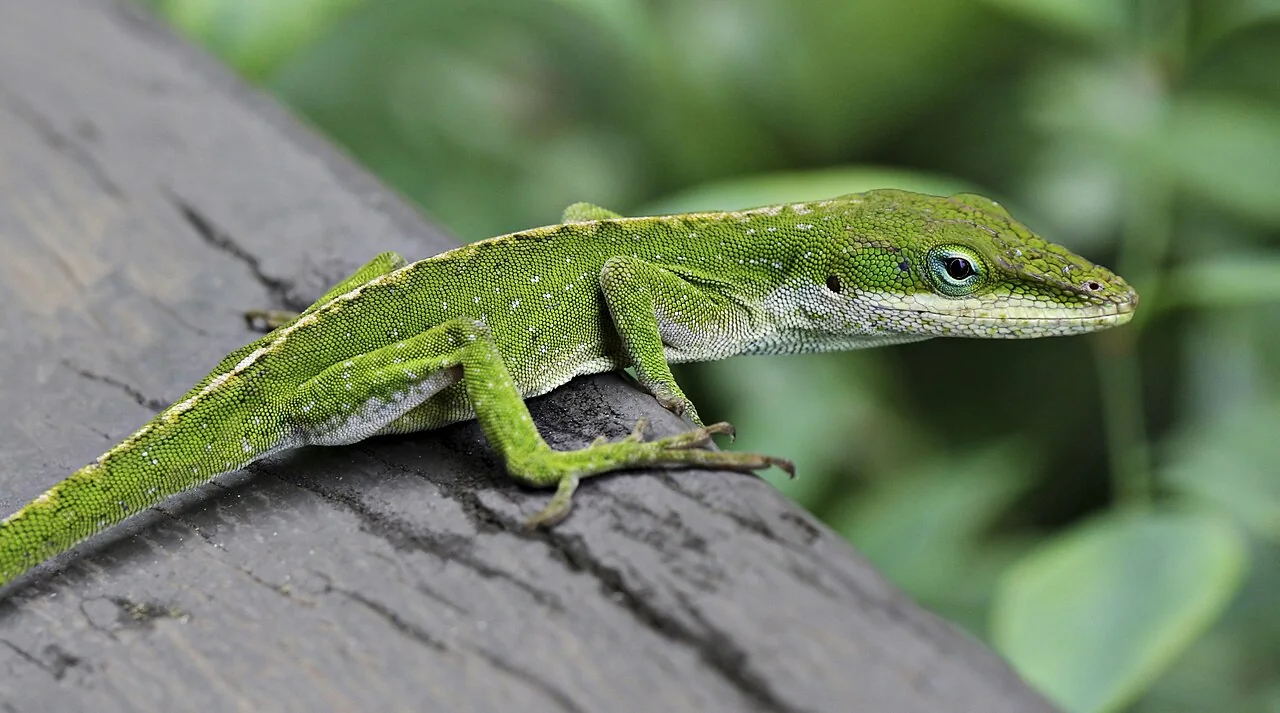
Scientific name
Anolis carolinensis
The green anole can turn brown, and the male extends a colourful dewlap. Despite its former nickname, the American chameleon, it belongs to a different group of lizards [1].
Origin
Southeastern United States [1].
- Diurnal
- Arboreal
- Insectivorous
At a glance
| ADULT SIZE | Up to ≈ 20 cm Up to approximately 20 cm according to Chicago Exotics; the care sheet does not specify the measurement convention [1]. |
|---|---|
| LIFESPAN | 4 to 8 years 4–8 years given for the green anole by Tree of Life Exotics [2]. |
| LIFESTYLE | Arboreal and diurnal Diurnal and arboreal, using foliage and branches [2]. |
Adult size
Up to approximately 20 cm according to Chicago Exotics; the care sheet does not specify the measurement convention [1].
Lifespan
4–8 years given for the green anole by Tree of Life Exotics [2].
Lifestyle
Diurnal and arboreal, using foliage and branches [2].
Housing
ROUTES THROUGH THE FOLIAGE
≈ 46 × 46 × 61 cm — Tree of Life recommends at least approximately 46 × 46 × 61 cm for one adult anole, with more space if possible. Dense cover, several levels and secure closure make this space usable [2].
Tree of Life recommends at least approximately 46 × 46 × 61 cm for one adult anole, with more space if possible. Dense cover, several levels and secure closure make this space usable [2].
Care parameters
BASKING · DAY
≈ 31–33 °C — Approximately 31–33 °C [2] Conversion of 88–92 °F, localised at the basking site; do not heat the entire enclosure to this temperature.
COOL AREA
≈ 22–26 °C — Approximately 22–26 °C [2] The veterinary centre’s reference for its guide to green and brown anoles; check the actual gradient.
Humidity
To be documented — The profile gives no humidity value. This still needs to be documented before setting up the enclosure.
Daytime basking
Approximately 31–33 °C [2] Conversion of 88–92 °F, localised at the basking site; do not heat the entire enclosure to this temperature.
Cool area
Approximately 22–26 °C [2] The veterinary centre’s reference for its guide to green and brown anoles; check the actual gradient.
Night — the clinic’s reference
Chicago Exotics suggests approximately 21–24 °C at night (70–75 °F). [1] Scope: captivity; Anolis carolinensis; Chicago Exotics guidance. A reported limit is not a target or an established physiological threshold.
Feeding
A VARIETY OF SMALL PREY
Offer a variety of suitable small prey, properly raised and fed. Chicago Exotics emphasises preparing the insects and removing uneaten prey [1]. Organise feeding according to age and lighting equipment.
Feeding
Offer a variety of suitable small prey, properly raised and fed. Chicago Exotics emphasises preparing the insects and removing uneaten prey [1]. Organise feeding according to age and lighting equipment.
Behaviour and precautions
Colour alone cannot diagnose a problem. Prioritise observation: chasing this animal or grabbing its tail puts it at risk of injury [1] [2].
Daily monitoring
Record prey actually caught, resting places and times of emergence. Associate each measurement with its position and time; a reading taken near the lamp does not describe the lower foliage.
Checklist
- Close gaps around cables.
- Test the gradient on several branches.
- Prepare leafy shelters.
Observations to record
- Meals
- Activity
- Sheds
- Temperature
- Humidity
The app provides individual animal records. Check which features are available for your animal in the released version.
Related guides
Original guides in French
Sources
Document-based overview; not a substitute for veterinary advice.
- Anole Care — Erica Mede, CVT
Source accessed - Tree of Life Exotic Pet Medical Center — Green & Brown Anole Care
Source accessed