
Scientific name
Pleurodeles waltl
Other names: Pleurodeles waltli · Pleurodeles waltlii
Pleurodeles waltl is a large, mainly aquatic newt native to the Iberian Peninsula and northern Morocco. Amphibian Species of the World retains the name waltl; the spellings waltli and waltlii appear in older texts. [1] Its apparent hardiness does not remove the need for suitable water.
Origin
Iberian Peninsula, excluding several northern areas, and northern Morocco. The University of Évora museum describes still or slow-moving waters, often vegetated. [1][2]
- Cool water
- Vegetated refuges
- Observation without grasping
Documentary overview: identity checked; natural observations and captive practices attributed separately. Undocumented limits remain explicit.
At a glance
Iberian Peninsula and northern Morocco. Aquatic amphibian inhabiting still or slow-moving waters, often vegetated. [1][2]
| SIZE | Up to≈30 cm Total length, Évora museum [2]. |
|---|---|
| LIFESPAN | Not quantified here No precise captive monitoring retained. |
| LIFESTYLE | Mainly aquatic Provide a terrestrial exit [3]. |
Adult size
Up to approximately 30 cm total length in the Évora museum account. Caudata Culture presents 15–20 cm as common captive size, without treating it as a maximum. [2][3]
Lifespan
No lifespan supported by precisely described monitoring was retained among the open sources; no guaranteed captive age is therefore displayed.
Lifestyle
Aquatic, with possible use of moist terrestrial retreats when natural water bodies dry out. [3]
Housing
MAIN ENVIRONMENT
Furnished aquarium — Vegetation and small emerged area [3].
Structured aquarium with vegetation, refuges and access to a small emerged area. Caudata Culture suggests 15–20 cm of water outside breeding; usable area must still be planned around the adult. [3]
Care parameters
WATER
Below 21 °C — Caudata Culture guide [3].
FLOW
Low — Still or slow-moving habitats described [2].
Humidity
Tested water — Filtration, leftovers and temperature; no terrestrial RH target.
Water
Below 21 °C in the Caudata Culture guide [3] Attributed advice; extreme tolerances are not husbandry targets.
Flow
Still or slow-moving waters [2] Provide filtration that does not turn the entire tank into a turbulent area.
Exit
Emerged access available [3] Check the actual route and lid closure.
Feeding
INVERTEBRATES AND ADAPTED DIET
Earthworms and appropriate formulated foods; observed consumption [3].
A name and range to clarify
The current reference distinguishes waltl from other Pleurodeles species. [1] A profile saying simply ‘Spanish newt’ is not enough to identify an animal or its origin. Natural occurrence in Morocco also avoids artificially restricting the range to Spain. Retaining the current spelling and older spellings as search aids makes documents comparable without creating several profiles for the same taxon.
Adult size, lifespan and lifestyle
Up to approximately 30 cm total length in the Évora museum account. Caudata Culture presents 15–20 cm as common captive size, without treating it as a maximum. [2][3]
No lifespan supported by precisely described monitoring was retained among the open sources; no guaranteed captive age is therefore displayed.
Aquatic, with possible use of moist terrestrial retreats when natural water bodies dry out. [3]
Vegetation serves several functions
The Évora museum describes varied aquatic habitats with vegetation and eggs attached to plants or stones. [2] Supports are therefore not merely decorative: they provide retreats, resting points and, in a reproductive context, deposition sites. In an aquarium, their arrangement must leave a visible movement area. Vegetation too difficult to inspect can conceal leftovers or a trapped animal.
Connecting the bottom to the surface
The specialist guide provides for a small emerged area. [3] Its presence on an equipment list is insufficient: follow the newt's route, check slopes and identify slippery edges. Access to air must remain simple as plants grow or the water level changes. Equipment openings and hose passages must be closed without removing necessary ventilation above the water.
Cool water and measurable cleaning
The temperature recommendation comes from Caudata Culture, not a calculation based on the Iberian climate. [3] Measuring water directly, particularly during hot hours, establishes what the animal experiences. Filter, food and waste must be monitored together: stable flow does not prove absence of dissolved pollution. An accessible bottom facilitates targeted leftover removal without completely rebuilding the tank.
Opportunistic feeding, organised diet
Caudata Culture describes invertebrate consumption and recommends earthworms and suitable formulated foods among other options. [3] This encourages resource variety without turning every accepted prey item into a dietary staple. Preparing portions for each individual helps identify competition. Food falling behind a refuge must be distinguished from food actually swallowed; apparent appetite does not directly reveal the amount consumed.
A defence that must not be provoked
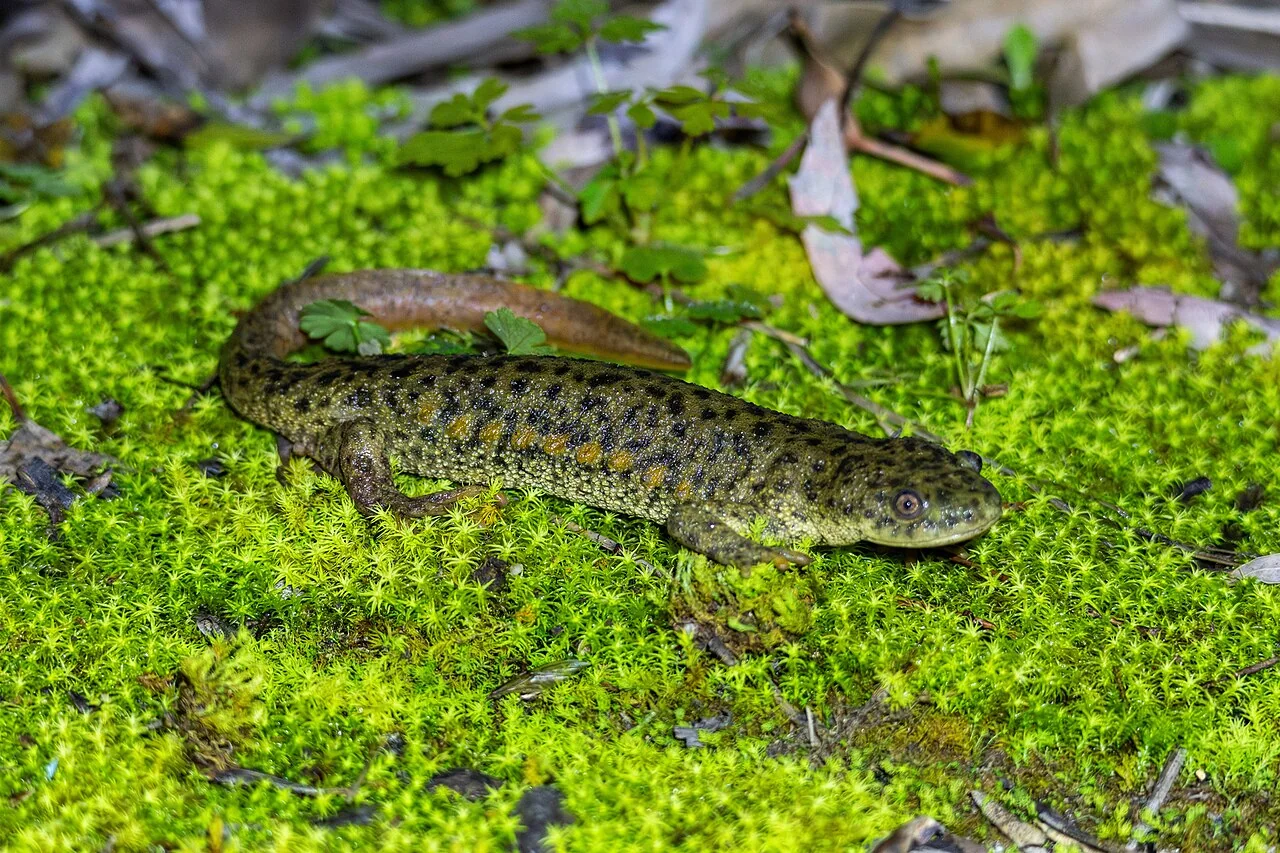
The orange lateral protrusions correspond to rib ends. The museum describes their role in a defence in which the ribs can pierce the skin. [2] There is no need to squeeze or grasp the animal to illustrate this mechanism. Transfer should favour a suitable container, limiting contact. A detailed photograph can be taken through the glass without deliberately making the ribs emerge.
Courtship and development
The specialist guide describes the male grasping the female, followed by a sequence leading to deposition and uptake of a spermatophore. Eggs are placed among vegetation. [3] This behaviour requires space and does not guarantee fertilisation of every egg. Planning containers and prey for larvae before mating avoids discovering too late that the adult tank cannot accommodate all rearing.
Protecting habitats and animals
The university museum links threats to loss or alteration of water bodies, pollution and introduced species. [2] This profile therefore proposes neither wild collection nor release of surplus animals. Documented captive origin and verification of keeping regulations are necessary before the project. Experimental temperature manipulations used in developmental research are not husbandry advice and are excluded here.
Checklist
- Check access to the surface.
- Plan for separation of juveniles.
- Do not provoke rib defence.
Observations to record
- Water
- Meals
- Growth
- Reproduction
The app provides individual animal records. Check which features are available for your animal in the released version.
Related guides
Original guides in French
Sources
Document-based overview; not a substitute for veterinary advice.
- Amphibian Species of the World — Pleurodeles waltl
Source accessed - Universidade de Évora, Museu Virtual da Biodiversidade — Pleurodeles waltl
Source accessed - Caudata Culture — Pleurodeles waltl
Source accessed