
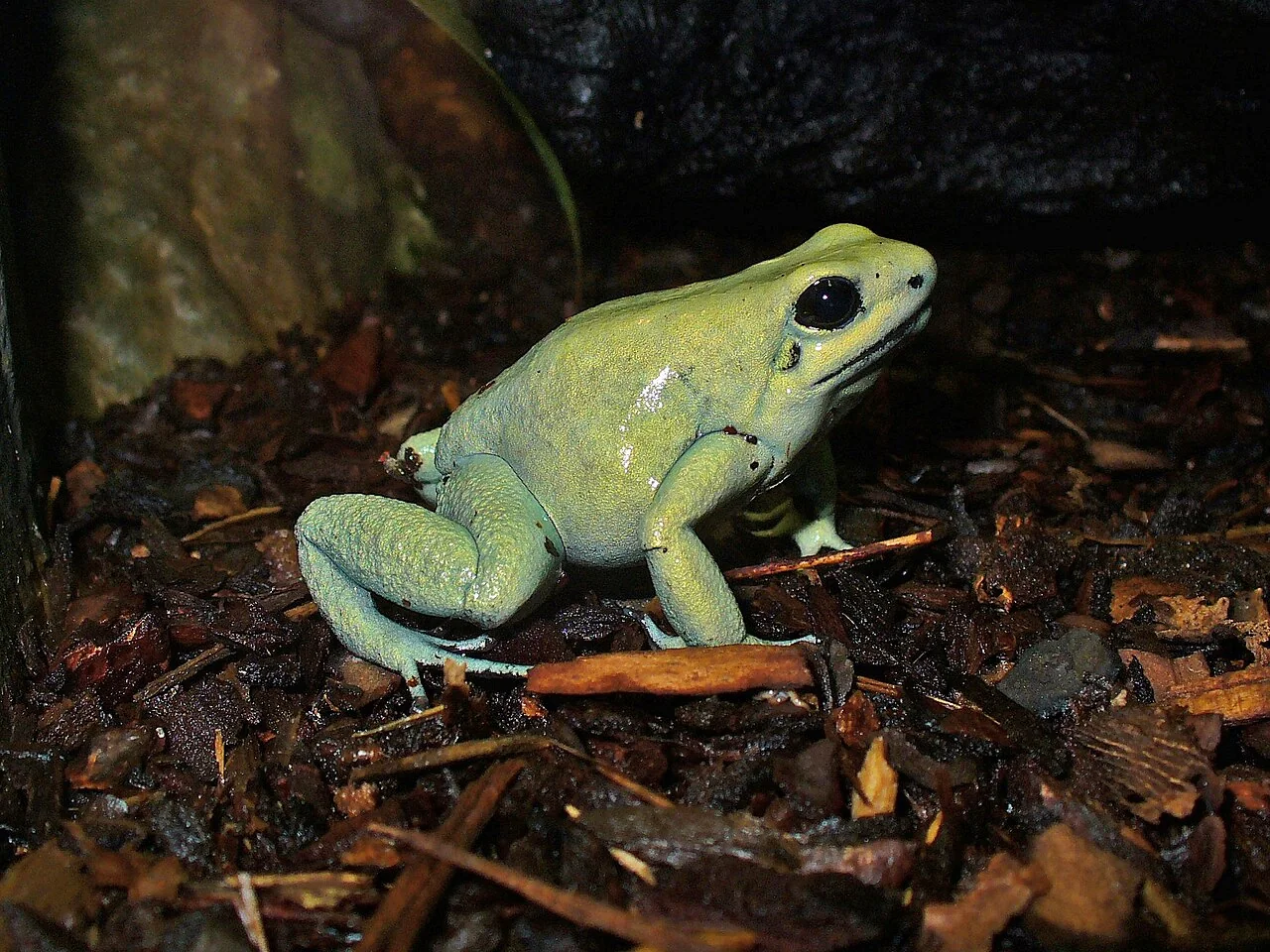
Scientific name
Phyllobates terribilis
Phyllobates terribilis is a Colombian frog in the family Dendrobatidae. Citizen Conservation provides a captive-breeding guide for it. [1] The name ‘terrible’ refers to its chemical defence; a serious account should primarily distinguish origin, habitat and actual breeding conditions.
Origin
Humid Colombian forests; the species is endemic to that country according to Sapporo Zoo. [3] A country's map must not be equated with occupancy of its entire territory.
- Documented origin
- Drained soil
- Paternal care
Documentary overview: identity checked; natural observations and captive practices attributed separately. Undocumented limits remain explicit.
At a glance
| SIZE | 4,5–4,7 cm Snout–vent, CC profile [1]. |
|---|---|
| LIFESPAN | ≈ 10 years Sapporo Zoo captive guideline [3]. |
| LIFESTYLE | Diurnal Ground refuges [2]. |
Adult size
Citizen Conservation gives 4,5–4,7 cm snout–vent length in its profile; this measurement excludes legs and is not presented as an absolute maximum. [1]
Lifespan
Sapporo Zoo gives approximately 10 years in captivity, without describing individual follow-up. This guideline is neither a demonstrated average nor a guarantee. [3]
Lifestyle
Diurnal and mainly associated with forest-floor retreats. [2]
Housing
COMPATIBLE PAIR
60 × 45 × 45 cm — Herpeton starting point, not a cohabitation guarantee [2].
Herpeton suggests 60 × 45 × 45 cm for a compatible pair, with more floor area for a group. This is an attributed starting point, not a cohabitation guarantee. [2]
Care parameters
DAYTIME AIR
21–24 °C — Herpeton guideline [2].
NIGHTTIME AIR
18–21 °C — Herpeton guideline [2].
Humidity
80–100 % — Herpeton guideline, with ventilation and drainage [2].
Air, husbandry
21–24 °C by day and 18–21 °C at night according to Herpeton [2] Measure at animal height, particularly beneath lighting.
Documented gradient
Cool ground 22–24 °C in the Citizen Conservation guide [1] Its warmer exposed areas are not a target for the whole terrarium.
Humidity
80–100 % in the Herpeton guide [2] With ventilation and drained soil; this guideline does not mean constantly flooded surfaces.
Feeding
CULTURED SMALL PREY
Suitable fruit flies and crickets; prepare regular availability [2].
Separate name, shade and lineage
The Herpeton guide distinguishes yellow, orange and pale lineages among others while assigning them to the same species. [2] Retaining origin information avoids replacing unknown lineage with simple resemblance. A shade observed under a different lamp is not a new identification. At transfer, communicating what is documented and flagging what remains unknown is more useful than adding a variety name afterwards.
Adult size, lifespan and lifestyle
Citizen Conservation gives 4,5–4,7 cm snout–vent length in its profile; this measurement excludes legs and is not presented as an absolute maximum. [1]
Sapporo Zoo gives approximately 10 years in captivity, without describing individual follow-up. This guideline is neither a demonstrated average nor a guarantee. [3]
Diurnal and mainly associated with forest-floor retreats. [2]
Understanding the two thermal readings
Citizen Conservation describes a gradient including cooler ground and warmer exposed areas. [1] Herpeton gives a narrower air range. [2] Measurements taken in the same place must therefore be compared, rather than opposing two numbers without context. A high value near a lamp must not become the target for the entire tank. Before summer, check that the least exposed retreats remain genuinely available.
Litter and drainage serve different roles
Herpeton combines litter, low refuges, drainage and ventilation. [2] In a concrete project, plan water removal before closing the furnishings. A leaf layer provides surfaces and retreats; it does not correct an overflowing lower reservoir. Feeding areas must remain accessible for cleaning while allowing a frog to retreat without crossing an entire open space.
Organising meals around reliable prey
The specialist guide uses small cultured prey, notably fruit flies and suitably sized crickets. [2] Terrarium preparation must include their regular availability and a backup if a culture fails. Distributing feeding points helps observe each animal's access. A coherent nutritional programme must account for products actually used; randomly multiplying supplements does not allow assessment of what the frog receives.
Chemical defence and unknown origin
In its poison-frog material, the Smithsonian explains the role of natural diet in acquiring certain toxins and cites batrachotoxin in P. terribilis. [4] This information does not make handling to prove an animal harmless acceptable. Unknown origin or previous diet must remain considered unknown. Observation behind glass and transfer in a container avoid demonstration contact with skin.
A distinctive reproductive sequence
Citizen Conservation describes reproduction without amplexus: the male deposits sperm on the support, then the female lays eggs. [1] A pair's presence does not guarantee completion of this sequence. An egg-laying support must be inspectable without regular overturning. Documenting the observed sequence distinguishes courtship, deposition and actual development, without declaring success at the first behaviours.
The male intervenes after laying
The same guide reports male care of eggs and tadpole transport to water. [1] The adult tank alone therefore does not constitute a complete plan for juveniles. Planning containers, maintenance and food resources before breeding avoids improvisation after hatching. The number of larvae visible on a particular date must remain distinct from the total number of eggs laid.
A project to plan over several years
The order of magnitude suggested by Sapporo implies a commitment beyond the success of an initial setup. [3] Anticipating absence, lighting failure and prey shortages makes care more resilient. Choose animals of documented captive origin and check applicable obligations before acquisition or transport. This review encourages no wild collection, proposes no release and provides neither diagnosis nor treatment based on colour or posture.
Checklist
- Prepare prey cultures.
- Check cool retreats.
- Avoid demonstration handling.
Observations to record
- Lineage
- Meals
- Microclimate
- Reproduction
The app provides individual animal records. Check which features are available for your animal in the released version.
Related guides
Original guides in French
Sources
Document-based overview; not a substitute for veterinary advice.
- Citizen Conservation — Breeding Guidelines Phyllobates terribilis, juillet 2024
Source accessed - Herpeton Academy — Phyllobates terribilis
Source accessed - Zoo de Sapporo, Maruyama — Phyllobates terribilis
Source accessed - Smithsonian National Zoo — Poison frogs
Source accessed