
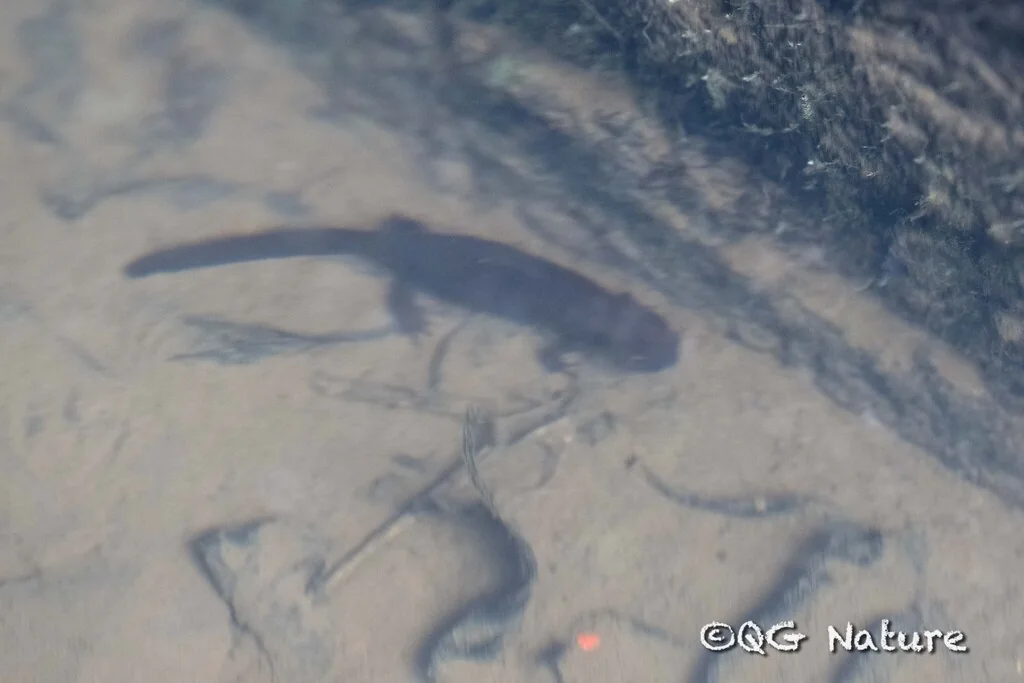
Scientific name
Hypselotriton orientalis
Other names: Cynops orientalis · Diemictylus orientalis · Triturus orientalis
The Chinese fire-bellied newt still often appears as Cynops orientalis. AmphibiaChina uses Hypselotriton orientalis. [1] A 2026 revision now distinguishes H. qianshan, formerly included as a subspecies: historical data must therefore be read within their taxonomic scope. [2][3]
Origin
Eastern China. The 2026 revision places orientalis in the strict sense notably in Anhui, Jiangsu, Zhejiang, Fujian and Jiangxi, comparing it with qianshan. [3]
- Revised taxonomy
- Cool water
- Origin to clarify
Documentary overview: identity checked; natural observations and captive practices attributed separately. Undocumented limits remain explicit.
At a glance
| SIZE | ≈5,6–9,4 cm Total length, historical data [1]. |
|---|---|
| LIFESPAN | Not quantified here Strict taxon recently revised. |
| LIFESTYLE | Water and terrestrial access Depending on stage and individual [4]. |
Adult size
AmphibiaChina gives 56–77 mm for males and 64–94 mm for females, in total length. These measurements come from references predating the 2026 separation. [1]
Lifespan
No precisely documented captive lifespan for orientalis in the strict sense after revision is retained; no guaranteed age is displayed.
Lifestyle
Adults often aquatic, with terrestrial access; metamorphosed juveniles may have a terrestrial phase. Older observations concern orientalis in the broad sense. [4]
Housing
PLANTED AQUARIUM
Accessible terrestrial exit — Historical husbandry guideline [4].
Caudata Culture recommends a cool planted aquarium with small land areas and supports near the surface. Its profile predates the taxonomic revision. [4]
Care parameters
WATER
14–20 °C — Caudata Culture, before the 2026 separation [4].
REFUGES
Aquatic vegetation — Documented habitat [1].
Humidity
Environments monitored separately — Managed water and terrestrial retreat; no overall RH target.
Water
14–20 °C according to Caudata Culture [4] Historical husbandry guideline, not comparative validation between orientalis and qianshan.
Vegetation
Aquatic plants and refuges [1] Keep a clear passage to air.
Terrestrial exit
Available, without forcing a return to water Environmental use must be observed alongside the animal's condition.
Feeding
SMALL INVERTEBRATES
The revision that changes interpretation
Amphibian Species of the World confirms the elevation of qianshan to species rank in 2026. [2] The taxonomic treatment published by Jiang and colleagues compares the characteristics and distribution of the two groups. [3] An older ‘Cynops orientalis’ group cannot automatically be renamed. Origin and documented photographs must be retained; the ventral pattern alone does not replace full identification.
Adult size, lifespan and lifestyle
AmphibiaChina gives 56–77 mm for males and 64–94 mm for females, in total length. These measurements come from references predating the 2026 separation. [1]
No precisely documented captive lifespan for orientalis in the strict sense after revision is retained; no guaranteed age is displayed.
Adults often aquatic, with terrestrial access; metamorphosed juveniles may have a terrestrial phase. Older observations concern orientalis in the broad sense. [4]
Vegetated waters, not a violent current
The Chinese account describes ponds, spring-fed water bodies and rice fields with vegetation. [1] Plant functions are represented in the setup by retreats and supports rather than compact decoration that blocks movement. The filter outlet must be positioned to leave calm areas. A pump's presence alone does not demonstrate that all animals can easily reach the surface.
Creating a genuine choice
The Caudata Culture guide combines cool water with a small terrestrial section. [4] A newt leaving the water must not be prevented from doing so to make the aquarium more attractive. Checking water, temperature, supports and the animal's condition allows the situation to be examined without selecting a single cause. An emerged area must remain usable when water level changes, and its access must not lead to a lid opening.
Prey suited to a small mouth
AmphibiaChina mentions small aquatic animals, including insect larvae and worms. [1] In captivity, Caudata Culture uses suitably sized worms or worms cut to the required size among other foods. [4] The offered portion must be visible enough to verify uptake without filling the tank with food. Repeated feeding at several points also reveals whether an individual actually reaches food.
Eggs attached one by one
The Chinese account describes successive laying of eggs adhering to vegetation. [1] Caudata Culture reports that the female may fold a leaf around an egg. [4] Plants are therefore also breeding supports. For observation, examine leaves without systematically unfolding them or tearing off the eggs. The number of eggs found depends on inspection effort and does not necessarily represent the entire clutch.
Larvae followed by terrestrial juveniles
The larval stage is aquatic; the breeding guide then emphasises the possibility of terrestrial juveniles after metamorphosis. [4] The transition requires containers, exits and small prey available in time. A juvenile must not be kept in deep water solely because adults live there. Date and observed stage must be recorded together to avoid confusing growth, transformation and sexual maturity.
Colour and identification
Caudata Culture describes individuals whose backs temporarily become lighter, without a single explanation. [4] The recent revision also shows pattern diversity within the complex. [3] An unusual photograph is therefore insufficient either to diagnose disease or announce a new variety. Comparing images under similar lighting and examining other observed changes allows a more precise question to be put to a specialist.
Origin, maintenance and limitations
Choose an animal of documented captive origin and check applicable rules before purchase. The older trade name guarantees neither lineage nor current identity. This profile deliberately retains the term ‘historical data’ when reusing an observation from before 2026. Editorial suggestions concern housing preparation and observation; they do not replace a veterinary protocol and encourage neither wild collection nor forced metamorphosis.
Checklist
- Keep the group's historical names.
- Provide a terrestrial exit.
- Prepare prey for juveniles.
Observations to record
- Identity
- Stage
- Water
- Egg-laying
The app provides individual animal records. Check which features are available for your animal in the released version.
Related guides
Original guides in French
Sources
Document-based overview; not a substitute for veterinary advice.
- AmphibiaChina, Kunming Institute of Zoology — Hypselotriton orientalis
Source accessed - Amphibian Species of the World — Hypselotriton qianshan
Source accessed - Jiang et al. (2026) — Traitement taxonomique qianshan, ZooKeys/Plazi
Source accessed - Caudata Culture — Cynops orientalis
Source accessed