
Scientific name
Dendrobates leucomelas
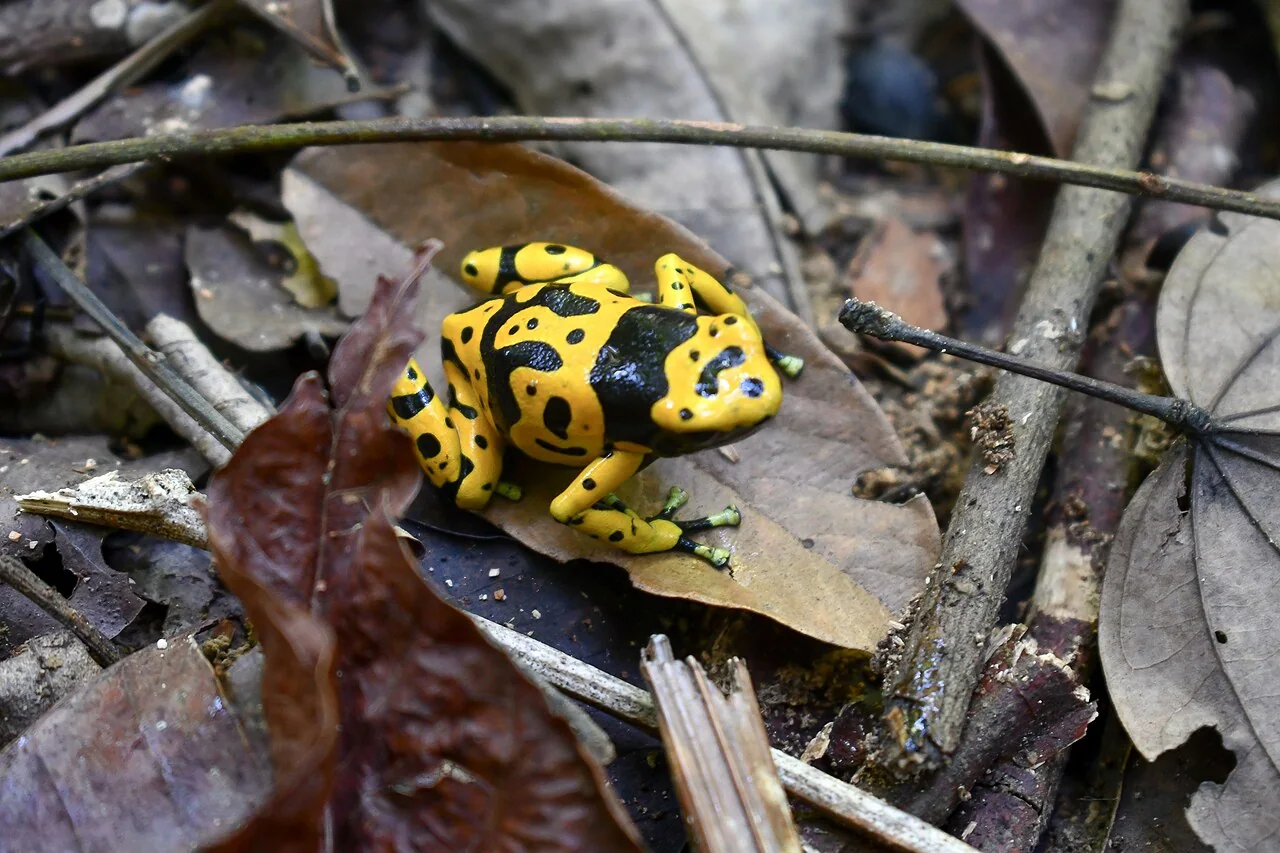
Dendrobates leucomelas is a diurnal frog from northern South America, recognisable by its yellow-and-black bands and spots. [1][2] It uses the forest floor but can also climb. A planted terrarium must therefore combine litter, retreats and usable low structures.
Origin
Guianan Orinoco basin in Venezuela, Guyana, far northern Brazil and eastern Colombian Amazonia, according to Amphibian Species of the World. [1]
- Leaf litter and shelters
- Small prey
- Documented lineage
Documentary overview: identity checked; natural observations and captive practices attributed separately. Undocumented limits remain explicit.
At a glance
| SIZE | 3,1–5 cm Snout–vent [2]. |
|---|---|
| LIFESPAN | 10–15 years suggested Captive zoological guideline [3]. |
| LIFESTYLE | Diurnal, ground and structures Can climb [2]. |
Adult size
ADW gives 3,1–5 cm snout–vent length, with many adults around 4 cm; females are generally larger. [2]
Lifespan
Zagreb Zoo presents 10–15 years in captivity as an educational guideline. The 20,5-year record sometimes cited for Dendrobates is not attributed with certainty to this species here. [2][3]
Lifestyle
Diurnal, mainly using the ground and low surfaces, with climbing ability; territorial behaviour possible. [2]
Housing
PAIR, BREEDER GUIDELINE
≈46 ×46 ×30 cm — Froglandia; prioritise furnished floor area [4].
Froglandia suggests approximately 46 ×46 ×30 cm for a pair. This is an attributed breeder guideline, not an experimental welfare standard; additional furnished floor space remains useful. [4]
Care parameters
DAYTIME AIR
≈20–26 °C — Froglandia [4].
STRUCTURES
Accessible and low — Continuous ground and refuges [2][4].
Humidity
70–80 % suggested — Froglandia practice, with ventilation and drainage [4].
Daytime air
Approximately 20–26 °C in the Froglandia guide [4] Conversion from 68–78°F; do not confuse regional climate with imposed temperature.
Relative humidity
70–80 % favoured by this guide [4] With locally moist litter and air exchange; no flooded soil.
Layout
Ground, refuges and low structures [2][4] Keep feeding points visible.
Feeding
SMALL LIVE PREY
Fruit flies, springtails and suitably sized crickets; monitor each individual [3].
Species name and lineage
The reference retains Dendrobates leucomelas, with a defined geographical distribution. [1] Lineage names used in breeding must not automatically become subspecies. A more orange colour or interrupted band is not enough to prove locality. For a breeding project, retaining the stated name and lineage documents avoids losing information that cannot be reconstructed from photographs.
Adult size, lifespan and lifestyle
ADW gives 3,1–5 cm snout–vent length, with many adults around 4 cm; females are generally larger. [2]
Zagreb Zoo presents 10–15 years in captivity as an educational guideline. The 20,5-year record sometimes cited for Dendrobates is not attributed with certainty to this species here. [2][3]
Diurnal, mainly using the ground and low surfaces, with climbing ability; territorial behaviour possible. [2]
A forest floor with passageways
ADW describes a frog active on the ground and capable of climbing vegetation. [2] Furnishings can represent this through several accessible levels while retaining a continuous lower surface. A waterfall or substantial pool is unnecessary to make the setup interesting. Passages behind roots must remain inspectable and sufficiently clear so the animal is not forced to skirt a single occupied area.
Humidity and ventilation are monitored together
Froglandia recommends drainage, litter and air exchange that prevents stagnation. [4] To understand how the tank works, observe what dries between mistings and what remains moist beneath leaves. A hygrometer positioned in the spray does not describe the entire terrarium. The amount of water introduced must relate to what drainage can actually receive and how easily excess can be removed.
Prepare small prey before the frogs
Zagreb Zoo uses springtails, fruit flies and crickets among other foods. [3] Their availability must be organised continuously: a culture working today does not guarantee the next. Planning several staggered batches reduces dependence on a single container. Feeding must remain observable to verify that each individual eats; microfauna in a terrarium alone does not prove a complete diet.
Calls and territoriality
Males produce calls and may defend a breeding space. [2] Visibility and calling are interesting to monitor, but alone are not evidence of good health or compatibility. An individual remaining hidden during meals may be secretive or obstructed by another: actual resource access must be examined. Separation must be planned before keeping a group.
Terrestrial eggs followed by tadpoles
The zoo describes small egg groups and male care. [3] ADW reports tadpole transport to water while noting contradictions in some older reviews. [2] Monitoring must distinguish terrestrial egg-laying from the subsequent aquatic phase. Tadpole setups and food are prepared separately; the parents' terrarium alone is not a complete rearing system.
Stages rather than yield
A laying date, first hatching and emergence from water are different events. Published durations depend on conditions and groups; they do not allow a promised number of juveniles by a fixed deadline. Photographing stages without systematically moving eggs provides useful reference points. Tiny prey availability and safe housing become particularly important as juveniles begin terrestrial life.
Responsible acquisition and observation
Request documented captive origin, retain the stated lineage and check current rules before any acquisition or transfer. Colours are not an invitation to handle. Observation through glass already allows movement, meals and interactions to be monitored. Lasting decline in condition or a lesion should prompt professional advice; this profile provides neither a treatment protocol nor automatic supplement dosages.
Checklist
- Prepare several prey cultures.
- Check drainage and ventilation.
- Plan for separating individuals.
Observations to record
- Meals
- Humidity
- Interactions
- Egg-laying
The app provides individual animal records. Check which features are available for your animal in the released version.
Related guides
Original guides in French
Sources
Document-based overview; not a substitute for veterinary advice.
- Amphibian Species of the World — Dendrobates leucomelas
Source accessed - University of Michigan, Animal Diversity Web — Dendrobates leucomelas
Source accessed - Zoo Zagreb — Dendrobates leucomelas
Source accessed - Froglandia — Dendrobates leucomelas care sheet
Source accessed