
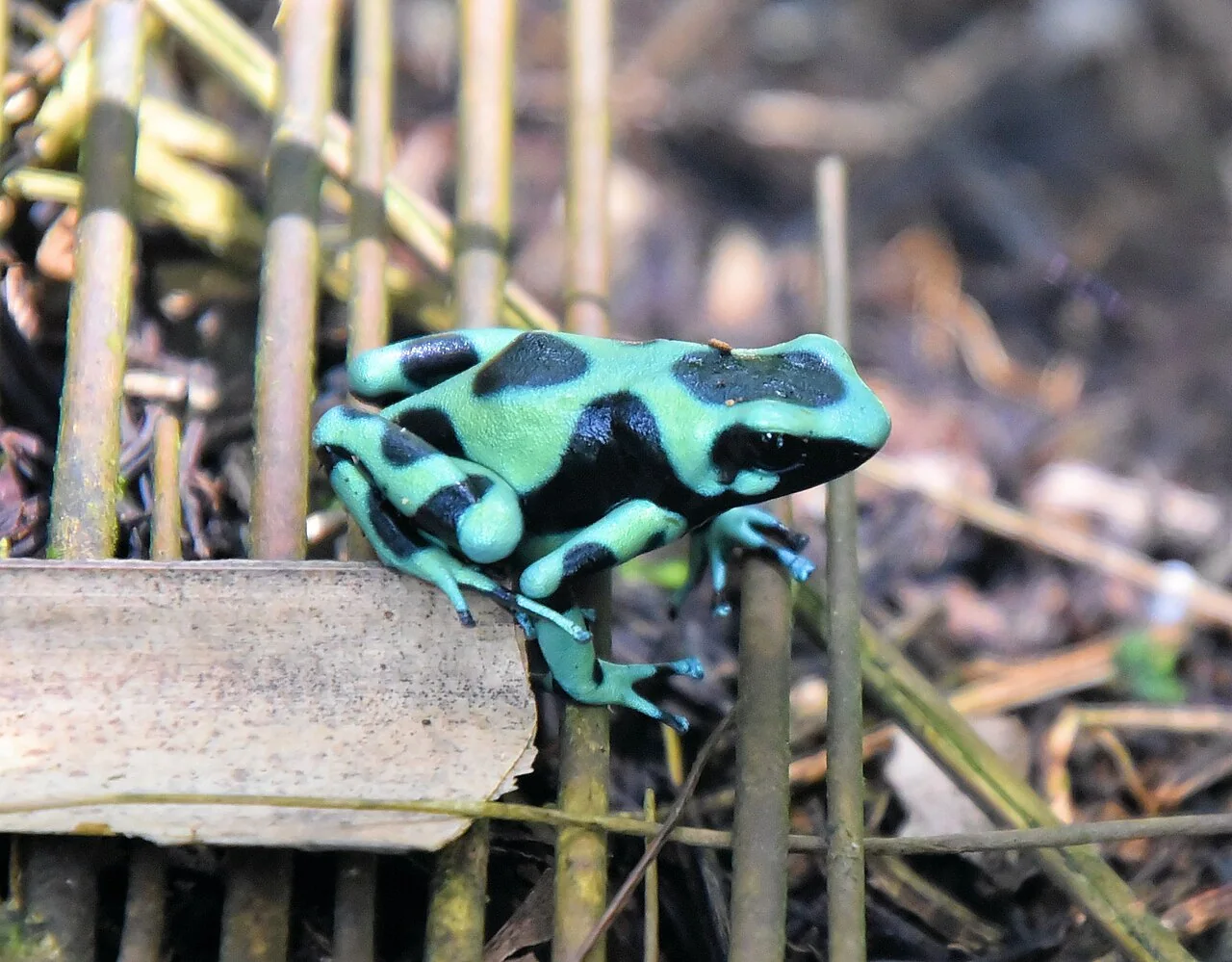
Scientific name
Dendrobates auratus
Other names: Phyllobates auratus
Dendrobates auratus is a small American frog with variable patterns. The accepted name appears in Amphibian Species of the World, which distinguishes its natural range from its introduction to Hawaii. [1] Its profile must describe documented origin rather than infer climate from colour alone.
Origin
From southern Nicaragua to northwestern Colombia, with different distributions on the Caribbean and Pacific slopes; a population was introduced to Oahu. [1]
- Origin to clarify
- Small prey
- Paternal care
Documentary overview: identity checked; natural observations and captive practices attributed separately. Undocumented limits remain explicit.
At a glance
| SIZE | 2,5–4 cm Body length, Sapporo Zoo [2]. |
|---|---|
| LIFESPAN | ≈ 10 years Zoo captive guideline, not a guarantee [2]. |
| LIFESTYLE | Ground and supports Diurnal activity [3]. |
Adult size
Approximately 2,5–4 cm in Sapporo Zoo's presentation: frog body length without outstretched legs. This guideline does not describe every lineage separately. [2]
Lifespan
Sapporo Zoo states approximately 10 years in captivity, without specifying a cohort or individual record. This is an attributed order of magnitude, not a guaranteed duration. [2]
Lifestyle
Diurnal, using the ground and supports for climbing. [3]
Housing
REFERENCE TERRARIUM
From 50 × 50 × 50 cm — DendroBase advice, to adapt to occupants [4].
DendroBase suggests a terrarium from 50 × 50 × 50 cm; refuge distribution and occupant compatibility still require monitoring. [4]
Care parameters
LOW ALTITUDE
24–26 °C — DendroBase guide; verify origin [4].
ALTITUDE
20–24 °C — Another context in the same guide [4].
Humidity
Observe cycle and soil — No uniform instruction for all localities [3][4].
Temperature
24–26 °C for lowland forms according to DendroBase [4] The same guide suggests 20–24 °C for upland forms: origin must be documented.
Humidity
Variable with environment and cycle [3] The FantasticFrogs table varies through the months; no universal constant value is retained.
Ground
Drainage, litter and retreats [3] Substrate must remain inspectable beneath plants and refuges.
Feeding
CULTURED SMALL PREY
Suitable fruit flies and springtails; monitor actual captures [3].
One species, several origins
The AMNH reference presents a natural range centred on Central America and northwestern Colombia. [1] A ‘Hawaii’ origin therefore does not mean the species is endemic there. At purchase, distinguish the seller's name, lineage name and an attested locality. A green-and-black photograph alone cannot determine a precise seasonal regime or certify origin.
Adult size, lifespan and lifestyle
Approximately 2,5–4 cm in Sapporo Zoo's presentation: frog body length without outstretched legs. This guideline does not describe every lineage separately. [2]
Sapporo Zoo states approximately 10 years in captivity, without specifying a cohort or individual record. This is an attributed order of magnitude, not a guaranteed duration. [2]
Diurnal, using the ground and supports for climbing. [3]
Connecting litter to supports
FantasticFrogs describes adults associated with trees and also using height; its layout includes branches, small pieces of wood and vegetation. [3] The project must retain accessible routes between these elements and the ground. A heavily decorated wall does not automatically add usable surface. Leaving a few visible areas allows feeding to be observed without removing refuges at every check.
Climate also depends on the measurement point
DendroBase distinguishes lowland and upland forms in its thermal advice. [4] This distinction must not become an automatic thermostat adjustment whenever a seller uses a trade name. While origin remains uncertain, have the project reviewed with its actual measurements. Recording temperature at animal level, in shade and near lighting identifies differences hidden by the room's average temperature.
Maintaining humidity without flooding
The FantasticFrogs guide combines drainage, litter and a small accessible water point. [3] These elements have different functions: drainage removes surplus, leaves structure retreats and the water point remains directly inspectable. Planning how to empty the lower reservoir before planting avoids dependence on complete dismantling. Probe humidity alone does not reveal substrate condition beneath bark.
Preparing small-prey cultures
Fruit flies and springtails are among the foods described in the husbandry guide. [3] Regular availability of suitable prey must precede the frogs' arrival. Several staggered cultures reduce dependence on a single container. During feeding, distinguish introduced insects from those actually captured; leftovers in a corner do not prove a shy individual has eaten. Supplementation should follow a coherent programme rather than an accumulation of products.
A visible group, sometimes subtle relationships
DendroBase recommends attention to dominance behaviours and separation if needed. [4] Two animals sharing a refuge is insufficient to validate the group. Observe prey access, retreat distribution and movements over several days. An already equipped separation container is more useful than an improvised solution after discovering an animal consistently excluded.
Documented paternal care
Sapporo Zoo describes eggs deposited beneath leaves, tended by the male until hatching, then individual transport of larvae on his back to water. [2] A male carrying a larva does not mean an entire clutch succeeded. For a breeding project, separately identifying egg deposits, hatchings and juveniles that completed metamorphosis clarifies the stages actually observed.
Anticipating metamorphosis
FantasticFrogs provides for suitable tadpole setups followed by gradual land access during transformation. [3] Small containers must not be prepared at the last moment without a plan for water or juvenile prey. Retaining lineage and avoiding mixing origins also allows reliable information to be passed on during transfer. Choose documented captive origin, check applicable obligations and undertake neither wild collection nor release.
Checklist
- Prepare several prey cultures.
- Measure near the ground and supports.
- Provide functional separation.
Observations to record
- Provenance
- Meals
- Behaviour
- Development
The app provides individual animal records. Check which features are available for your animal in the released version.
Related guides
Original guides in French
- Dendrobates auratus « Gold » : choisir sa souche et préparer le terrarium
- Quelle eau utiliser pour les grenouilles et autres amphibiens ?
- Quarantaine des amphibiens : préparer un accueil séparé
- Hygiène des reptiles et amphibiens : gestes et prévention
- Que mange une grenouille en captivité ? Aliments et repas
Sources
Document-based overview; not a substitute for veterinary advice.
- Amphibian Species of the World — Dendrobates auratus
Source accessed - Zoo de Sapporo, Maruyama — Dendrobates auratus
Source accessed - FantasticFrogs — Dendrobates auratus management overview
Source accessed - Ostrowski et Mahn, DendroBase — Dendrobates auratus
Source accessed