
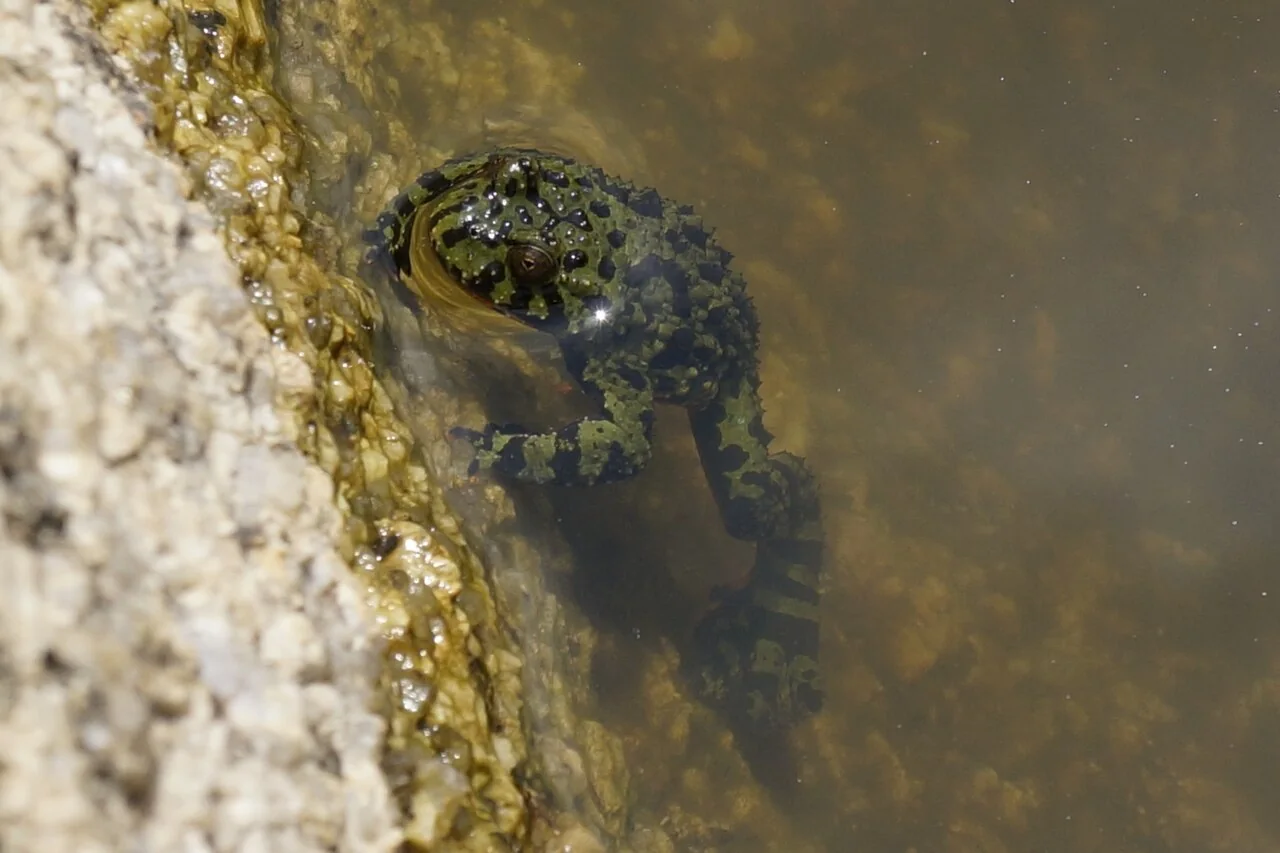
Scientific name
Bombina orientalis
Bombina orientalis is a small amphibian associated with water and banks. The British Herpetological Society review describes its activity, vocalisations and aquatic reproduction. [1] Its brightly coloured belly accompanies defensive secretions; it is an animal to observe in its enclosure, without demonstration handling.
Origin
Korea, northeastern China and neighbouring regions of the Russian Far East, according to Galapagos clinic. [2] Broader mentions in some older profiles are not repeated without checking.
- Water and land
- Group to monitor
- Observation
Documentary overview: identity checked; natural observations and captive practices attributed separately. Undocumented limits remain explicit.
At a glance
| SIZE | ≈4,5 cm Adult clinical guideline [2]. |
|---|---|
| LIFESPAN | Up to 15 years suggested Captivity, attributed guideline [2]. |
| LIFESTYLE | Semi-aquatic Shallow water and banks [1]. |
Adult size
Approximately 4,5 cm in the clinical sheet, adult body length without outstretched legs. This is a common guideline, not an absolute maximum. [2]
Lifespan
The clinic presents captive longevity of up to 15 years; detailed follow-up is not provided, so this figure remains an attributed guideline. [2]
Lifestyle
Semi-aquatic, using shallow water and emerged areas; active both for feeding and communication. [1]
Housing
GROUP OF 4–6, CLINICAL GUIDE
80–90 ×40–50 cm — Suggested floor area; separation possible [2].
The clinic suggests a floor area of 80–90 ×40–50 cm for a group of 4–6, with accessible water and land. This advice does not guarantee compatibility among all individuals. [2]
Care parameters
BREEDER GUIDELINE
18–24 °C — Bombina.org experience [3].
CLINICAL GUIDELINE
22–26 °C daytime — Galapagos, without making the whole tank uniform [2].
Humidity
Water and ventilated air — Accessible moist banks; no universal RH target.
Temperature
18–24 °C from breeder Bombina.org [3] The clinic suggests 22–26 °C by day: retain the attribution, not an artificial average. [2]
Water
7–10 cm in the clinical design [2] With easy banks and filtration without excessive turbulence.
Ventilation
Secure lid and air exchange [2] Humidity does not simply mean sealing the tank airtight.
Night — clinic indication
Chicago Exotics mentions a nighttime drop to 72 °F, approximately 22 °C; this is not an established physiological threshold. [5] Scope: captivity; Chicago Exotics guidance. A reported limit is not a target or an established physiological threshold.
Feeding
LIVE INVERTEBRATES
Varied small prey, monitored consumption and prepared nutrition [2][3].
A bank, not just a bowl
BHS describes B. orientalis in marshes, rice fields and small low-mountain streams. [1] The setup must allow passage from water to emerged surfaces through several access points. A simple dish in the middle of a dry terrarium does not reproduce this arrangement. Conversely, a tiny platform above a large volume of deep water can remove retreat and feeding opportunities.
Adult size, lifespan and lifestyle
Approximately 4,5 cm in the clinical sheet, adult body length without outstretched legs. This is a common guideline, not an absolute maximum. [2]
The clinic presents captive longevity of up to 15 years; detailed follow-up is not provided, so this figure remains an attributed guideline. [2]
Semi-aquatic, using shallow water and emerged areas; active both for feeding and communication. [1]
Understanding differences between guides
Bombina.org explicitly presents personal husbandry experience, whereas Galapagos publishes a clinical recommendation. Their temperatures and dimensions differ. [2][3] These differences are not resolved by displaying a supposedly universal value. For a concrete project, defining animal numbers, genuinely available areas and measured temperatures allows review of a specific setup rather than a mixture of tables.
Accessible water and filtration
The clinic recommends removing chlorine and using a small filter without strong flow. [2] Cleaning must remain possible beneath islands and along banks. Planning filter access from the design stage avoids destroying refuges at every maintenance session. The amount of water changed and remaining food help explain tank variations; transparency alone is insufficient to judge quality.
Insects and observed portions
The breeder's guide uses worms and small live insects among other foods. [3] The clinic stresses nutritional preparation of prey. [2] Organised variety is preferable to accumulating several food types left in the water. Observing each animal during feeding identifies one staying apart. A vitamin preparation must not be chosen solely to intensify belly colour.
Calls, distances and conflicts
The BHS review describes several vocalisations in orientalis, along with attacks between males in a reproductive context. [1] A group seen together must therefore not be interpreted as constantly peaceful. Several retreats and access points reduce situations where one individual controls the only passage. Available separation allows action if an animal can no longer reach meals or faces repeated advances.
Mating and eggs
The male grasps the female in front of the hindlimbs: this is inguinal amplexus. [1] ADW then describes external fertilisation and eggs deposited in small groups on submerged supports. [4] Calling does not prove that laying will follow, and laying does not guarantee every egg will hatch. To document reproduction, distinguish observed behaviours, egg deposits found and larvae actually present.
Preparing juveniles' exit
Tadpoles develop in water before becoming young fire-bellied toads. [4] Published durations vary with conditions and sources; no single countdown is proposed. The rearing setup must provide terrestrial access when transformation requires it. Closure needs particular checking for small individuals, as does availability of sufficiently small prey after emergence.
Secretions, origin and caution
The colourful belly and defensive posture must not be provoked to obtain an image. BHS describes skin secretions as irritating. [1] Keep animals away from household contact and limit handling to necessary interventions. Choose traceable captive origin and check applicable rules before acquisition. Possible absence from an international trade listing does not automatically mean absence of every local obligation.
Dietary supplements: distinguish the situations
The Chicago Exotics sheet includes calcium and vitamin supplements on food. [5]
Scope: captivity; Chicago Exotics protocol for Bombina orientalis. Consider diet composition and setup; this review sets no universal dosage.
Checklist
- Provide several banks.
- Compare temperatures actually available.
- Plan exits for metamorphs.
Observations to record
- Water
- Meals
- Behaviours
- Egg-laying
The app provides individual animal records. Check which features are available for your animal in the released version.
Related guides
Original guides in French
Sources
Document-based overview; not a substitute for veterinary advice.
- Mathias Lang (1989), British Herpetological Society — Bombina life history
Source accessed - Clinica Veterinaria Galapagos — Bombina orientalis
Source accessed - Bombina.org — Personal fire-bellied toad care sheet
Source accessed - University of Michigan, Animal Diversity Web — Bombina orientalis
Source accessed - Fire Bellied Toad Care (Bombina orientalis)
Source accessed