
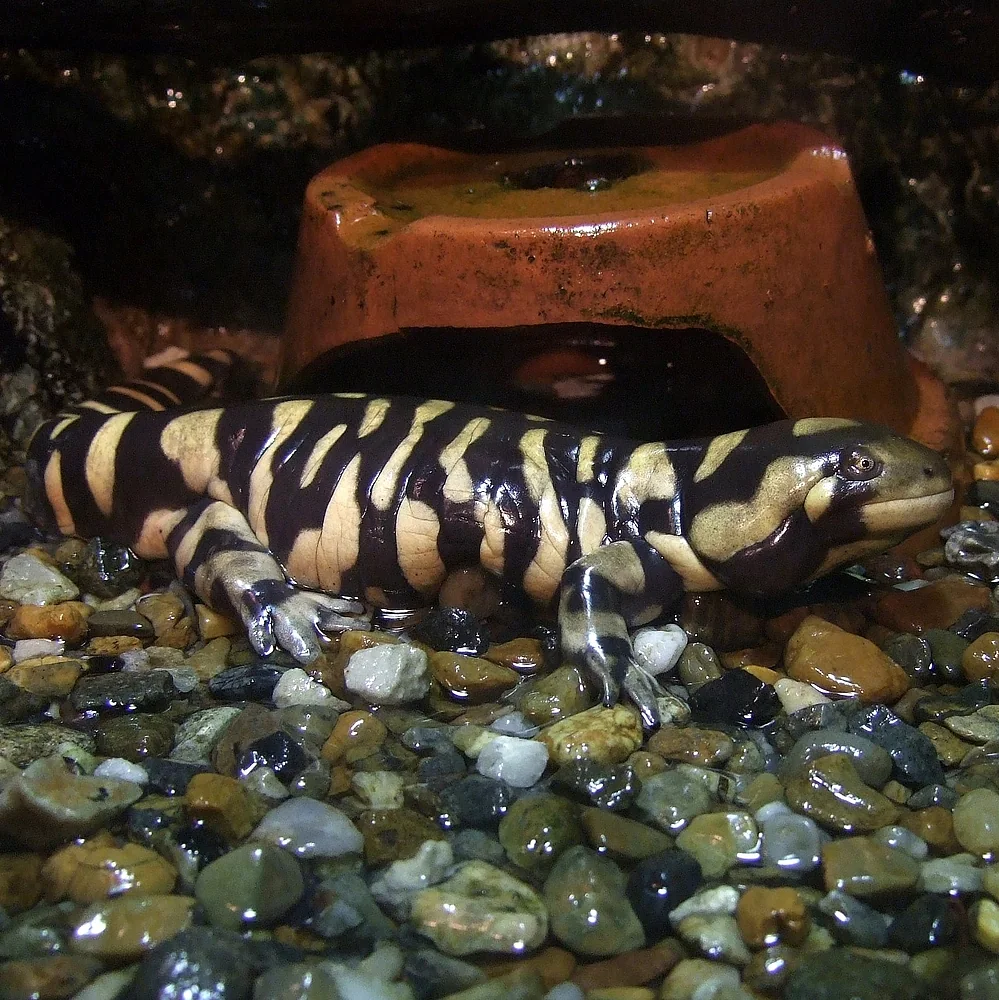
Scientific name
Ambystoma mavortium
Other names: Ambystoma tigrinum mavortium
Ambystoma mavortium is recognised as a distinct species by Amphibian Species of the World. The older combination Ambystoma tigrinum mavortium still explains some labels. [1] Its care depends first on its form: a metamorphosed adult is terrestrial, whereas some adults remain aquatic and gilled. [2]
Origin
Central and western North America, from Canada through the United States to Mexico; the reference also distinguishes introductions outside the native range. [1]
- Form to identify
- Deep soil
- Water according to stage
Documentary overview: identity checked; natural observations and captive practices attributed separately. Undocumented limits remain explicit.
At a glance
| SIZE | ≈20 cm terrestrial Total length, males in the Canadian report [2]. |
|---|---|
| LIFESPAN | Not quantified here Older data on the complex are difficult to separate. |
| LIFESTYLE | Two possible forms Terrestrial or gilled aquatic adult [2]. |
Adult size
The Canadian report describes terrestrial males around 20 cm total length. Individuals exceeding 30 cm are often aquatic forms retaining their larval features. [2]
Lifespan
No specifically documented maximum lifespan without conflation with A. tigrinum is retained here; the Canadian report discusses several studies of the complex. [2]
Lifestyle
Burrowing after metamorphosis; some populations include paedomorphic adults that are aquatic and reproductive. [2]
Housing
CHOOSE BEFORE SETUP
Terrestrial or aquatic — The stage determines equipment [2][3].
For the terrestrial adult, Herpeton suggests deep soil, stable dark hides and a shallow dish. A gilled form requires a different aquatic system. [3]
Care parameters
TERRESTRIAL AIR
16–22 °C — Herpeton guide [3].
OVERHEATING
Avoid prolonged exposure — Above 24°C discouraged by the guide [3].
Humidity
Moist soil in areas — Without stagnation; no universal RH target retained [3].
Air, terrestrial form
16–22 °C according to Herpeton [3] The guide advises against prolonged exposure above 24 °C.
Humidity
Moist soil without saturation [3] Provide several retreats and sufficient air exchange.
Choice of housing
Verify terrestrial or aquatic form [2] No forced metamorphosis is proposed.
Feeding
INVERTEBRATE PREDATOR
Adapt feeding to the stage; observe ingestion and leftovers [4].
Do not import figures from the wrong taxon
The current reference separates mavortium from tigrinum, whereas many older works combined their data. [1] In a profile, the source of a maximum age or size must therefore be examined before reuse. Retaining the historical name for searches is useful; displaying it as certain current identity is not. This caution notably avoids attributing the size of a large aquatic individual to a terrestrial adult.
Adult size, lifespan and lifestyle
The Canadian report describes terrestrial males around 20 cm total length. Individuals exceeding 30 cm are often aquatic forms retaining their larval features. [2]
No specifically documented maximum lifespan without conflation with A. tigrinum is retained here; the Canadian report discusses several studies of the complex. [2]
Burrowing after metamorphosis; some populations include paedomorphic adults that are aquatic and reproductive. [2]
Refuges in a sometimes dry landscape
The Canadian report explains that burrows allow use of relatively dry surface habitats. [2] This does not justify a terrarium that is dry throughout: the underground space is precisely a different refuge. To reproduce this function, provide enough loose material and areas whose moisture can be inspected. A photographically faithful grassland layout can be biologically incomplete if no usable retreat exists.
Furnishing stability and access
Herpeton emphasises solid refuges and substrate depth for adults. [3] Imagine the tank after the animal has moved some of the soil: do supports, small stones and containers remain stable? Items intended to conceal equipment must not become inaccessible spaces. Checking the dish and removing waste must be possible without collapsing the main tunnels.
Measure heat in the right place
The captive range attributed to the guide does not correspond to weather extremes in the states where the species lives. [3] Refuge temperature and air temperature beneath a lamp may differ. Testing the empty setup, then noting its maxima during hot days, establishes what the tank actually provides. A heat lamp is not equipment to add automatically to every terrarium setup.
Feeding and life form
Caudata Culture presents tiger salamanders as invertebrate predators, with different feeding methods for aquatic and terrestrial stages. [4] The menu must correspond to the form actually kept. Offered foods, leftovers and body condition are compared over time; rapid acceptance of prey does not demonstrate that quantity should increase. Rich foods do not replace a coherent nutritional strategy.
Breeding ponds and growth
The Canadian assessment describes aquatic reproduction and larval survival varying with water persistence, resources and density. [2] A drying pond is therefore not a model of manipulation to reproduce deliberately. In captivity, anticipating several juvenile sizes allows separation when necessary. Maturity and metamorphosis must be recorded as distinct observations, without automatically inferring one from the other.
Recognising observation limits
A hidden salamander is not automatically ill; terrestrial adults spend much time beneath the substrate. [2] It remains necessary to confirm its presence and condition at reasonable intervals. Preparing an inspectable refuge and a feeding routine reduces intrusive searches. Visible gills or a persistent aquatic phase must not alone be interpreted as a defect to correct.
A traceable project with separation possible
Introductions outside the native range are documented in the reference. [1] Never release a captive animal or empty its maintenance water into a natural habitat. Request precise origin and check local obligations. Separation of new arrivals, equipment and larval groups must be possible before acquisition. Parameters published here are attributed guidelines; clinical situations and breeding projects require appropriate support.
Checklist
- Identify the stage before purchase.
- Provide a real gradient within the soil.
- Keep groups and tools separable.
Observations to record
- Form
- Meals
- Ground
- Growth
The app provides individual animal records. Check which features are available for your animal in the released version.
Related guides
Original guides in French
Sources
Document-based overview; not a substitute for veterinary advice.
- Amphibian Species of the World — Ambystoma mavortium
Source accessed - COSEWIC Canada (2012) — Western tiger salamander
Source accessed - Herpeton Academy — Ambystoma mavortium
Source accessed - Caudata Culture — Tiger salamanders
Source accessed