
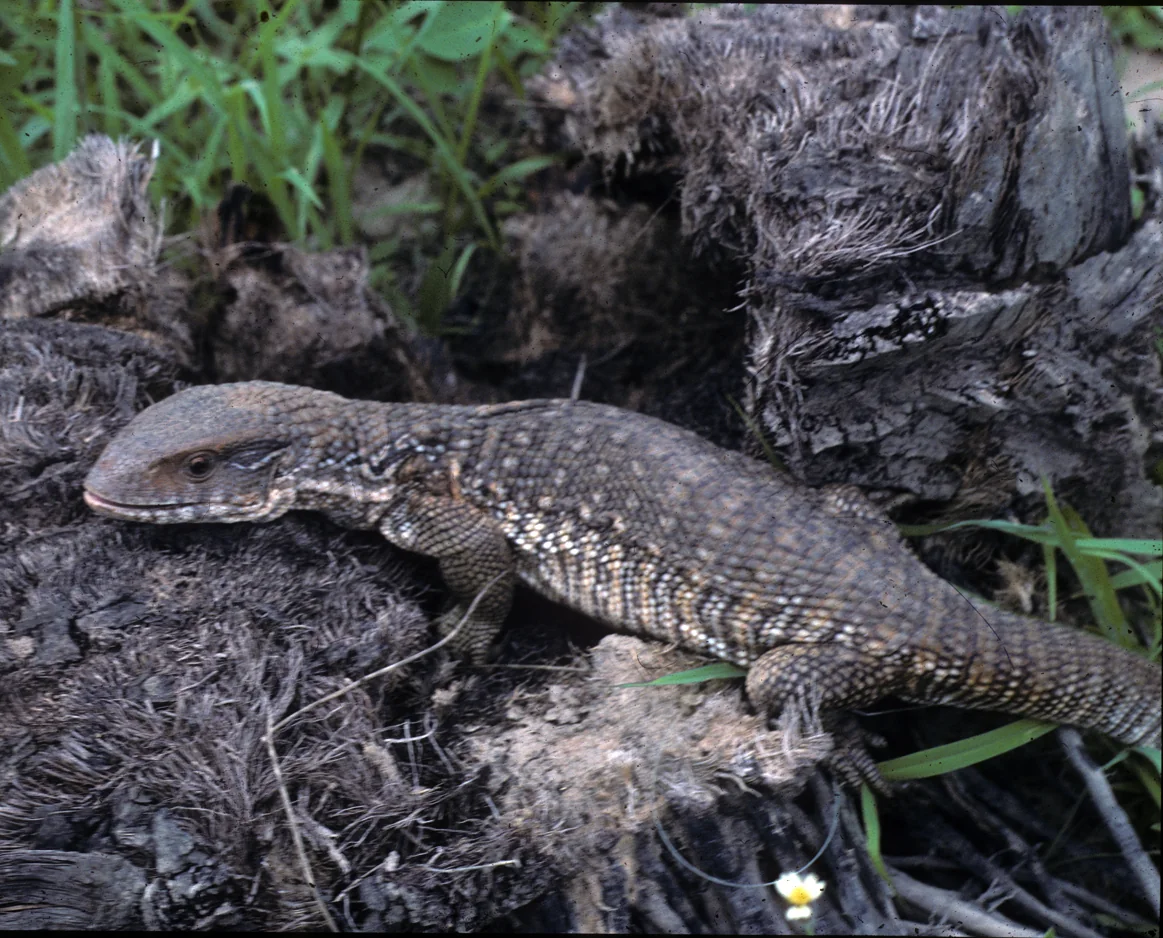
Scientific name
Varanus exanthematicus
Other names: Lacerta exanthematica
This burrowing African monitor is often described too broadly as carnivorous. Field studies distinguish populations, seasons and ages, and show the importance of invertebrates [2][4].
Origin
Sub-Saharan Africa, widely represented in West Africa; introduced presence in Florida must be distinguished from the native range [1].
- Terrestrial
- Burrowing
- Invertebrates
At a glance
A burrowing African monitor; field studies show dietary differences between ages, seasons and populations [2][4].
| ADULT SIZE | ≈ 50 cm body length Snout to vent cited by Bennett; tail excluded [2]. |
|---|---|
| ACTIVITY | Burrowing Burrows observed in Ghana [2]. |
| DIET | Animal prey Importance of invertebrates documented [2][4]. |
Adult size
Bennett cites approximately 50 cm from snout to vent, excluding the tail. Ness clinic gives an adult length of 91–122 cm without explaining its method; these values are not interchangeable [2][3].
Lifespan
Ness clinic gives 8–15 years without a detailed survival series; a captive husbandry estimate, not a demonstrated average lifespan in the wild [3].
Lifestyle
Terrestrial, uses burrows and searches for prey; studies from Ghana and Senegal describe diets and seasonal variations [2][4].
Housing
ARRANGING ITS HABITAT
Large terrestrial space — Ness favours 244–305 × 122–152 cm floor area, height ≥ 61 cm and burrowing space [3].
Ness clinic favours approximately 244–305 × 122–152 cm of floor area, at least 61 cm in height and deep space for digging; a practical reference point, not an experimental optimum [3].
Care parameters
CAPTIVE CLIMATE
To be clarified — The guide does not define the heating method sufficiently [3].
Humidity
45–60 % · ambient — Ness reference point; burrow humidity remains distinct [3].
Captive climate
To be clarified The clinical guide’s basking-temperature method is insufficiently detailed to set a surface instruction.
Published ambient humidity
45–60 % [3] Ness clinic reference point, distinct from humidity in a burrow.
Burrowing substrate
Locally moist [3] The source describes slightly moistened soil, without saturating it.
Feeding
FEEDING AND MONITORING
Varied invertebrates and a monitored ration; track body condition to prevent overfeeding [2][3][4].
Identify the right monitor
The current name is Varanus exanthematicus; Lacerta exanthematica belongs to its nomenclatural history [1]. Bennett emphasises that older descriptions sometimes equated its ecology with that of Varanus albigularis, a distinct species [5]. For a purchase or taking over an animal, retaining photographs, transfer documentation and stated origin is therefore essential. A simple “African monitor” label does not allow a habitat or diet to be chosen, even when animals look similar in a photograph.
Adult size, lifespan and lifestyle
Bennett cites approximately 50 cm from snout to vent, excluding the tail. Ness clinic gives an adult length of 91–122 cm without explaining its method; these values are not interchangeable [2][3].
Ness clinic gives 8–15 years without a detailed survival series; a captive husbandry estimate, not a demonstrated average lifespan in the wild [3].
Terrestrial, uses burrows and searches for prey; studies from Ghana and Senegal describe diets and seasonal variations [2][4].
Plan the adult setup and burrowing space
The clinical profile emphasises a large area, shelters and a soil zone that permits digging [3]. In Ghana, the juveniles studied were found in burrows in cultivated plots [2]. Space beneath the surface is therefore a function to take seriously. Anticipating substrate mass, cleaning access and support fixing avoids designing an enclosure that cannot be maintained. The setup must allow turning around and movement without having to remove shelters.
Measuring climate without confusing levels
The Ness guide provides basking temperatures but does not define their method precisely enough to reuse them as a single surface target [3]. A husbandry record should separate exposed surface, air and refuge depth. Room temperature alone describes none of these three levels. Preparing the setup before arrival, checking accessible zones and photographing probe positions provides a usable basis for adjusting the system with an experienced practitioner.
Water and refuge humidity
The clinic gives ambient humidity of 45–60 % and a slightly moist digging area, along with regularly renewed water [3]. These elements are not interchangeable: moistening only the air does not describe soil condition at depth. Checking the water container after soiling and observing substrate stability allows targeted maintenance. An unusual smell, compaction or a constantly waterlogged layer are observations to record, without automatically inferring disease.
What natural prey shows
Bennett studied juveniles in Ghana: orthopterans dominated the samples, alongside scorpions, beetles and some amphibians [2]. Cissé, in Senegal, mainly observed invertebrates and some eggs in the digestive contents examined [4]. These two studies support the importance of small prey, but not an identical ration in every population. Nor do they justify reproducing every wild prey item in captivity. A varied captive-bred offering must be considered with its nutritional profile and safety.
Body condition and feeding behaviour
Ness identifies obesity as a common problem linked to overfeeding and recommends monitored feeding [3]. An animal willing to eat therefore does not, by that fact alone, express an energy need. Linking the amount supplied to weights, comparable photographs and activity provides more useful information. Food-searching can be observed without chasing or starving the animal. Seasonal variations recorded in Senegal [4] do not constitute a fasting prescription for a captive animal with an unknown history.
Breeding and origin of juveniles
Bennett reports breeding during the dry season and hatching at the start of the rains in Ghana [2]. His other overview emphasises the rarity of documented captive breeding during the period studied [5]. A captive birth must therefore be distinguished from a collected animal or one originating from collected eggs. No complete incubation protocol is inferred from these observations. A breeding project requires additional information on the adults, laying site and juvenile housing before any pairing.
Precautions and useful monitoring
The clinic describes supporting the animal beneath its body during necessary handling and emphasises risks of burns and nutritional imbalance [3]. To prepare a consultation, keeping a concrete history of meals, weights and the thermal setup avoids retrospective estimates. Abnormal stools or persistent decline call for appropriate assessment; no antiparasitic treatment or therapeutic-dose supplement is proposed here. Published data describe precise contexts, without guaranteeing success for a particular setup.
Checklist
- Keep the animal’s identity and provenance.
- Prepare exposed zones and refuges where measurements can be taken.
- Monitor meals, weight and behaviour individually.
Observations to record
- Meals
- Weight
- Sheds
- Temperature
- Humidity
- Behaviour
The app provides individual animal records. Check which features are available for your animal in the released version.
Related guides
Original guides in French
Sources
Document-based overview; not a substitute for veterinary advice.
- The Reptile Database — Varanus exanthematicus
Source accessed - Bennett (2000) — Preliminary data on the diet of juvenile Varanus exanthematicus in Ghana
Source accessed - Ness Exotic Wellness Center — Savannah Monitor Care
Source accessed - Cissé (1972), traduction Daniel Bennett — The diet of Varanids in Senegal, dans Varanus Translations
Source accessed - Daniel Bennett (2000) — Observations on Bosc’s Monitor Lizard in the Wild, résumé auteur
Source accessed