
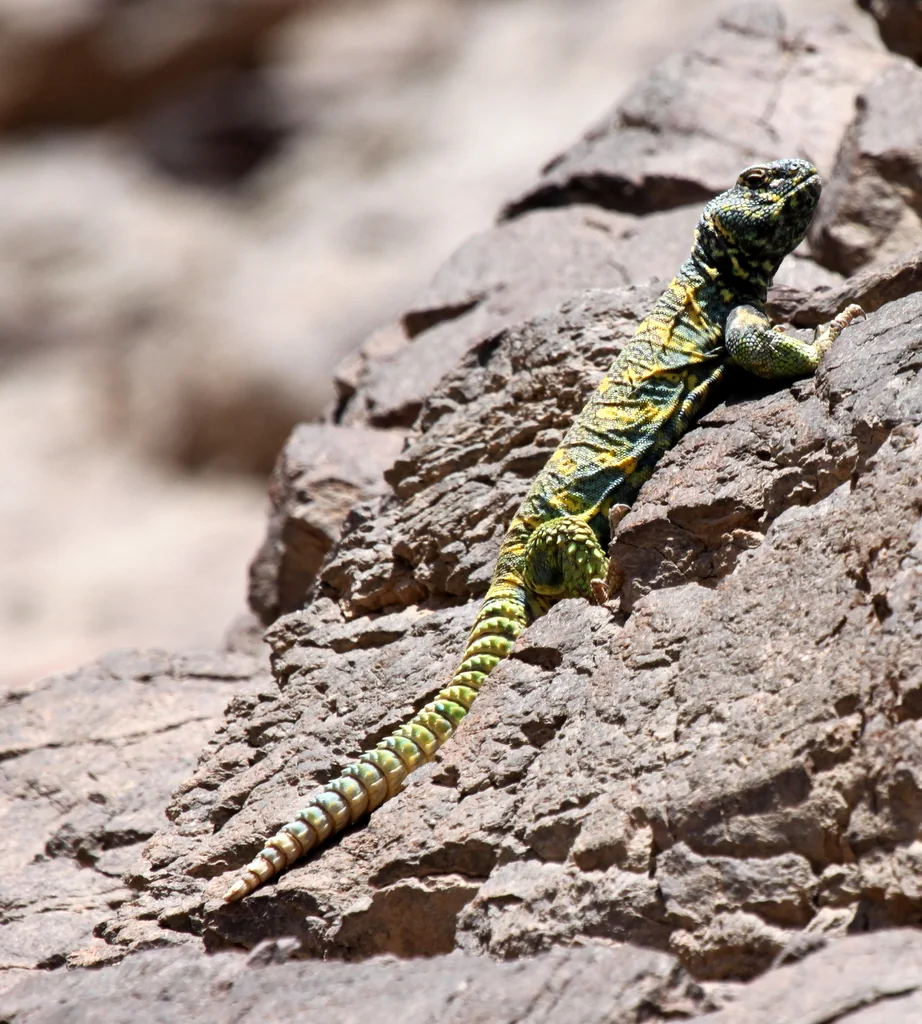
Scientific name
Uromastyx ornata
Other names: Uromastyx ornatus · Uromastyx ocellata ornata
This colourful spiny-tailed lizard inhabits arid rocky landscapes of the Red Sea region. Israeli observations describe detailed use of crevices and plant resources [1][3].
Origin
Egypt, Israel, Saudi Arabia and Yemen according to RDB, which retains ornata and philbyi as subspecies [1].
- Diurnal
- Rock-dwelling
- Herbivorous
At a glance
A spiny-tailed lizard from the Red Sea region; the profile separates historical Israeli data from attributed husbandry experience [1][2][3].
| ADULT SIZE | ≈ 30–41 cm Total length in the species-specific profile [4]. |
|---|---|
| ACTIVITY | Diurnal Rocky slopes and wadis in Israel [3]. |
| DIET | Herbivorous Plants in local observations [3]. |
Adult size
Approximately 30–41 cm total length in the species-specific Reptiles Magazine profile; the source explicitly states a measurement including the tail [4].
Lifespan
The Reptiles Magazine profile states 12–20 years in captivity without individual histories; a practical estimate, not a verified demographic average [4].
Lifestyle
Daytime activity between rocky slopes, crevices and vegetated wadi areas in the Israeli observations [3].
Housing
ARRANGING ITS HABITAT
≈ 122 × 61 cm floor area — Footprint for one individual at Troy Jones’s facility; keeper’s practice [2].
Troy Jones uses a footprint of approximately 122 × 61 cm for one individual; a keeper’s reference point, with several shelters and a usable gradient [2].
Care parameters
BASKING · JONES GUIDE
49–54 °C — Published basking zone, not uniform air [2].
COOL END
27–32 °C — Reference point from the same breeding setup [2].
Humidity
Not quantified — Arid natural environment; no captive percentage validated here [3].
Published basking zone
49–54 °C [2] Conversion of 120–130 °F; Jones’s basking zone, not uniform air temperature.
Published cool end
27–32 °C [2] Rounded conversion of 80–90 °F; the author’s practice.
Humidity
Not quantified Arid natural environment; no species-specific captive percentage validated here.
Feeding
FEEDING AND MONITORING
Identified edible foliage and flowers; provide variety without copying a wild-plant list exactly [2][3].
Names and geographical provenance
Uromastyx ornatus and Uromastyx ocellata ornata appear in the synonymy; philbyi remains included in the species by the database consulted [1]. The field data used here mainly concern Israel and do not cover all these populations evenly. For an animal sold under a regional designation, retain the original information and ask what supports it. Spectacular coloration is insufficient to identify sex, subspecies or locality with certainty.
Adult size, lifespan and lifestyle
Approximately 30–41 cm total length in the species-specific Reptiles Magazine profile; the source explicitly states a measurement including the tail [4].
The Reptiles Magazine profile states 12–20 years in captivity without individual histories; a practical estimate, not a verified demographic average [4].
Daytime activity between rocky slopes, crevices and vegetated wadi areas in the Israeli observations [3].
Rocks, crevices and shelter access
Simon Nemtzov’s report describes refuges on rocky wadi slopes and movement towards plants on the valley floor [3]. For enclosure design, the value of this observation is in linking shelter, exposure and food. Stacks must remain safe if the animal pushes or digs around them. Providing inspectable cavities avoids having to extract a lizard by force. A desert-like appearance alone does not prove these functions are available.
Heat one zone, leave a choice
The temperatures published by Troy Jones describe his breeding setup, in a room containing many enclosures [2]. They are attributed to that practice and are not presented as the result of a physiological trial. Before use, clarify the method and measurement location on the exposed support. Also check retreats during the hottest period. The wattage printed on a lamp does not reveal the temperature achieved or UVB exposure at back level.
Humidity and water: avoid an absolute rule
The Israeli observations concern an extremely arid environment, but distinguish open spaces from crevices used as shelters [3]. The two husbandry texts minimise use of a dish [2][4]; they nevertheless do not establish that an animal can never need accessible water. No precise percentage is retained here. A project must describe how hydration will be monitored and how to intervene with a veterinarian if condition deteriorates, without waiting for a dramatic sign.
Building an identifiable plant-based menu
The field report lists leaves, flowers and fruit of Ochradenus baccatus and other shrubs [3]. It supports plant-based feeding without turning local plants into a compulsory shopping list. In captivity, Jones proposes varied edible foliage and flowers [2]. Identifying each plant, its origin and absence of treatments avoids approximate substitutions. A flower’s colour or “natural” character does not guarantee edibility. Supplements must be considered alongside the menu and light exposure.
Behaviour and group precautions
The Israeli report describes chasing between males and partial sharing of space, with an organisation more nuanced than a simple permanent pair [3]. Jones also reports combinations that eventually require separation [2]. For individual keeping, adding another animal to reproduce a group image is therefore unnecessary. An abrupt interaction must be described through its consequences: escape, injury, blocked access or a missed meal. It does not become harmless because it occurs in nature.
Breeding: distinguish field observations from captivity
In the Israeli population reported, females dig a laying site on the wadi floor; observations mention 7–17 eggs and hatching approximately two months later [3]. These natural durations do not give an incubator temperature. Jones separately describes his captive breeding and the risks of violent interactions [2]. Preparing a project therefore requires a laying setup, a separation solution and monitoring of females; no automatic cooling timetable is imposed.
Monitoring and scope of the sources
The captive lifespan published in the older Reptiles Magazine profile is not accompanied by a documented cohort [4]. The report’s field observations are historical and local; their population estimates or regulatory mentions are not updated here. Keeping weight history, plant consumption and shelter use allows comparison of similar periods. A lasting change must be examined alongside actual terrarium measurements rather than explained solely by a desert-species label.
Checklist
- Keep the animal’s identity and provenance.
- Prepare exposed zones and refuges where measurements can be taken.
- Monitor meals, weight and behaviour individually.
Observations to record
- Meals
- Weight
- Sheds
- Temperature
- Humidity
- Behaviour
The app provides individual animal records. Check which features are available for your animal in the released version.
Related guides
Original guides in French
Sources
Document-based overview; not a substitute for veterinary advice.
- The Reptile Database — Uromastyx ornata
Source accessed - Troy Jones — Ornate Uromastyx Care and Breeding Tips
Source accessed - Simon C. Nemtzov — Uromastyx lizards in Israel, NDF Workshop WG7, case study 5
Source accessed - Reptiles Magazine — Ornate Uromastyx, fiche spécifique
Source accessed