
Scientific name
Underwoodisaurus milii
Other names: Nephrurus milii
This thick-tailed Australian gecko can give a defensive call resembling a bark. It hunts at night and spends the day under cover; provoking the call adds nothing to monitoring [2].
Origin
Mainland southern Australia, in dry woodland, scrub and rocky areas [1][2].
- Nocturnal
- Terrestrial
- Australia
At a glance
A nocturnal gecko from southern Australia; contradictory humidity figures in one guide are explicitly flagged [1][2][3].
| ADULT SIZE | Up to 10 cm Snout to vent, excluding the tail [2]. |
|---|---|
| ACTIVITY | Nocturnal Terrestrial; daytime shelters sometimes shared [2]. |
| DIET | Insectivorous Natural diet described by Museums Victoria [2]. |
Adult size
Up to 10 cm from snout to vent according to Museums Victoria; the tail is not included in this measurement [2].
Lifespan
Monkfield states 8–10 years in captivity without providing an individual series; BGSU explicitly gives lifespan as unknown [3][4].
Lifestyle
Nocturnal and terrestrial; aggregations are observed in natural daytime shelters [2].
Housing
ARRANGING ITS HABITAT
Shelters and low features — A horizontal setup with a moist refuge and distinct areas [3][4].
A horizontal terrarium with shelters, low features and a moist hide; commercial dimensions must not prevent a real gradient [3][4].
Care parameters
WARM ZONE
28–32 °C — Monkfield reference point [3].
COOL AMBIENT CONDITIONS
18–22 °C — Value separate from the heated zone [3].
Humidity
To confirm — The Monkfield PDF gives two incompatible ranges; no standard retained [3].
Warm zone
28–32 °C [3] Reference point from the Monkfield captive setup.
Cool ambient conditions
18–22 °C [3] A zone distinct from the heated area, to measure in the setup.
Humidity
Value to confirm Monkfield lists 40–50 % then 70–80 % in the same PDF; neither figure is retained as a standard.
Feeding
FEEDING AND MONITORING
Suitable insects, consumption monitored; natural aggregations do not guarantee captive compatibility [2][3][4].
Recognising the species and its former names
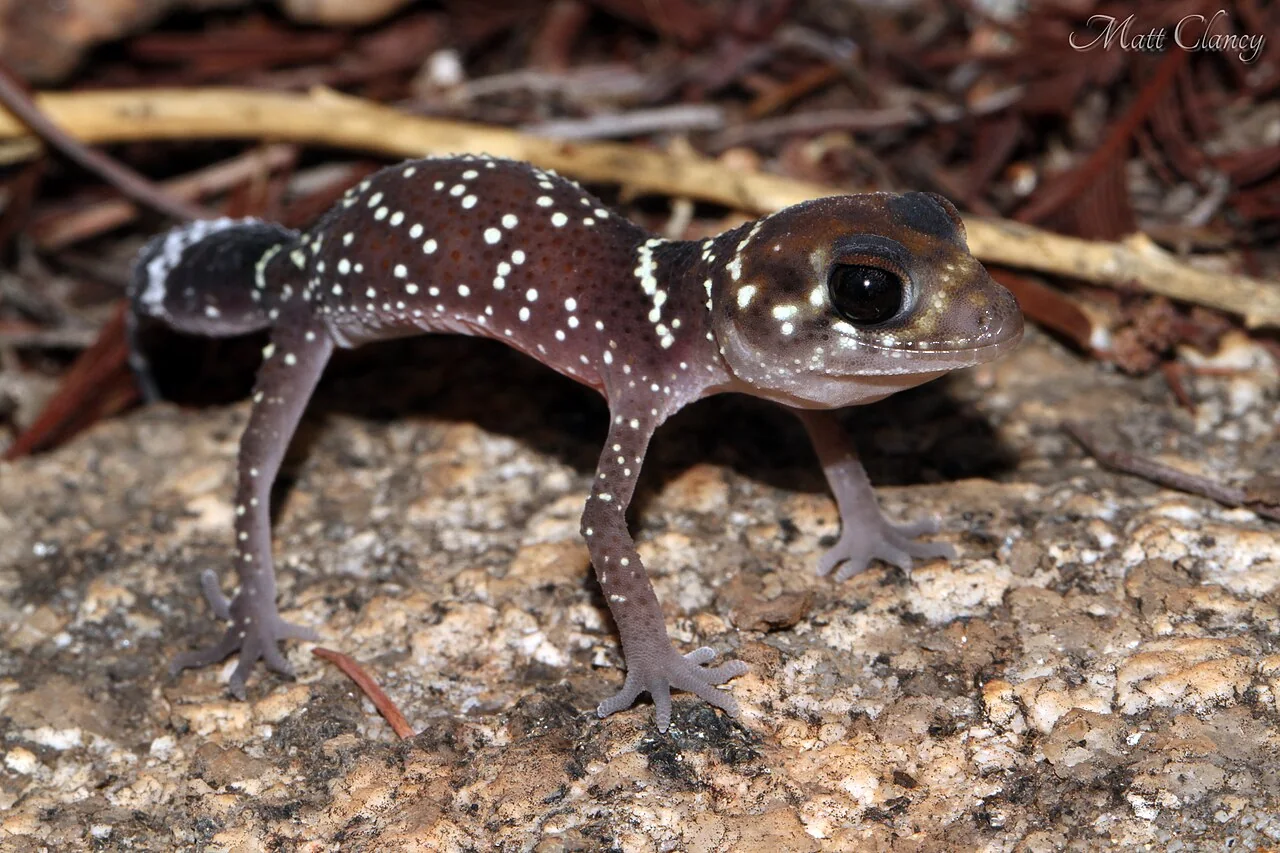
Nephrurus milii is a former combination of this name, now placed in Underwoodisaurus [1]. Settings for Nephrurus levis must therefore not automatically be applied to it. Museums Victoria describes brown to purplish coloration dotted with pale markings and a broad banded tail [2]. A regenerated tail may differ from the original pattern. Recording this feature avoids confusing regeneration, individual variation and a characteristic of a supposed locality.
Adult size, lifespan and lifestyle
Up to 10 cm from snout to vent according to Museums Victoria; the tail is not included in this measurement [2].
Monkfield states 8–10 years in captivity without providing an individual series; BGSU explicitly gives lifespan as unknown [3][4].
Nocturnal and terrestrial; aggregations are observed in natural daytime shelters [2].
Preparing ground that can be traversed
The university source BGSU proposes cork shelters, a shallow dish and a moist hide [4]. These elements can be arranged to offer several sheltered ground-level routes, without requiring a completely exposed crossing to drink. Stones must rest on a stable base. Testing removal of a hide and cleaning of the water container before adding the animal shows whether the decor will remain usable after several weeks, beyond its appearance at installation.
Heat: comparing specific setups
Monkfield publishes a basking point of 28–32 °C with cooler ambient conditions and a night-time drop [3]. The BGSU document describes another setup with higher heating [4]. These differences are not resolved by calculating an average. Surfaces, sensors and shelter positions must be specified. To prepare a project, choose a coherent protocol with a specialist and then check the temperatures actually available, instead of assembling extremes from several profiles.
Moist refuge and critical reading
The Monkfield PDF contains two contradictory humidity ranges; displaying only the one that seems more convenient would be misleading [3]. The practical need for a moist refuge, however, is explicit in the university profile [4]. Checking its condition directly complements ambient measurement. Retained shed is not treated by increasing humidity throughout the enclosure without limit: access to the refuge, temperature, hydration and the animal’s condition must be examined with appropriate advice.
Prey and supplementation
The museum describes nocturnal insect hunting [2]. The captive protocols consulted use several farmed insects and supplements [3][4]. Recording products and prey consumed allows intake to be checked without inventing a dose from the gecko’s weight alone. Offering food where capture can be observed also helps distinguish food refusal from prey disappearing beneath the decor. Food size must remain appropriate for the individual, not simply for the label on the batch purchased.
Natural aggregations and cohabitation
Individuals sometimes share a refuge in the field [2]. This observation does not demonstrate that a confined group remains compatible throughout the year. In a terrarium, the ability to move away is limited and access to a shelter can be monopolised without visible fighting. Individual housing simplifies attribution of meals and droppings. If an experienced keeper studies a group, results must be monitored for each animal and separation must be possible immediately.
Clutches and development
Museums Victoria reports clutches of two eggs. In its captive protocol, BGSU describes hatching at around 60 days at 28 °C [2][4]. This duration depends on conditions and alone does not establish an egg’s viability. Reproductive cooling described in older profiles is not prescribed here. Providing a laying area and separate housing for juveniles remains necessary before any attempt, with reliable parent identification and monitoring of the female.
Useful monitoring and missing data
A monitoring sheet can connect nocturnal emergence, the chosen shelter, sheds and meals. The defensive call must be interpreted in the context of disturbance, not as a trait to seek out. The sources differ on several parameters and provide no controlled longevity register. Keeping these uncertainties visible helps ask the right questions of the previous keeper or veterinarian. The aim is to document an actual animal, without passing off an isolated husbandry habit as a biological rule.
Checklist
- Keep the scientific name and documented origin.
- Check access to shelters, water and food.
- Measure the gradient before placing the animal in the setup.
Observations to record
- Meals
- Weight
- Sheds
- Temperature
- Humidity
- Behaviour
The app provides individual animal records. Check which features are available for your animal in the released version.
Related guides
Original guides in French
Sources
Document-based overview; not a substitute for veterinary advice.
- The Reptile Database — Underwoodisaurus milii
Source accessed - Museums Victoria — Thick-tailed Gecko
Source accessed - Monkfield Reptile — Barking Gecko Care Sheet 2022
Source accessed - BGSU Herpetarium — Thick-tailed Barking Gecko
Source accessed