
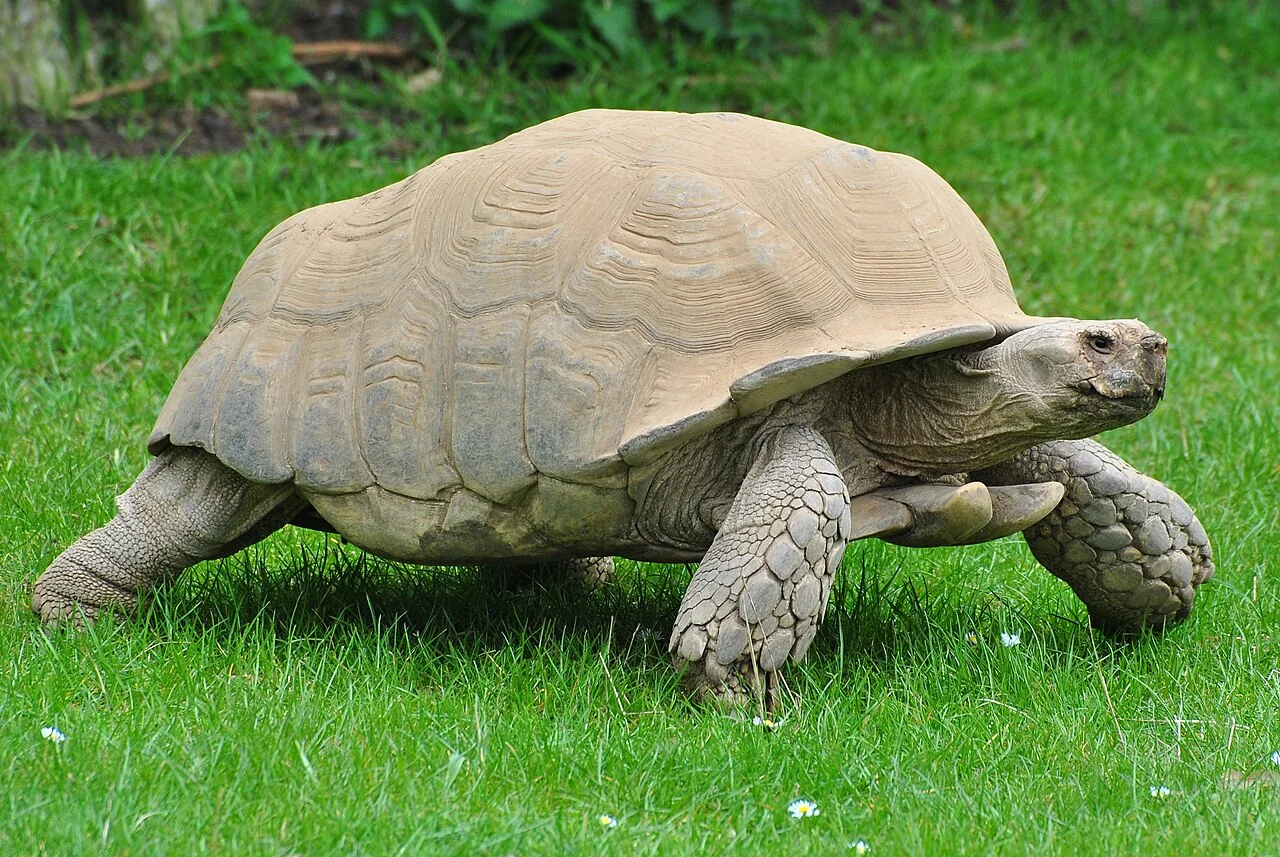
Scientific name
Centrochelys sulcata
Centrochelys sulcata is the current name; Geochelone sulcata persists in older publications. [1]
Origin
The African Sahel, the transition between the Sahara and wetter regions. [2]
- Large tortoise
- Burrower
- No hibernation
At a glance
| ADULT SIZE | Up to ≈ 76 cm Up to around 76 cm in length according to Oakland Zoo; some males greatly exceed average body size. [2] |
|---|---|
| LIFESPAN | ≈ 80 years Around 80 years in captivity according to Oakland Zoo’s estimate; this is not an established maximum record. [2] |
| LIFESTYLE | Burrower It digs burrows and avoids thermal extremes; activity is often crepuscular. [2] |
Adult size
Up to around 76 cm in length according to Oakland Zoo; some males greatly exceed average body size. [2]
Adult weight
Large males can exceed 100 kg; this described maximum is not a target weight. [6] Scope: a maximum described in males, not an individual health reference.
Lifespan
Around 80 years in captivity according to Oakland Zoo’s estimate; this is not an established maximum record. [2]
Lifestyle
It digs burrows and avoids thermal extremes; activity is often crepuscular. [2]
Housing
PLAN FOR A LARGE ADULT
Large, robust enclosure — Plan a large, robust enclosure and a heated solution for the colder season. The Aurora care sheet stresses adults’ strength and space requirements. [3]
Plan a large, robust enclosure and a heated solution for the colder season. The Aurora care sheet stresses adults’ strength and space requirements. [3]
Care parameters
WARM SPOT · DAY
35–40 °C — 35–40 °C in the 2016 RVC care sheet. [4] General reference, not a separate hatchling protocol; measure at the occupied site.
COOL AREA · DAY
25 °C — 25 °C in the same care sheet. [4] Heating must not remove every opportunity to retreat.
NIGHT
At least 20 °C — At least 20 °C in the RVC care sheet. [4] Check the actual minimum; plan specifically for the age and enclosure.
Humidity
Plan requires clarification — The care sheet calls for a suitable humidity plan, particularly for young animals. Dry origins do not remove the need for water or shelters [3][4].
Daytime warm spot
35–40 °C in the 2016 RVC care sheet. [4] General reference, not a separate hatchling protocol; measure at the occupied site.
Daytime cool area
25 °C in the same care sheet. [4] Heating must not remove every opportunity to retreat.
Night
At least 20 °C in the RVC care sheet. [4] Check the actual minimum; plan specifically for the age and enclosure.
Feeding
GRASSES AND HAY
Aurora places grasses and hay at the centre of a fibrous diet. Growth must not be pursued with rich foods intended for other animals. [3]
Feeding
Aurora places grasses and hay at the centre of a fibrous diet. Growth must not be pursued with rich foods intended for other animals. [3]
Behaviour and precautions
This species does not hibernate. Its dry origin does not remove the need for water, shelters or a suitable humidity plan, particularly for young animals. [3][4]
Useful records
Record weight, growth, foods eaten and winter temperatures. Also plan doorway access and the ability to move a large animal. Values from the older source are identified as such; juvenile humidity still needs clarification before their arrival.
Distinguishing fibrous plants from rich foods
The clinical reference places grasses and fibrous plants at the centre of the diet. It excludes dog or cat foods, dairy products and sugary foods as dietary staples. Fruit must not replace fibrous plants. [5]
The log can distinguish the categories offered and the weight observed, without assuming that a shell abnormality alone identifies a nutritional cause. Supplements must be coordinated with the rest of the ration and the lighting. [5]
Adult weight: read the context
Large males can exceed 100 kg; this described maximum is not a target weight. [6] Scope: a maximum described in males, not an individual health reference.
Individual monitoring must take age, sex and body condition into account; a published maximum does not provide an ideal weight.
Checklist
- Size the enclosure for the adult.
- Prepare heated winter accommodation.
- Check the strength of the boundaries.
Observations to record
- Growth
- Weight
- Feeding
- Temperatures
The app provides individual animal records. Check which features are available for your animal in the released version.
Related guides
Original guides in French
Sources
Document-based overview; not a substitute for veterinary advice.
- The Reptile Database — Centrochelys sulcata
Source accessed - Oakland Zoo — African spurred tortoise
Source accessed - Dayna Willems, DVM, Aurora Animal Hospital — Sulcata tortoise care
Source accessed - Royal Veterinary College — Sulcata tortoise care, document 2016
Source accessed - Chicago Exotics — Diet for Sulcata Tortoises
Source accessed - Centrochelys sulcata — Chelonian Research Monographs 5, account 110
Source accessed