
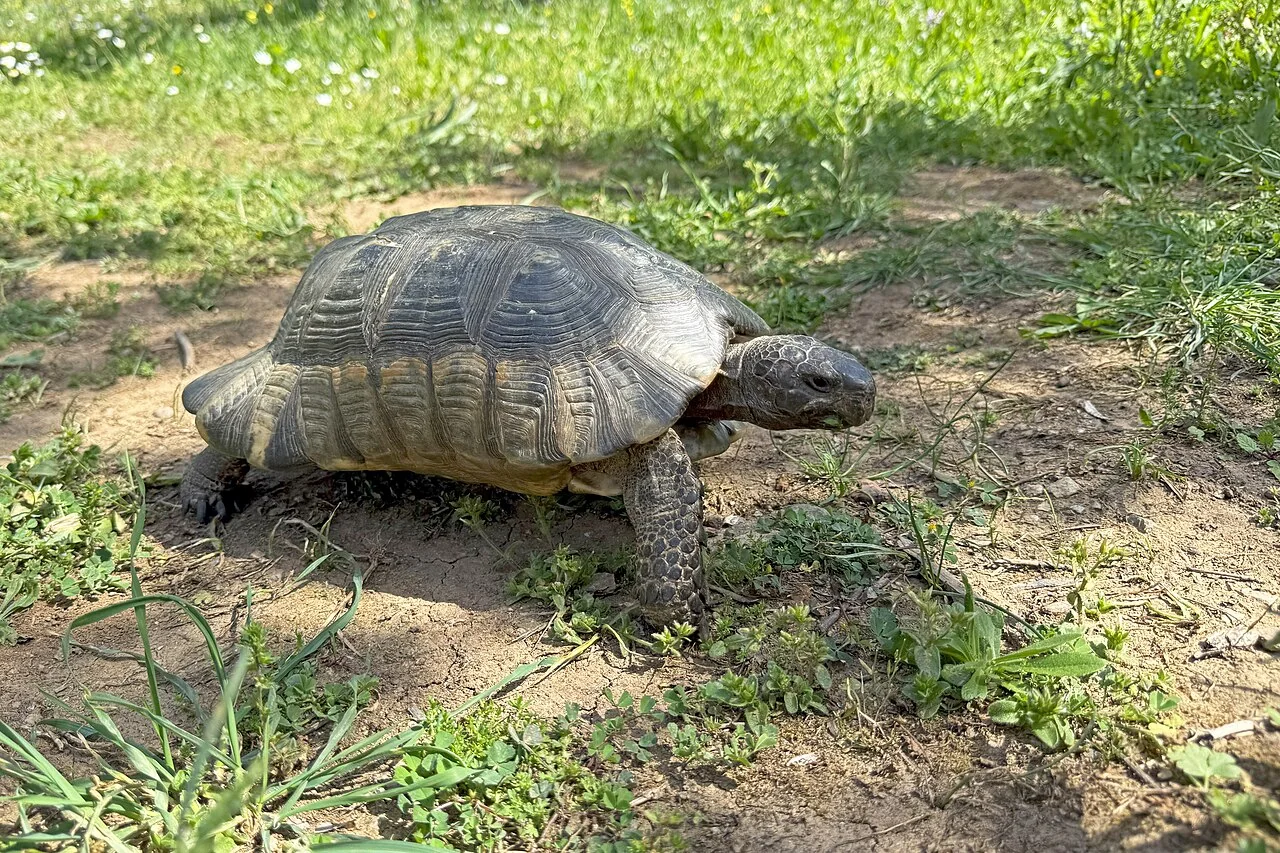
Scientific name
Testudo marginata
Testudo marginata is a Mediterranean tortoise distinct from Hermann’s tortoise; flared rear scutes characterise large adults. [1][2]
Origin
Greece and Albania; introduced populations in Italy. [1][2]
- Mediterranean
- Herbivorous
- Outdoors
At a glance
| ADULT SIZE | Up to 35 cm Limit stated by Gdansk Zoo. [2] |
|---|---|
| LIFESPAN | 21 years: average Context not specified by the zoo; this is not a maximum. [2] |
| LIFESTYLE | Diurnal Mainly emerges in the morning and late afternoon. [2] |
Adult size
Up to 35 cm according to Gdansk Zoo; this value is a limit in its profile, not an adult average. [2]
Lifespan
Gdansk Zoo gives an average of 21 years without specifying context; this figure is not a biological ceiling. [2]
Lifestyle
Diurnal, mainly in the morning and late afternoon; seeks shade in intense heat. [2]
Housing
A MEDITERRANEAN ENCLOSURE
Ideal: ≥ 10 m² — Per tortoise according to San Pio: shade, fencing and a well-drained shelter. Outdoor reference to be adapted to climate. [3]
San Pio clinic ideally recommends at least 10 m² per tortoise outdoors, with secure fencing, shade and a raised insulated shelter. Adapt this Italian proposal to the local climate. [3]
Care parameters
DAY · INDOORS
24–27 °C — Temporary active husbandry according to the clinic. [3]
WARM SPOT
≈ 32 °C — Reference distinct from ambient temperature. [3]
NIGHT · ACTIVE
≈ 18 °C — Does not correspond to hibernation. [3]
Humidity
Well-drained shelter — No validated percentage in the selected sources. Protect the shelter from rain. [3]
Temporary indoor husbandry
24–27 °C by day; warm spot ≈ 32 °C. [3] Clinic references for monitoring or keeping warm, not a uniform enclosure temperature.
Night during active husbandry
≈ 18 °C. [3] Do not confuse with winter rest.
Humidity
No husbandry percentage established by the selected sources. Rain-protected shelter and well-drained ground, with accessible water. [3]
Feeding
HERBACEOUS PLANTS AND GRASSES
The zoo describes a plant-based diet high in fibre and low in protein. [2]
Feeding
Herbaceous plants, grasses and fibre-rich shoots make up the diet described by the zoo. [2]
Seasons and cohabitation
Hibernation requires preparation suited to health status. The clinic also reports injuries linked to chasing and mating; space alone does not guarantee peaceful cohabitation. [3]
Useful records
Record temperatures in the shelter and shade, outings, food intake and weight. Keep an overview of the enclosure after each rearrangement. A species profile alone does not determine whether an individual can hibernate: have the decision and setup clarified before cold weather arrives.
Adapting the ground to life stage
For young animals, the breeder describes substrate deep enough for burrowing, with moisture retained in shelters rather than entirely dried-out ground. A shallow dish completes the setup. These juvenile observations do not set a uniform humidity for an adult enclosure. [4]
For outdoor housing, the care sheet favours well-draining ground, sunny areas and shaded retreats. Documenting life stage and enclosure makes the log’s measurements interpretable. [4]
Dietary supplements: distinguish the situations
Chris Leone describes freely available cuttlebone and occasional use of phosphorus-free calcium. [4]
Scope: Chris Leone’s breeding practice for Testudo marginata. Consider diet composition and the enclosure; no universal dosage is set by this synthesis.
Checklist
- Check fencing and predator protection.
- Check shelter drainage.
- Prepare seasonal monitoring.
Observations to record
- Weight
- Activity
- Feeding
- Seasons
The app provides individual animal records. Check which features are available for your animal in the released version.
Related guides
Original guides in French
Sources
Document-based overview; not a substitute for veterinary advice.
- The Reptile Database — Testudo marginata
Source accessed - Zoo de Gdansk — Marginated tortoise
Source accessed - Clinica Veterinaria San Pio — Testudo marginata
Source accessed - Marginated Tortoise Care Guide
Source accessed