
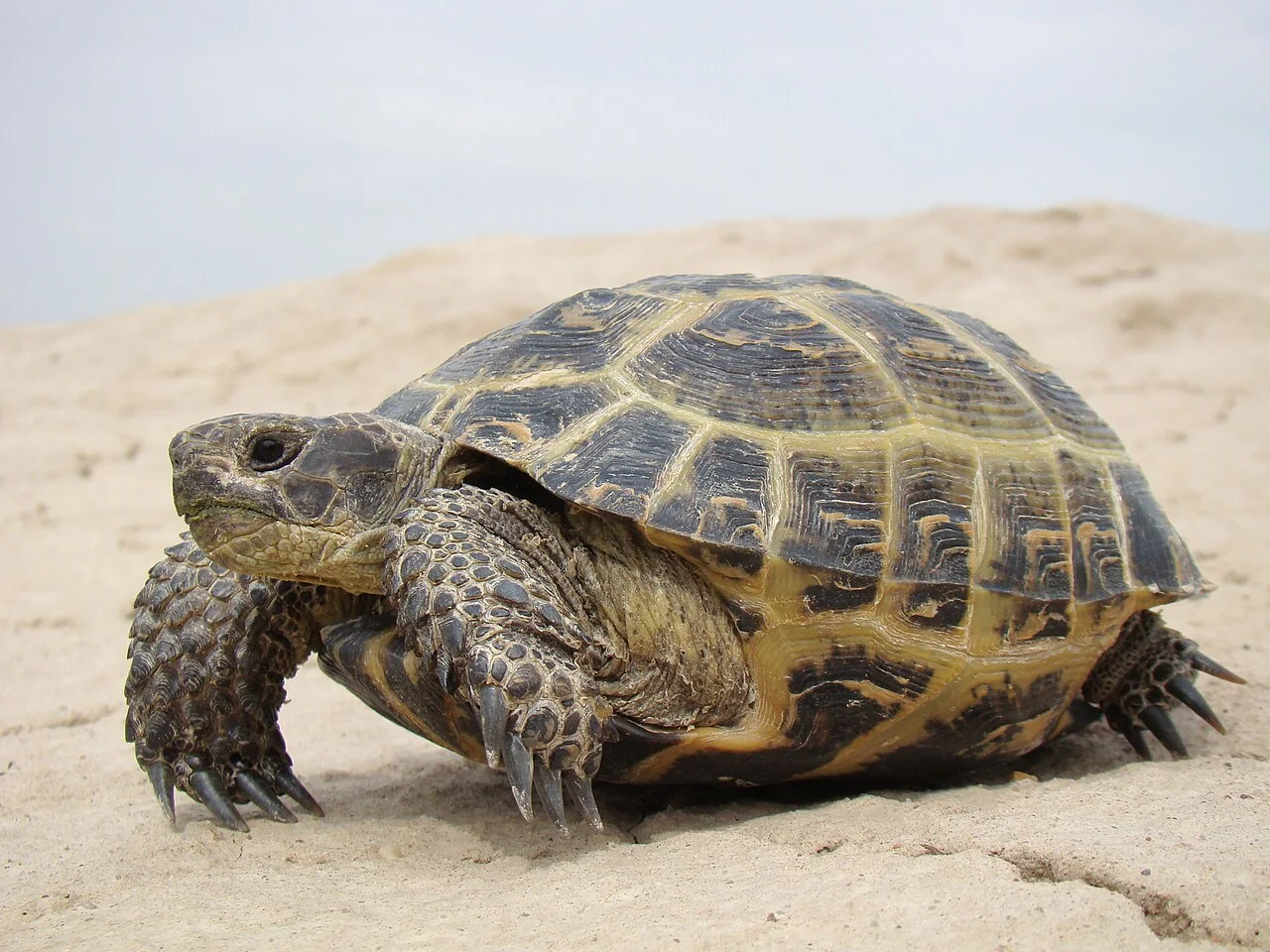
Scientific name
Testudo horsfieldii
Other names: Agrionemys horsfieldii
Testudo horsfieldii is a terrestrial tortoise in the Testudinidae family. Agrionemys horsfieldii is a former combination still common in veterinary and commercial guidance; it refers here to the same species. [1]
Origin
Central Asia and neighbouring regions: southern Kazakhstan, Kyrgyzstan, Tajikistan, Turkmenistan, Uzbekistan, Iran, Afghanistan, northern Pakistan and northwestern China. [1]
- Burrower
- Herbivorous
- Central Asia
At a glance
Central Asia and neighbouring regions. [1] Terrestrial and burrowing: shelters and opportunities to dig are necessary. [2]
| ADULT SIZE | ≈ 15–25 cm Adult: around 15–25 cm according to Ness Exotic; length convention not specified. [2] |
|---|---|
| LIFESPAN | More than 40 years More than 40 years in the Ness Exotic captive care sheet. [2] |
| LIFESTYLE | Terrestrial and burrowing Terrestrial and burrowing, it uses different shelters. [2] |
Adult size
Around 15–25 cm in adults: a conversion of the 6–10 inches given by Ness Exotic, with no measurement convention specified. [2]
Adult weight
No sufficiently contextualised adult range is given in the selected sources. Use an individual trend linked to shell length and body-condition assessment, without inventing an ideal weight.
Lifespan
More than 40 years are possible according to the Ness Exotic care sheet; this is not a guaranteed lifespan. [2]
Lifestyle
Terrestrial and burrowing: shelters and opportunities to dig are part of its habitat. [2]
Experienced keeper
Editorial assessment: burrowing, humidity control, UVB and the cold season require a prepared enclosure. [2][3]
Housing
SPACE TO DIG
180 × 120 cm indoors — Shared RSPCA reference; 10 m² outdoors. Ness cites a smaller adult minimum, explained in the profile. [2][3]
Ness Exotic cites at least 122 × 91 cm for an adult. The RSPCA suggests larger dimensions in its shared care sheet: 180 × 120 cm indoors and 10 m² outdoors. Prioritise available space rather than the smallest published minimum. [2][3]
Care parameters
WARM SPOT · DAY
≈ 35–38 °C — Around 35–38 °C. [2] Conversion of 95–100 °F; measure at the exposure site.
AMBIENT · DAY
≈ 21–27 °C — Around 21–27 °C. [2] Conversion of 70–80 °F, away from the warm spot.
NIGHT · ACTIVE HUSBANDRY
≈ 21–24 °C — Around 21–24 °C in this care sheet. [2] This clinical reference is not a hibernation temperature.
Humidity
40–50 % — Chicago Exotics ambient conditions; a more humid soil shelter, around 70 %. [4]
Warm spot · day
≈ 35–38 °C [2] Conversion of 95–100 °F; a localised, regulated area.
Ambient conditions · day
≈ 21–27 °C [2] Conversion of 70–80 °F, away from the warm spot.
Night · active husbandry
≈ 21–24 °C [2] Ness reference, distinct from brumation; other, cooler protocols exist.
Ambient humidity
40–50 % [4] Chicago Exotics reference, with a more humid burrowing shelter.
UVB
Essential for indoor husbandry [2] Effective exposure without intervening glass, and an opportunity for shade.
Feeding
LEAVES AND GRASSES
The diet is based on leaves and grasses; the clinic advises against fruit. Keep clean water available. [2]
Habitat by age
The Ness minimum explicitly concerns an adult; no juvenile size table by length is provided. For a young animal, maintain easy access to resources and daily monitoring without removing the thermal gradient. The enclosure must grow with the animal. [2]
Provide an area of additive-free soil for digging and shelters at both ends. The burrowing container suggested by Ness measures at least two tortoise lengths on each side. Secure the walls and underside: a small tortoise can also climb and escape. [2][3]
Substrate, water and microclimates
Chicago Exotics distinguishes ambient humidity of 40–50 % from a soil shelter at around 70 %. Measure these places separately: a humid shelter does not mean a cold, saturated habitat. The soil must remain clean and not muddy. [4]
A stable, shallow water dish allows drinking and bathing, with an easy exit. Clean it as soon as it is soiled; neither arid origins nor burrowing removes the need for available water. [4]
Feeding and frequency
Vary identified edible grasses, leaves and flowers: plantain, dandelion and endive can be part of a varied menu. Exclude fruit according to Ness’s specific recommendation; do not transfer the red-footed tortoise’s menu to this species. [2]
Young animals are fed daily. The RSPCA states every other day for the other tortoises in its guidance, whereas Chicago describes daily grazing; adapt feeding to the plants accessible, growth and body condition, rather than using the same ration all year. [3][4] Combine calcium, vitamins and UVB in a coherent plan, without adding together dosages from different care sheets. [2]
Cohabitation and handling
Individual housing avoids competition for food and harassment. In a group, watch for injuries, chasing and each animal’s access to warmth; provide for immediate separation if needed. [3] For weighing or transfer, support the whole tortoise close to a stable surface; avoid holding a leg or allowing falls. [2]
Reproduction and the seasonal cycle
This tortoise lays eggs. Rest periods and reproduction are not triggered by a date in an app. The species and individual must be identified before preparing a seasonal cycle. [1][3]
Hibernation requires an assessment of health and the available conditions; a tortoise kept active in winter continues to need appropriate heating, feeding and monitoring. No fasting, cooling or incubation programme is provided here. [3]
Warning signs and records
Abnormal breathing, discharge, lethargy or persistent appetite loss require advice from an exotic-animal veterinarian. [2] Record weight, shell measurements, droppings, food intake and readings at shelter level. Weight loss should be interpreted alongside these observations and seasonal history; it is not automatically corrected by increasing supplements.
Checklist
- Install a proper burrowing area and two shelters.
- Separate ambient measurements from those of the humid shelter.
- Prepare active husbandry or the seasonal plan with a professional.
Observations to record
- Weight and shell
- Meals eaten
- Burrowing and activity
- Day/night temperatures
- Microclimate humidity
The app provides individual animal records. Check which features are available for your animal in the released version.
Related guides
Original guides in French
Sources
Document-based overview; not a substitute for veterinary advice.
- The Reptile Database — Testudo horsfieldii
Source accessed - Ness Exotic Wellness Center — Russian Tortoise Care
Source accessed - RSPCA — Spur-thighed, Hermann’s, marginated and Horsfield’s tortoises
Source accessed - Chicago Exotics Animal Hospital — Russian Tortoise Care
Source accessed