
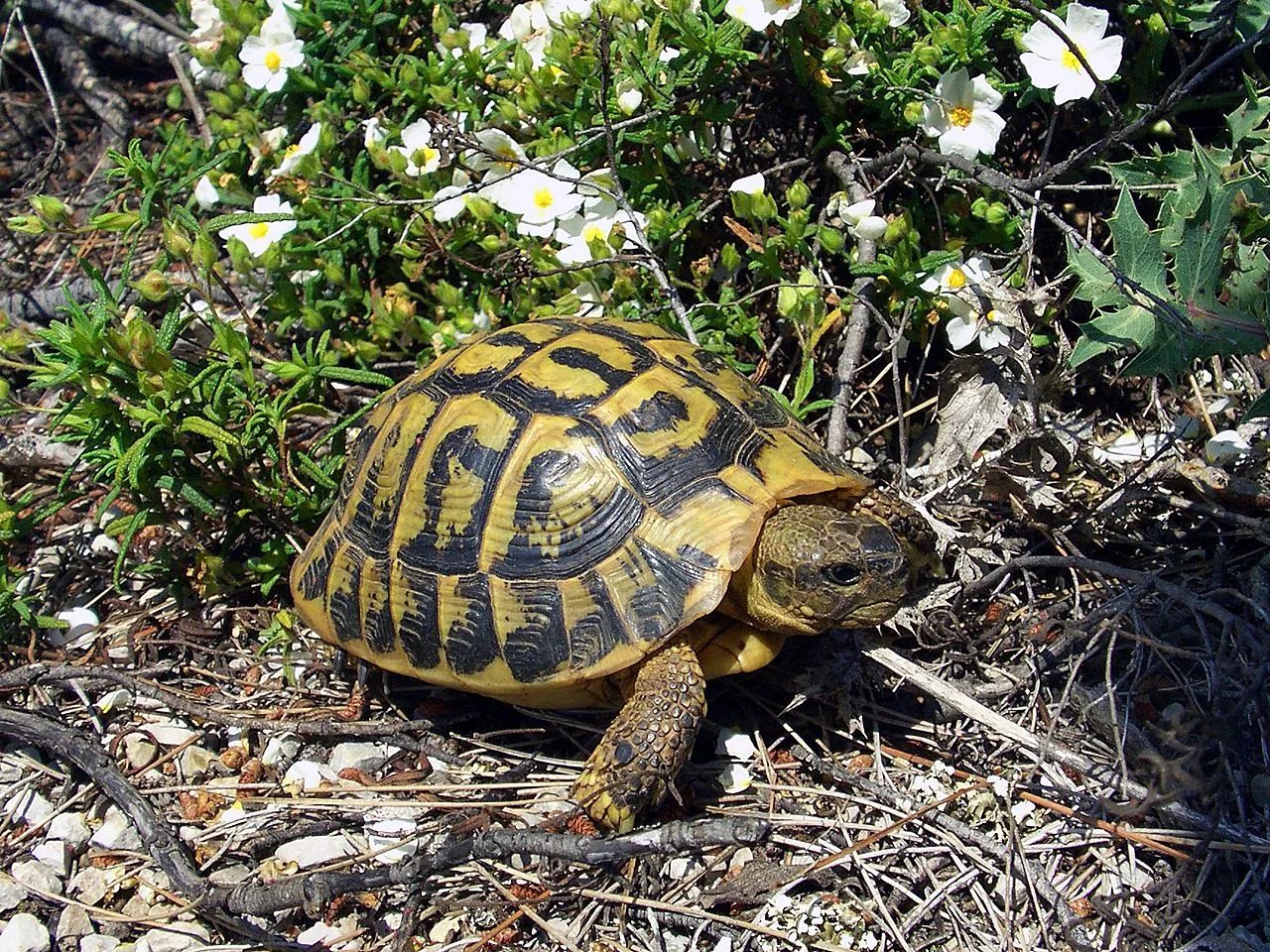
Scientific name
Testudo hermanni
Other names: Eurotestudo hermanni · Chersine hermanni
Testudo hermanni belongs to the Testudinidae. The Reptile Database distinguishes T. h. hermanni and T. h. boettgeri; Eurotestudo hermanni and Chersine hermanni are taxonomic combinations found in the literature, not additional species. [1]
Origin
Mediterranean Europe, with western and Balkan populations. It uses a mosaic of low vegetation, bushes and wooded areas rather than a uniformly dry, bare environment. [2][4]
- Terrestrial
- Herbivorous
- Seasonality
At a glance
Mediterranean Europe. Terrestrial and diurnal, in a mosaic of low vegetation, bushes and woodland. [2][4]
| ADULT SIZE | Usually 13–20 cm Adults usually 13–20 cm according to LafeberVet; size varies with sex and population, and the exact measurement convention is not specified. [2] |
|---|---|
| LIFESPAN | Several decades 70–100 years: Oakland Zoo estimate, not an individual guarantee. [4] |
| LIFESTYLE | Terrestrial It inhabits Mediterranean environments combining herbaceous vegetation, bushes and wooded areas. [2] |
Adult size
Usually 13–20 cm according to LafeberVet; sex and population influence size. The care sheet does not specify its measurement convention. [2]
Adult weight
No universal target weight: Oakland Zoo reports 2–2,5 kg in its general presentation, without a breakdown by sex or population. This figure alone cannot assess the condition of a small Hermann’s tortoise. [4]
Lifespan
Several decades; Oakland Zoo publishes an estimate of 70–100 years, which is neither a demonstrated average nor an individual guarantee. [4]
Lifestyle
Terrestrial and diurnal, with seasonal changes in activity. [4]
Experienced keeper
Editorial assessment: outdoor space, UVB, growth and the cold season must be planned together. [2][3]
Housing
WALKING AND TAKING SHELTER
A secure enclosure — RSPCA references: 180 × 120 cm indoors, 10 m² outdoors for one individual; shared guidance. [3]
The RSPCA cites 180 × 120 cm indoors and 10 m² outdoors for one individual, in guidance shared by four tortoises. These are attributed reference points, not dimensions validated for every life stage. [3]
Care parameters
WARM SPOT · DAY
32–35 °C — Localised area according to LafeberVet. [2]
COOL AREA · DAY
20–25 °C — RVC reference for active husbandry. [5]
NIGHT · ACTIVE HUSBANDRY
≥ 18–20 °C — RVC reference; this is not a hibernation temperature. [5]
Humidity
40–75 % — General LafeberVet range; microclimates and age need consideration. [2][6]
Warm spot · day
32–35 °C [2] A localised, accessible area with an opportunity to retreat.
Cool zone · day
20–25 °C [5] RVC reference for active husbandry; measure at the animal’s height.
Night · active husbandry
18–20 °C minimum [5] RVC reference, distinct from any winter programme.
Humidity
40–75 %: LafeberVet range [2] General range not separated by age; maintain microclimates.
UVB
Suitable exposure and shade [5] Check installation, distance and output according to the lamp.
Feeding
HERBIVOROUS IN CAPTIVITY
Despite occasional observations of animal matter being eaten in the wild, LafeberVet recommends a strictly herbivorous captive diet. Offer a variety of suitable plants rather than pursuing rapid growth. [2]
Habitat by age
A juvenile needs stronger protection from predators and an environment that can be measured. The selected documentation does not provide a table of dimensions by age: do not automatically scale down adult reference dimensions in proportion to length. [3]
For an adult, arrange walking routes, shelters and sunny or shaded areas; also prevent escape by digging. An outdoor enclosure must remain well drained. Sunlight through glass does not replace suitable UVB exposure. [3][5]
Water, substrate and humidity
Clean natural soil that allows burrowing and shelters with different humidity levels are preferable to an entirely dry, sterile surface. LafeberVet notes that young animals may need greater humidity and suggests a humid shelter; this does not mean soaking the whole enclosure. [6]
Provide clean water in a shallow container that is easy to leave. Remove soiling and replace the water; providing a bath does not remove the need to check the environment. [5]
Feeding and frequency
The captive diet is herbivorous: suitable leafy plants, grasses and identified flowers, free from pesticides. LafeberVet does not recommend reproducing the rare consumption of animal matter observed in the wild. [2]
The RSPCA suggests daily meals for juveniles and every other day for others. This rhythm needs adjustment alongside monitoring of growth, season and access to plants in the enclosure. [3] Calcium and vitamin/mineral supplements should be considered together with the ration and UVB; avoid stacking several products without a plan. [5]
Cohabitation and handling
Living alone makes monitoring easier. The RSPCA describes biting, ramming and exclusion from food in groups; keeping several tortoises therefore requires space and the option to separate them. [3] To move the animal, support its body from underneath, stay close to the ground and wash your hands after handling. [6]
Reproduction and the cold season
The species lays buried eggs and has seasonal reproductive activity. The dates described by Oakland Zoo relate to a natural context, not a schedule to trigger in every enclosure in France. [4]
Reduced activity does not justify starting improvised hibernation. Body and health condition, origin and husbandry conditions must be assessed before a decision; this profile prescribes neither cooling nor incubation. [2][3]
Warning signs and records
Nasal discharge, noisy breathing, weakness, persistent appetite loss or an abnormally soft shell warrant advice from an exotic-animal veterinarian. [2][3] In SquamaTracker, keep comparable weights, shell measurements, food eaten, activity and enclosure readings: changes over time help describe a change, without establishing a diagnosis.
Checklist
- Check shelters, shade and outdoor protection.
- Measure both zones and the overnight minimum.
- Prepare growth records and the seasonal plan.
Observations to record
- Weight and shell length
- Plants eaten
- Droppings and activity
- Temperatures and humidity
- UVB and seasonal monitoring
The app provides individual animal records. Check which features are available for your animal in the released version.
Related guides
Related guides
Original guides in French
Sources
Document-based overview; not a substitute for veterinary advice.
- The Reptile Database — Testudo hermanni
Source accessed - LafeberVet — Basic Information Sheet: Hermann’s Tortoise (2015)
Source accessed - RSPCA — Spur-thighed, Hermann’s, marginated and Horsfield’s tortoises
Source accessed - Oakland Zoo — Hermann’s Tortoise
Source accessed - Royal Veterinary College — Mediterranean tortoise care and advice (décembre 2022)
Source accessed - LafeberVet — Basic Information Sheet: Mediterranean Tortoises
Source accessed