
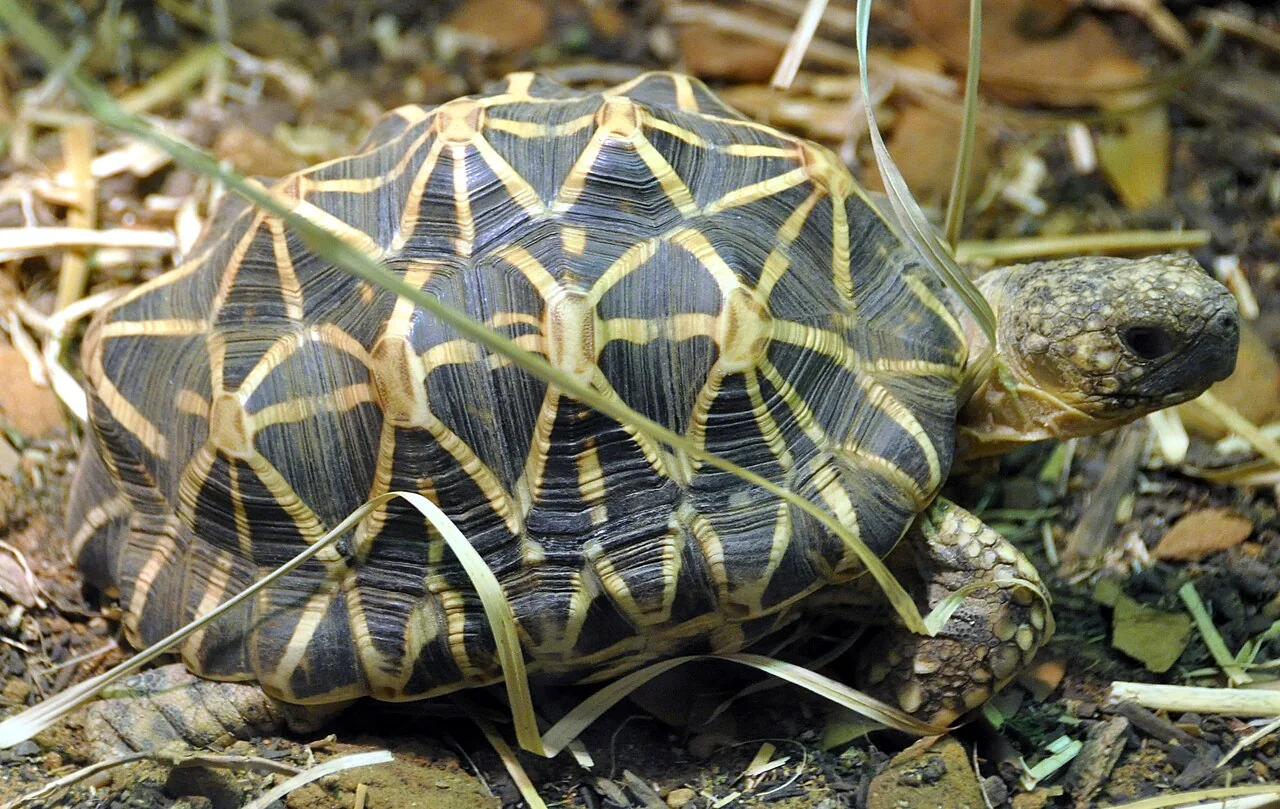
Scientific name
Geochelone elegans
Geochelone elegans is the species from the Indian subcontinent. The Burmese star tortoise belongs to a different species. [1][2]
Origin
India, southeastern Pakistan and Sri Lanka. [1][3]
- Herbivorous
- Seasonal climate
- No hibernation
At a glance
| ADULT SIZE | 15–30 cm Males 15–20 cm; females 25–30 cm of shell, usually. [3] |
|---|---|
| LIFESPAN | 30–80 years Dublin Zoo estimate; wild and captive settings not distinguished. [2] |
| LIFESTYLE | Terrestrial Activity mainly at cooler times during the dry season. [3] |
Adult size
Shell usually 15–20 cm in males, 25–30 cm in females; female record of 38 cm cited by Animal Diversity Web. [3]
Lifespan
Dublin Zoo states 30–80 years without separating wild and captive settings; this broad estimate does not predict an individual’s lifespan. [2]
Lifestyle
Terrestrial; morning and late-day activity during dry periods. [3]
Housing
A WELL-VENTILATED ENCLOSURE
Warm and cool shelters — Open enclosure, large floor area and daily UVB; no hibernation. [4]
The RVC recommends an open, ventilated enclosure, with warm and cool shelters, a large floor area and daily UVB. Do not hibernate this tortoise. [4]
Care parameters
HEATING SPOT
≈ 32 °C — Reference from the 2022 RVC care sheet. [4]
COOL AREA
≈ 25 °C — Measure independently from the warm spot. [4]
NIGHT
≥ 20 °C — RVC documentary minimum. [4]
Humidity
Low to moderate — The RVC gives no percentage; have husbandry clarified according to age and enclosure. [4]
Heating spot
≈ 32 °C. [4] RVC care sheet revised in December 2022; it replaces the older, higher 2017 reference here.
Cool zone and night
≈ 25 °C at the cool end; night ≥ 20 °C. [4] Thermostatically controlled heating, checked with an independent thermometer.
Humidity
Low to moderate, without a percentage provided. [4] Natural habitats are seasonal; a single annual value does not describe every microhabitat. [3]
Feeding
A PLANT-BASED FOUNDATION
Grasses, leaves and flowers characterise its natural diet. Adapt a captive ration with a professional. [2][3]
Feeding
The species mostly eats plants: grasses, leaves, flowers and fruits feature in its natural diet. Mentions of insects or carrion do not constitute a captive menu. [2][3]
Understanding its climate
Populations occupy environments ranging from forests to semi-arid grasslands, sometimes subject to monsoons. Their seasonality must not be used as a reason to improvise cooling in captivity. [3][4]
Useful records
Keep documented origin, enclosure dimensions and probe positions. Monitor weight, appetite and activity periods at regular intervals. Sizes differ by sex and population: first compare the animal with its own records, then discuss deviations with a competent veterinarian.
Checklist
- Check warm and cool shelters.
- Record overnight minimums.
- Keep provenance documents.
Observations to record
- Weight
- Appetite
- Shell
- Temperatures
The app provides individual animal records. Check which features are available for your animal in the released version.
Related guides
Original guides in French
Sources
Document-based overview; not a substitute for veterinary advice.
- The Reptile Database — Geochelone elegans
Source accessed - Dublin Zoo — Indian star tortoise
Source accessed - University of Michigan — Animal Diversity Web : Geochelone elegans
Source accessed - Royal Veterinary College — Indian star tortoise care, révision décembre 2022
Source accessed