
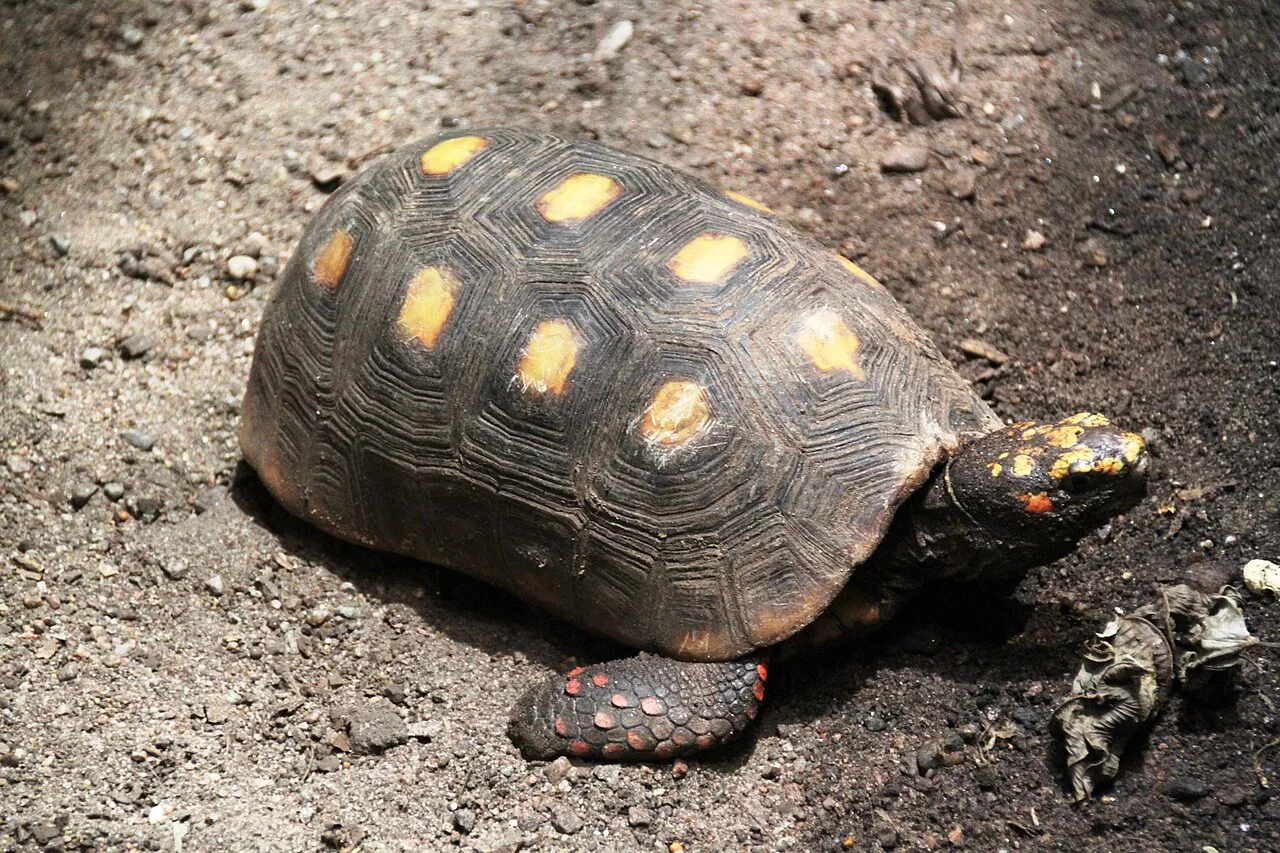
Scientific name
Chelonoidis carbonarius
Other names: Chelonoidis carbonaria · Geochelone carbonaria
Chelonoidis carbonarius belongs to the Testudinidae. The names Chelonoidis carbonaria and Geochelone carbonaria remain visible in older documents; the ending carbonarius is used by the taxonomic reference consulted. [1]
Origin
Tropical and subtropical South America, with a broad distribution and island occurrences, some of them introduced. It inhabits forests, savannas and transitions between open and wooded environments. [1][2]
- Tropical
- Terrestrial
- No hibernation
At a glance
South America, across forests, savannas and transitional environments. [1][2] Terrestrial, it uses shelters and does not hibernate. [2][4]
| ADULT SIZE | Male: up to 34 cm The Smithsonian states up to 34 cm in males and an average of 28,5 cm in females; measurement method not specified. [2] |
|---|---|
| LIFESPAN | 50 years or more 50 years or more according to the Smithsonian; wild/captive context is not separated on the page. [2] |
| LIFESTYLE | Terrestrial It inhabits dry or wet forests, grasslands and savannas, depending on the region. [2] |
Adult size
The Smithsonian reports up to 34 cm in males and an average of 28,5 cm in females, without specifying the measurement method; these are not universal limits. [2]
Adult weight
Up to 9 kg for some adult males according to the Smithsonian. This is a published maximum, not an expected weight or feeding target. [2]
Lifespan
50 years or more according to the Smithsonian; the page does not consistently separate wild and captive settings. [2]
Lifestyle
Terrestrial, using shelters and protective vegetation. A non-hibernating species. [2][4]
Experienced keeper
Editorial assessment: large adult floor area, warmth and humidity all year, and a ration different from Testudo. [3][4]
Housing
GROWING WITH SPACE
244 × 122 cm outdoors — Exotic Pet Vets adult minimum, suitable climate; juvenile indoors: 91 × 61 cm. [4]
Exotic Pet Vets suggests at least 91 × 61 cm for a juvenile indoors and 244 × 122 cm for an adult outdoors; outdoor housing requires a suitable climate and a heated shelter if necessary. These dimensions alone do not validate the enclosure’s layout. [4]
Care parameters
AMBIENT · DAY
≈ 23–27 °C — Around 23–27 °C; warm spot 28–32 °C. [3] Conversions of Chicago Exotics references, without age separation.
WARM SPOT · DAY
≈ 28–32 °C — Around 23–27 °C; warm spot 28–32 °C. [3] Conversions of Chicago Exotics references, without age separation.
NIGHT
Minimum ≈ 21 °C — Around 21 °C minimum in this care sheet. [3] Measure the minimum; this is not a hibernation instruction.
Humidity
50–70 % + shelter — Chicago protocol. Another clinic suggests 70–90 %: differences are explained in the profile. [3][4]
Ambient conditions · day
≈ 23–27 °C [3] Chicago Exotics protocol; maintain a difference between zones.
Warm spot · day
≈ 28–32 °C [3] Same protocol, localised and controlled temperature.
Night
Minimum ≈ 21 °C [3] No hibernation; check the night shelter.
Humidity
50–70 % + a more humid shelter [3] Chicago protocol; other clinics recommend 70–90 %, see details.
UVB
UVB and access to shade [4] Measure effective exposure; glass can block UVB.
Feeding
A VARIED NATURAL MENU
The natural diet mainly comprises plants, but also small amounts of animal matter. The zoo uses a formulated ration and plant-based enrichment; this institutional menu is not a home recipe. [2]
Growing in a suitable habitat
The cited juvenile and adult dimensions have different contexts: a juvenile’s indoor enclosure must not become its permanent habitat. For adulthood, plan substantial walking space, access to several shelters and daily maintenance. [4]
Chicago Exotics cites an indoor minimum of around 122 × 122 cm for one individual, smaller than Exotic Pet Vets’ outdoor reference. Choose the largest feasible floor area and check the gradient rather than looking for a tank volume in litres. [3][4]
Humidity, water and substrate
Clinical guidance differs: Chicago gives 50–70 % and a more humid burrowing area; Exotic Pet Vets recommends 70–90 %. These ranges do not demonstrate the same optimum for every age. Have the protocol clarified for the actual origin, size and housing, especially for a juvenile. [3][4]
The ground must retain moisture without becoming muddy. Provide a wide, shallow dish that is easy to leave, and replace soiled water. A thermometer and hygrometer in the areas used are more useful than a single reading above the furnishings. [3][4]
Feeding and frequency
The diet is mainly plant-based, with varied leaves and flowers; the species also eats fruit and small quantities of animal matter. The natural diet does not justify protein-rich food every day. [2]
Exotic Pet Vets suggests offering plants daily without a separate schedule for each age. Adapt amounts, cutting size and supplements to the growing juvenile or adult; have calcium and vitamins clarified alongside the ration and UVB. Formulated foods are possible menu components, not proof of automatic balance. [4]
Cohabitation and handling
Males can fight and overturn a rival, a behaviour described by the Smithsonian. Cohabitation therefore requires real monitoring and spaces that can be separated; do not impose it to obtain reproduction. [2] For maintenance or weighing, prepare a stable surface and support the animal; its mass must be considered before every move.
Reproduction and the annual cycle
Females bury their eggs at a laying site. Development times depend on conditions; the biology reported by the zoo is not a home incubation recipe. [2]
This species must not receive the hibernation programme of a Hermann’s or Horsfield’s tortoise. A winter drop in appetite can accompany cooler conditions, but must not automatically be considered normal. [4]
Warning signs and records
Loss of appetite, lethargy, nasal discharge, breathing difficulties, swollen eyes or impaired movement require consultation with an exotic-animal veterinarian. [4] Record weights, shell length, foods actually eaten, droppings and parameters. Distinguish air measurements from shelter measurements to make the records useful.
Checklist
- Plan adult floor area and year-round heating.
- Measure humidity and temperature in the shelters.
- Prepare a ration specific to this omnivorous species.
Observations to record
- Weight and shell
- Plants and other foods
- Droppings and hydration
- Microclimates
- Activity and any egg laying
The app provides individual animal records. Check which features are available for your animal in the released version.
Related guides
Original guides in French
Sources
Document-based overview; not a substitute for veterinary advice.
- The Reptile Database — Chelonoidis carbonarius
Source accessed - Smithsonian National Zoo — Red-footed tortoise
Source accessed - Chicago Exotics Animal Hospital — Redfoot Tortoise Care
Source accessed - Exotic Pet Vets — Red-Footed Tortoise Care Guide
Source accessed