
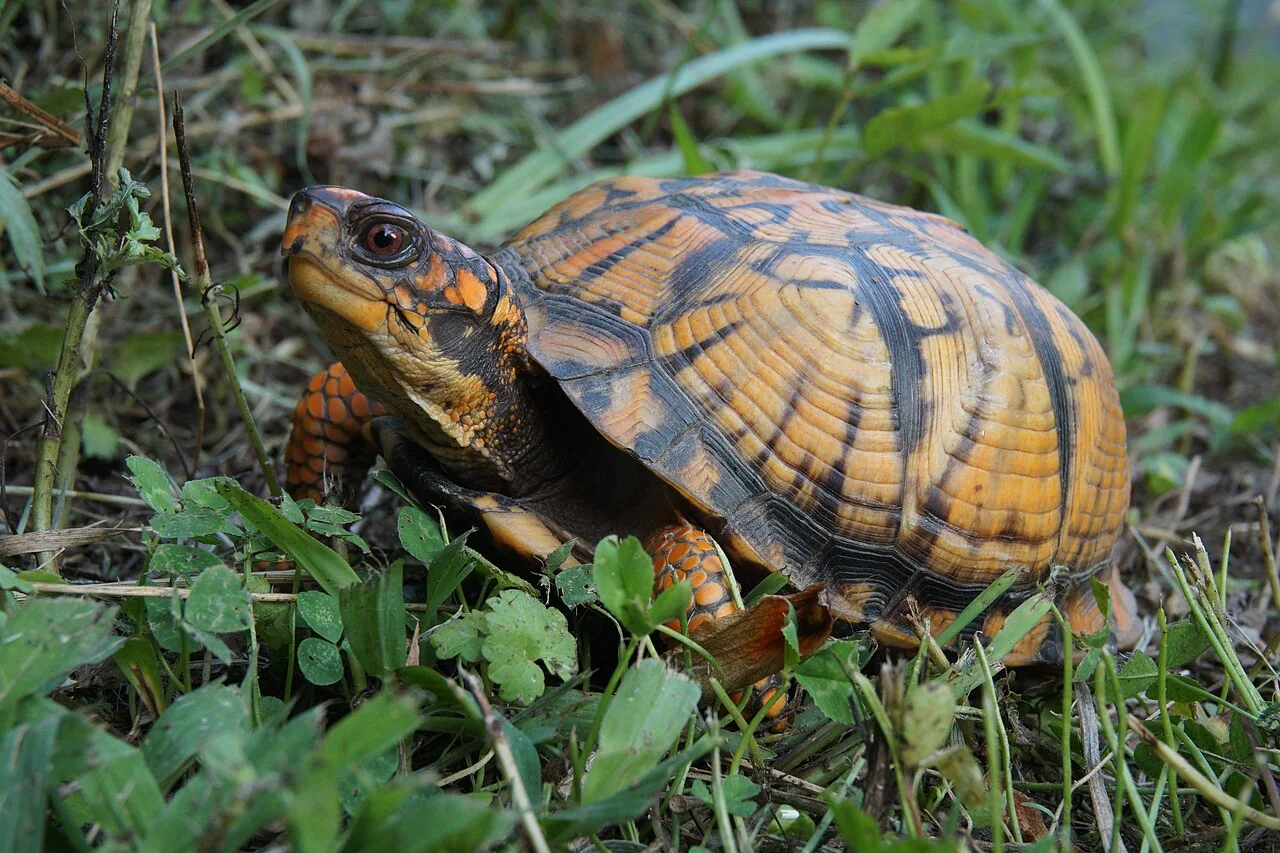
Scientific name
Terrapene carolina
Terrapene carolina includes several populations and subspecies. The zoological references below mainly concern T. c. carolina, the eastern form. [1][2]
Origin
Eastern United States; distribution varies by subspecies. [1][2]
- Terrestrial
- Omnivorous
- Humid shelters
At a glance
| ADULT SIZE | ≈ 15 cm Typical length of the eastern form according to the Smithsonian. [2] |
|---|---|
| LIFESPAN | 25–35 years General reference; centenarian records are not an average. [2] |
| LIFESTYLE | Terrestrial Undergrowth, edges and wetlands. [2] |
Adult size
The eastern form typically reaches around 15 cm in length according to the Smithsonian; other subspecies differ. [2]
Lifespan
The Smithsonian cites 25–35 years and individuals exceeding 100 years, without separating environments; records are not an average. [2]
Lifestyle
Terrestrial, associated with undergrowth, edges and wetlands. [2]
Housing
SHELTERS AT GROUND LEVEL
Land + accessible bath — Several shelters and a humid microhabitat. Clinical references concern several box turtles. [3]
Provide a ground-level habitat with several shelters, a damp soil corner and easily accessible shallow water. [3]
Care parameters
AMBIENT · DAY
≈ 23–27 °C — Shared care sheet; adapt to the subspecies. [3]
WARM SPOT
≈ 28–32 °C — Reference distinct from ambient conditions. [3]
NIGHT · ACTIVE
≥ 21 °C — No brumation protocol here. [3]
Humidity
Shelter ≈ 70 % — The clinic gives 40–50 % ambient humidity and a more humid shelter. Adapt to the subspecies. [3]
Day
≈ 23–27 °C; warm spot ≈ 28–32 °C. [3] Shared clinical source for North American box turtles, to be adapted to the subspecies.
Night during activity
Minimum ≈ 21 °C. [3] Active husbandry reference, distinct from brumation.
Humidity
40–50 % ambient; shelter around 70 %. [3] The source includes drier-habitat species; do not remove the humid microhabitat.
Feeding
AN OMNIVOROUS DIET
Plants and invertebrates; young animals eat more animal prey. The diet changes with age. [2]
Feeding
An opportunistic omnivore, it eats plants, fungi and invertebrates; young animals are more carnivorous. The menu changes with age. [2]
Observing without forcing
Its hinged plastron allows it to close the shell almost completely. A defensive closure must not be forced open. In the wild, it shelters under debris or in the soil when it is too hot. [2]
Useful records
Distinguish general air readings from those in the humid shelter. Record bath use, foods actually eaten and weight. Keep the stated subspecies with its proof of origin; shell colour alone is not enough to define the whole husbandry or seasonal-rest programme.
Checklist
- Identify the subspecies if possible.
- Check entry to and exit from the bath.
- Measure the humid shelter separately.
Observations to record
- Weight
- Feeding
- Humidity
- Activity
The app provides individual animal records. Check which features are available for your animal in the released version.
Related guides
Original guides in French
Sources
Document-based overview; not a substitute for veterinary advice.
- The Reptile Database — Terrapene carolina
Source accessed - Smithsonian National Zoo — Eastern box turtle
Source accessed - Chicago Exotics Animal Hospital — Box Turtle Care
Source accessed