
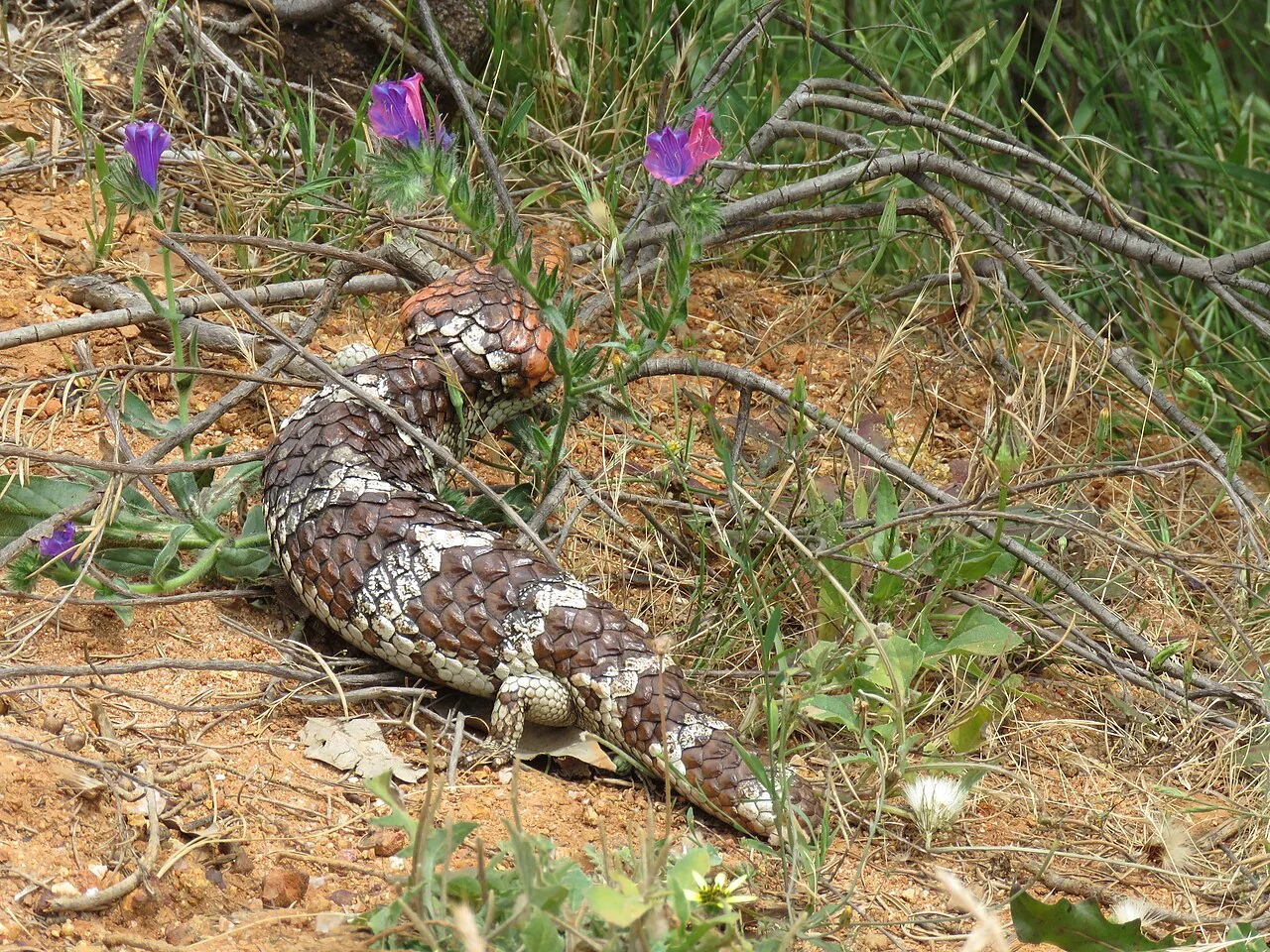
Scientific name
Tiliqua rugosa
Other names: Trachydosaurus rugosus
This heavily built Australian skink is recognisable by its rough scales and short tail. Mate fidelity has been studied, but it does not describe permanent pair living [2][4].
Origin
Southern and western Australia, extending into part of Queensland; four subspecies are retained by The Reptile Database [1].
- Terrestrial
- Diurnal
- Omnivorous
At a glance
A short-tailed Australian skink; its studied seasonal pairs do not demonstrate permanent captive cohabitation [2][4].
| ADULT SIZE | Up to 41 cm Total maximum; up to 34 cm head-and-body length [2]. |
|---|---|
| ACTIVITY | Diurnal Terrestrial, rests in ground-level shelters [2]. |
| DIET | Omnivorous Plants and small prey [2][3]. |
Adult size
Up to 41 cm total length, including 34 cm head-and-body length, according to the Australian Museum; this is a maximum [2].
Lifespan
Perth Zoo mentions up to 50 years in protected individuals, without providing their histories; no verifiable captive average is retained here [3].
Lifestyle
Terrestrial, active by day; forages after basking in the sun and uses ground-level shelters [2].
Housing
ARRANGING ITS HABITAT
Ground area and shelters — Wide passages and stable supports; no minimum validated in these sources.
A structured ground area, shelters and passages wide enough for the heavily built body; no species-specific minimum dimensions have been validated in the sources consulted.
Care parameters
CAPTIVE CLIMATE
Not established — The museum’s 30–35 °C concerns the active body, not the air [2].
Humidity
Not established — Varied natural habitats; no captive percentage retained [2][3].
Natural body heat
30–35 °C [2] Body temperature during activity; do not use as an air setting.
Captive climate
To be documented A gradient to define using a reference specific to the population kept.
Humidity
Not established No reliable captive percentage retained in these sources.
Feeding
FEEDING AND MONITORING
An identifiable omnivorous menu; an institutional ration does not determine every individual’s portion [2][3].
Identity and subspecies
The names aspera, rugosa, konowi and palarra designate the four listed subspecies; konowi concerns Rottnest and palarra the Shark Bay region. Trachydosaurus rugosus is a former name for the species [1]. This diversity calls for keeping the stated origin with supporting documentation. A brown or pale hue is insufficient to assign a population. For an animal without precise provenance, writing “subspecies undetermined” is more informative than a forced identification.
Adult size, lifespan and lifestyle
Up to 41 cm total length, including 34 cm head-and-body length, according to the Australian Museum; this is a maximum [2].
Perth Zoo mentions up to 50 years in protected individuals, without providing their histories; no verifiable captive average is retained here [3].
Terrestrial, active by day; forages after basking in the sun and uses ground-level shelters [2].
Usable ground and stable shelters
The museum describes open habitats with plant cover, leaf litter, logs or stones serving as retreats [2]. A coherent setup therefore combines walking space and accessible shelters, without reducing the habitat to a bare surface. Heavy supports must remain stable if the substrate is moved. Providing a visible exit route also facilitates maintenance: a container can be replaced without trapping the lizard between the wall and its refuge.
Heat: distinguish the animal from the terrarium
The 30–35 °C published by the Australian Museum describes the body of an active animal [2]. It gives neither the temperature of its hide nor that of a heated point. To compare two setups, record measurement type and exact location: shaded air, a lit surface and a shelter are three different pieces of information. An isolated figure does not allow a lamp to be sized. The collected sources do not justify a seasonal captive temperature curve.
Omnivorous menu and feeding
Perth Zoo lists plants, flowers, fruit and various small prey among foods consumed [3]. The museum describes a varied supplemented captive ration, but within its own collection context [2]. An institutional portion must not be turned into a universal quantity for every age. Preparing a list of foods actually eaten, not simply supplied, helps identify systematic selection. A nutritional proposal must also specify supplements and UVB exposure.
Water and maintenance of movement areas
The habitats mentioned range from shrubland to dunes and eucalyptus woodland [3]. “Australian” therefore does not describe a single humidity level. Without sufficiently documented captive measurement, no percentage is stated as a target. Examining places where the belly and feet rest helps identify persistently soiled ground. Choosing containers that do not tip and shelters that can be inspected without picking up the animal makes monitoring simpler and less intrusive.
Seasonal pairs and defensive behaviour
How and Bull experimentally tested pair reunions after separation. Their abstract describes a pre-mating association followed by separation after mating; several explanations for this fidelity remain possible [4]. This does not demonstrate that two unfamiliar animals can share a terrarium. Displaying the blue tongue, opening the mouth and defensive hissing are described by the museum [2]. Provoking them for a photograph does not indicate usual sociability.
Birth and preparation for juveniles
The species gives birth to live young; the museum describes a small litter and embryonic development supported by a placenta [2]. Preparing their individual identification and housing before a possible birth avoids last-minute improvisation. Perth’s account and the museum’s do not give exactly the same duration of family proximity [2][3]. No rule for keeping newborns with adults is inferred from these general descriptions.
Long-term monitoring and limitations
The high lifespan figure cited by Perth Zoo describes a possibility, without an individual record accessible on that page [3]. It must therefore be distinguished from a guaranteed life expectancy. Keeping comparable side-view and tail photographs, weights and menu changes helps document the animal’s development. Loss of mobility or persistent weight loss warrants veterinary assessment; a reputation for hardiness does not provide a diagnosis.
Checklist
- Identify the animal and retain its provenance.
- Check measurements and refuges before arrival.
- Plan individual monitoring of meals and body condition.
Observations to record
- Meals
- Weight
- Sheds
- Temperature
- Humidity
- Behaviour
The app provides individual animal records. Check which features are available for your animal in the released version.
Related guides
Original guides in French
Sources
Document-based overview; not a substitute for veterinary advice.
- The Reptile Database — Tiliqua rugosa
Source accessed - Australian Museum — Shingleback Lizard
Source accessed - Perth Zoo — Shingleback Lizard
Source accessed - How et Bull (2002) — Reunion vigour: an experimental test of the mate guarding hypothesis in the monogamous sleepy lizard
Source accessed