
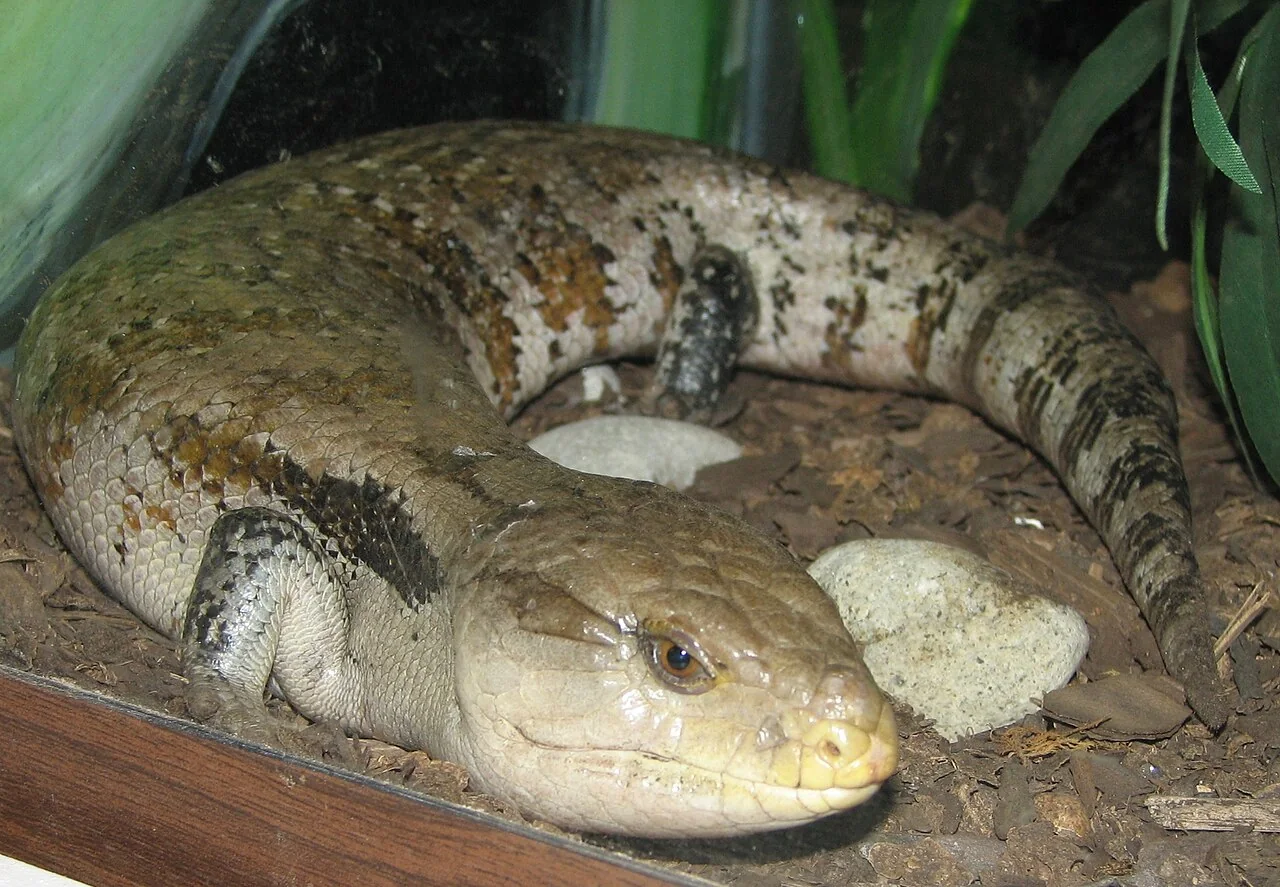
Scientific name
Tiliqua gigas
Other names: Scincus gigas · Tiliqua scincoides gigas
This blue-tongued skink comprises several subspecies from Indonesia and New Guinea. Exact identity matters, because guides distinguish humidity needs by population [1][2].
Origin
New Guinea and neighbouring islands, including several of the Moluccas, Kei and Aru; three subspecies are recognised in the database consulted [1].
- Diurnal
- Terrestrial
- Omnivorous
At a glance
A skink from New Guinea and neighbouring islands; trade labels are not all subspecies [1].
| ADULT SIZE | ≈ 50 cm · keyensis Guide without a measurement method; not the whole species [4]. |
|---|---|
| ACTIVITY | Diurnal Terrestrial and burrowing in the guide [2]. |
| DIET | Omnivorous Menu to adapt to the identified animal [2][4]. |
Adult size
The profile devoted to keyensis gives up to 50 cm, without an explicit measurement protocol; this value is not extended to the whole species [4].
Lifespan
The ReptiFiles/HappyDragons guide mentions 15–20 years for the skinks it treats together; an average specific to T. gigas is not demonstrated there [2].
Lifestyle
Diurnal, terrestrial and burrowing in the keeping guide that explicitly includes T. gigas [2].
Housing
ARRANGING ITS HABITAT
183 × 61 × 61 cm — Minimum from the guide explicitly including T. gigas; to adapt to the individual [2].
ReptiFiles/HappyDragons proposes at least 183 × 61 × 61 cm for the skinks covered, including T. gigas; a guide reference point, to adapt to the individual [2].
Care parameters
HEATING SURFACE
38–41 °C — The guide’s reference point for Indonesian forms [2].
Humidity
60–80 % · classic form — The guide distinguishes Halmahera; check the population before generalising [2].
Heating surface
38–41 °C [2] Rounded conversion of the 100–105 °F reserved for Indonesian forms.
Humidity, classic form
60–80 % [2] The same guide distinguishes Halmahera; do not generalise before identification.
Night — classic form
For the classic form T. gigas gigas, The Bio Dude advises a night-time drop without falling below approximately 21 °C (70 °F). [5] Scope: Tiliqua gigas gigas, classic form; do not extrapolate to other forms. A reported limit is neither a target nor an established physiological threshold.
Feeding
FEEDING AND MONITORING
Varied omnivorous menu; document the form kept and body condition [2][4].
Identify before choosing settings
The database recognises gigas, evanescens and keyensis. Halmahera appears as a commercial provenance within gigas, not as a fourth subspecies in this reference [1]. The labels Irian Jaya and Indonesian are not always sufficient to resolve confusion. Keeping photographs, reported origin and known parentage allows verification to be requested. Tiliqua gigas must also be distinguished from T. scincoides, already covered separately: a blue tongue is too general a characteristic to identify the species.
Adult size, lifespan and lifestyle
The profile devoted to keyensis gives up to 50 cm, without an explicit measurement protocol; this value is not extended to the whole species [4].
The ReptiFiles/HappyDragons guide mentions 15–20 years for the skinks it treats together; an average specific to T. gigas is not demonstrated there [2].
Diurnal, terrestrial and burrowing in the keeping guide that explicitly includes T. gigas [2].
A habitat organised around the ground
The ReptiFiles/HappyDragons guide explicitly covers Australian and Indonesian skinks but distinguishes their substrates [2]. For gigas, design must allow ground movement, retreat and burrowing. Fixing heavy elements before pouring in the material prevents them from resting on a layer moved by the animal. Providing a sufficiently wide passage around shelters and an easy-to-clean feeding area is more useful than accumulating decorative branches. The area that can actually be traversed matters more than the stated gross volume.
Humidity and provenance
The guide proposes 60–80 % for the so-called classic Indonesian form and a different range for Halmahera [2]. The commercial keyensis profile describes the moist undergrowth of Kei and Aru [4]. These sources show the value of knowing provenance, without demonstrating an identical need for every animal. Check soil beneath shelters, air humidity and air circulation separately. Saturated material is not an obligatory translation of the phrase humid forest.
Heating and lighting
The basking surface proposed for Indonesian forms must remain distinct from ambient air and refuges [2]. A broad body can be partly exposed: taking several readings across the resting area helps explain the setup. Lamp choice must account for distance, screens and access to shade. No percentage printed on a tube alone describes the animal’s exposure. Keeping equipment references and measurements allows precise technical discussion.
An omnivorous menu to build
The profile devoted to keyensis lists plant and animal foods while warning of the need for balance [4]. This broad acceptance does not mean that a highly favoured food is suitable in unlimited quantities. Presenting ration composition, supplements and frequencies to the veterinarian makes assessment possible. Also record foods left aside: a mix offered is not necessarily a mix consumed. Weight gain must be considered alongside body shape and activity, without treating appetite as a target to maximise.
Sexing: recognising the limits of photographs
Spadola and colleagues studied a pair of T. gigas gigas, one T. gigas evanescens and an Irian Jaya form. They emphasise the difficulty of external sexing and describe a clinical endoscopic method, on only four animals [3]. This technique belongs to veterinary practice and is not detailed here as a home procedure. A broad head or a size difference is therefore insufficient to guarantee sex. This uncertainty must be resolved before any mating project.
Birth of young and preparation
The database indicates reproduction resulting in live young; La Ferme Tropicale describes viviparity for keyensis [1][4]. Offspring numbers and timetables from one subspecies are not generalised to all lineages. A project requires available housing for juveniles, monitoring of the female and an option to separate animals. Weight gain alone does not confirm pregnancy; it must be interpreted with the history and, if needed, an appropriate examination.
Individual monitoring and commitment
During shedding, observing the toes, tail and rubbing areas helps document the process without forcibly removing skin. A record of meals and movement can clarify an activity change after altering the setup. Provenance, sex and age information sometimes remain incomplete; retaining them as uncertain is better than turning them into facts. A guide’s generic lifespan does not allow the age of an adult bought without a history to be established or its lifespan to be predicted.
Checklist
- Keep the scientific name and documented origin.
- Check access to shelters, water and food.
- Measure the gradient before placing the animal in the setup.
Observations to record
- Meals
- Weight
- Sheds
- Temperature
- Humidity
- Behaviour
The app provides individual animal records. Check which features are available for your animal in the released version.
Related guides
Original guides in French
Sources
Document-based overview; not a substitute for veterinary advice.
- The Reptile Database — Tiliqua gigas
Source accessed - ReptiFiles / HappyDragons — Blue Tongue Skink Care, sections Tiliqua gigas
Source accessed - Spadola et al. 2021 — Cloacal anatomy and sex determination in Tiliqua sp.
Source accessed - La Ferme Tropicale — Tiliqua gigas keyensis
Source accessed - Care sheet for Classic Indonesian Blue Tongue Skink (Tiliqua gigas gigas)
Source accessed