
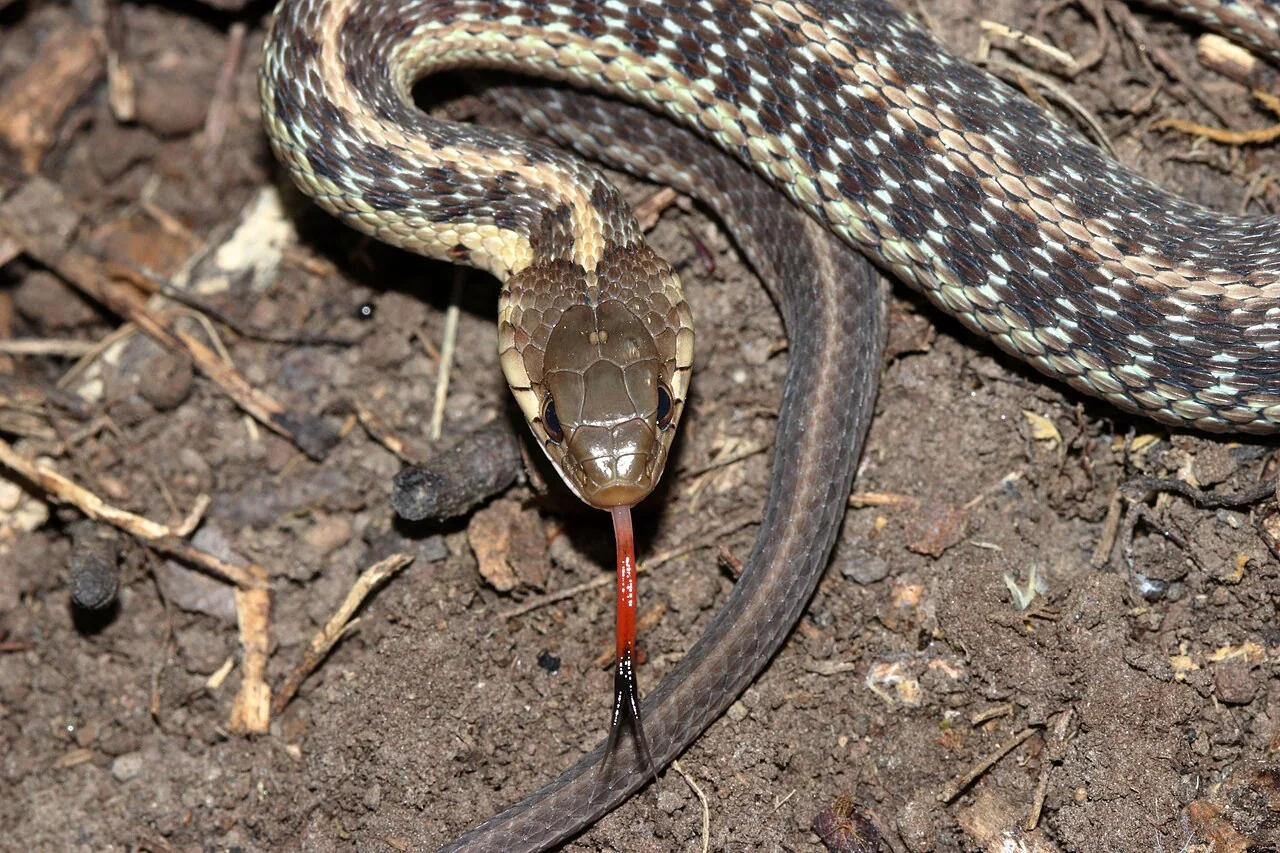
Scientific name
Thamnophis sirtalis
Other names: Coluber sirtalis · Eutainia sirtalis
Thamnophis sirtalis comprises highly diverse North American populations. The Reptile Database recognises several subspecies, including parietalis, concinnus and tetrataenia. [1] Provenance and the full name are therefore useful: the profile presents the species without turning all its colours and populations into a single climate profile.
Origin
Much of North America; presence varies by region, particularly in connection with sufficiently moist environments. [2]
- Varied populations
- Live young
- Menu to prepare
Documentary overview: identity checked; natural observations and captive practices attributed separately. Undocumented limits remain explicit.
At a glance
| SIZE | 46–137 cm Total length [2]. |
|---|---|
| LIFESPAN | 6–10 years Captive reference point; 20-year case [2]. |
| LIFESTYLE | Land and water Habitat diversity [2]. |
Adult size
46–137 cm total length in Animal Diversity Web; females are generally larger than males. [2]
Lifespan
ADW gives 6–10 years as a captive reference point and reports a 20-year-old individual. The record must not be presented as an average. [2]
Lifestyle
An active snake using terrestrial habitats and areas near water; coloration and behaviours vary by population. [2]
Housing
SPECIALIST REFERENCE POINT
120 × 60 × 60 cm — An average adult; larger according to build [3].
Herpeton proposes 120 × 60 × 60 cm for an average adult, more for a large female; incorporate shelters and an easy exit from water. [3]
Care parameters
HEATING
29–32 °C — Herpeton [3].
COOL
21–24 °C — Herpeton [3].
Humidity
40–60 % — Specialist air reference point; unsaturated ground [3].
Localised heating
29–32 °C according to Herpeton [3] Specialist-guide recommendation; thermostat and independent checks.
Cool side
21–24 °C according to Herpeton [3] An actually available zone for retreating from heat.
Air humidity
40–60 % according to Herpeton [3] Keep ground unsaturated and provide a localised more humid refuge.
Feeding
VARY PREY
Fish choice to check: risk of B 1 deficiency [4].
Stripes, populations and former names
Coluber sirtalis and Eutainia sirtalis appear among the former combinations. Current subspecies are not automatically morphs created through captive selection. [1] Keeping species name, stated subspecies and commercial colour name separate makes exchanges clearer. An attractive photograph without origin does not reconstruct this information. Mixing of lineages must remain stated rather than receive a geographical label inferred from appearance.
Adult size, lifespan and lifestyle
46–137 cm total length in Animal Diversity Web; females are generally larger than males. [2]
ADW gives 6–10 years as a captive reference point and reports a 20-year-old individual. The record must not be presented as an average. [2]
An active snake using terrestrial habitats and areas near water; coloration and behaviours vary by population. [2]
A snake of varied environments
ADW describes grasslands, marshes, woodland and banks, often near ponds or streams and beneath protective cover. [2] The presence of water does not mean that the entire area must be flooded. Drawing an actual terrestrial zone, shelters and a maintainable pool allows remaining movement space to be assessed. Elements that conceal the animal must also remain accessible for a necessary check, without removing all opportunities to retreat.
Making space and climate work
The Herpeton guide provides hides at both ends and a pool with an easy exit. [3] Testing these routes before arrival is more useful than multiplying accessories. Then check every cable opening and door groove against the size of the expected juvenile. Climate values must be recorded at identifiable places; changes between day and night matter as much as a measurement taken in the enclosure’s centre.
Compose a menu, not simply choose fish
Herpeton describes a rotation of whole prey including earthworms, thawed rodents and fish selected for low thiaminase content. [3] This list must not be converted into an arbitrary assortment. Precisely identifying the food, its provenance and presentation allows the menu to be discussed with a veterinarian. A fillet, whole prey and a worm are not nutritionally interchangeable portions at equal weight.
Understanding the risk of vitamin B 1 deficiency
The Merck Veterinary Manual links thiamine deficiencies in fish-eating snakes to fish rich in thiaminase or low in thiamine, including when thawed. [4] Freezing therefore does not guarantee a suitable ration. Fish-species choice and menu composition must be examined together. Tremors or poor coordination require prompt consultation, without self-diagnosing a deficiency or improvising vitamin doses.
Live young, without an egg incubator
The female gives birth to live young; ADW also states an ability to store sperm. [2] A female isolated after acquisition must therefore not be assumed to lack a reproductive history. Provide suitable housing and foods before deliberate breeding. Large gatherings observed during some seasons do not, by themselves, constitute a permanent-cohabitation protocol for every captive individual.
Observe each individual
If several animals are kept, observation must still establish which has eaten, shed or changed behaviour. A missing meal does not prove that every snake received its share. Plan a concrete separation solution before any grouping. Liveliness or frequent emergence does not justify repeated handling: favour observation from a distance, where shelter choices and routes remain spontaneous.
Choosing realistic provenance and a realistic project
Ask for the full name, previous conditions and documented captive origin. Do not collect or release. The presence of several subspecies in the reference does not guarantee that they share the same keeping or trade rules. This profile is not regulatory authorisation. Before acquisition, check the obligations corresponding to the animal actually offered and plan the resources needed to keep it for several years.
Checklist
- Check species and subspecies.
- Secure doors and pool.
- Document foods precisely.
Observations to record
- Meals
- Weight
- Sheds
- Movement
The app provides individual animal records. Check which features are available for your animal in the released version.
Related guides
Original guides in French
Sources
Document-based overview; not a substitute for veterinary advice.
- The Reptile Database — Thamnophis sirtalis
Source accessed - Animal Diversity Web — Thamnophis sirtalis
Source accessed - Herpeton Academy — Common Garter Snake, Fact Sheet
Source accessed - Merck Veterinary Manual — Nutritional, Metabolic, and Endocrine Diseases of Reptiles
Source accessed