
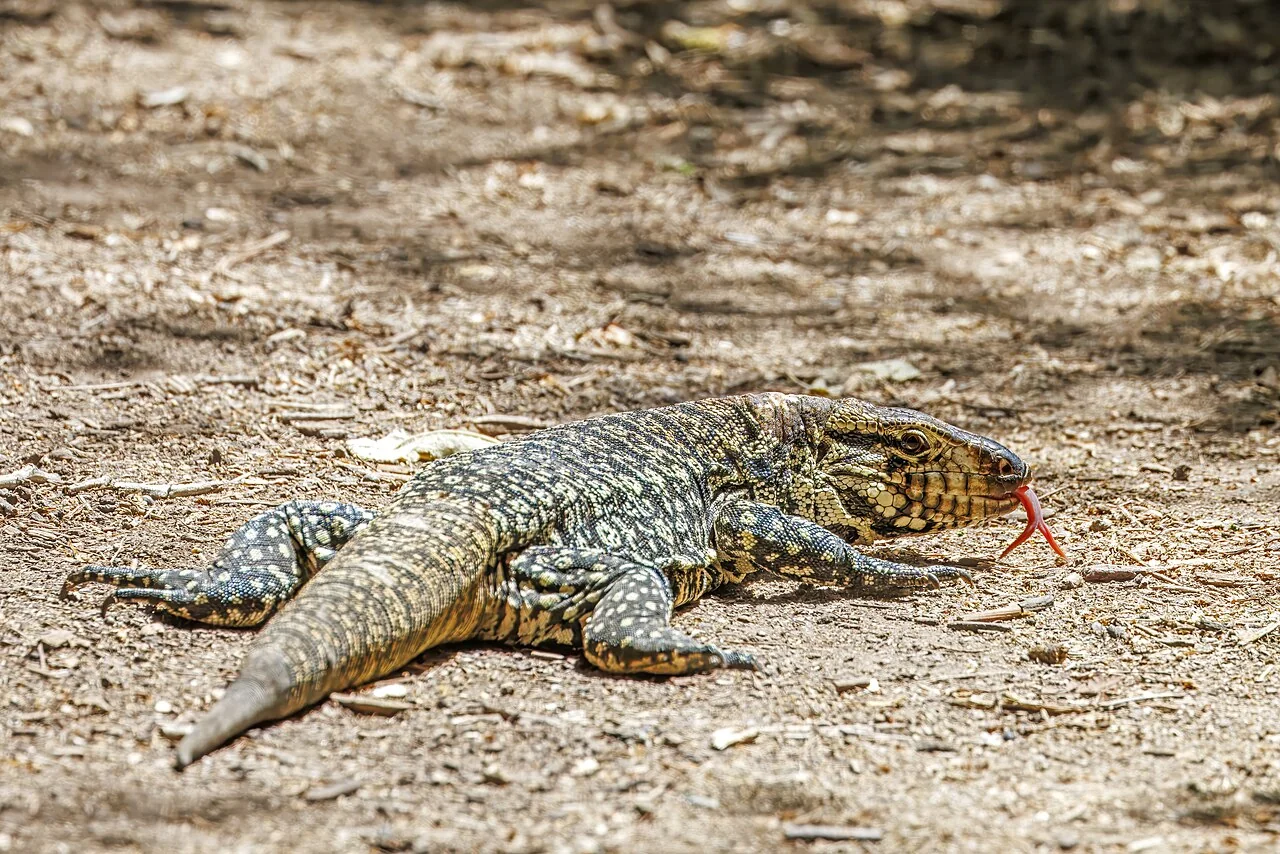
Scientific name
Salvator merianae
The black and white tegu becomes imposing as an adult. Young animals have a green tint that fades as they grow [2].
Origin
South America: particularly Brazil, Paraguay, Uruguay and Argentina [3].
- Terrestrial
- Burrowing
- Omnivorous
At a glance
| ADULT SIZE | ≈ 91–137 cm max. Female then male maximums, including the tail [2]. |
|---|---|
| LIFESPAN | 15–20 years Zoo range; environment not explicitly distinguished [2]. |
| LIFESTYLE | Terrestrial Digging and ground exploration [1]. |
Adult size
Up to around 91 cm in females and 137 cm in males, including the tail, according to Potawatomi Zoo [2].
Lifespan
15–20 years reported by Potawatomi Zoo, without explicitly separating environments [2].
Lifestyle
On the ground, with digging activity [1].
Housing
A LARGE GROUND-LEVEL ENCLOSURE
180 × 90 × 90 cm — General veterinary minimum for tegus; adapt to body size [1].
The general veterinary tegu care sheet gives a minimum of 180 × 90 × 90 cm; adapt this reference to adult body size [1].
Care parameters
HEATING ZONE
35–38 °C — [1] General veterinary reference for tegus; air/surface not distinguished.
COOL AREA
≈ 24 °C — [1] Maintain a gradient in the enclosure.
Humidity
≈ 80 % — Captive reference from the general veterinary tegu care sheet; monitor the substrate as well [1].
Heating zone
35–38 °C [1] General veterinary reference for tegus; air/surface not distinguished.
Cool area
≈ 24 °C [1] Maintain a gradient in the enclosure.
Humidity
≈ 80 % Captive reference from the general veterinary tegu care sheet; monitor the substrate as well [1].
Feeding
AN APPROPRIATE DIET
Animal and plant foods; more insects for young animals [1].
Feeding
Omnivorous: animal and plant foods, with proportions adapted to growth. Young animals eat more insects [1].
Behaviour and precautions
Potawatomi Zoo describes a seasonal decrease in activity linked to cold [2]. Do not automatically interpret every drop in appetite as brumation.
Daily monitoring
Monitor weight with suitable scales and record portions actually eaten. Log outings, digging and seasonal changes. Plan a realistic transport method for the adult, and test it before an emergency.
Checklist
- Size the enclosure for the future adult.
- Provide a digging area.
- Test weighing equipment.
Observations to record
- Meals
- Weight
- Sheds
- Temperature
- Humidity
The app provides individual animal records. Check which features are available for your animal in the released version.
Related guides
Original guides in French
Sources
Document-based overview; not a substitute for veterinary advice.
- Tree of Life Exotic Pet Medical Center — Tegu Lizard Care
Source accessed - Potawatomi Zoo — Argentine Black and White Tegu
Source accessed - The Reptile Database — Salvator merianae
Source accessed