
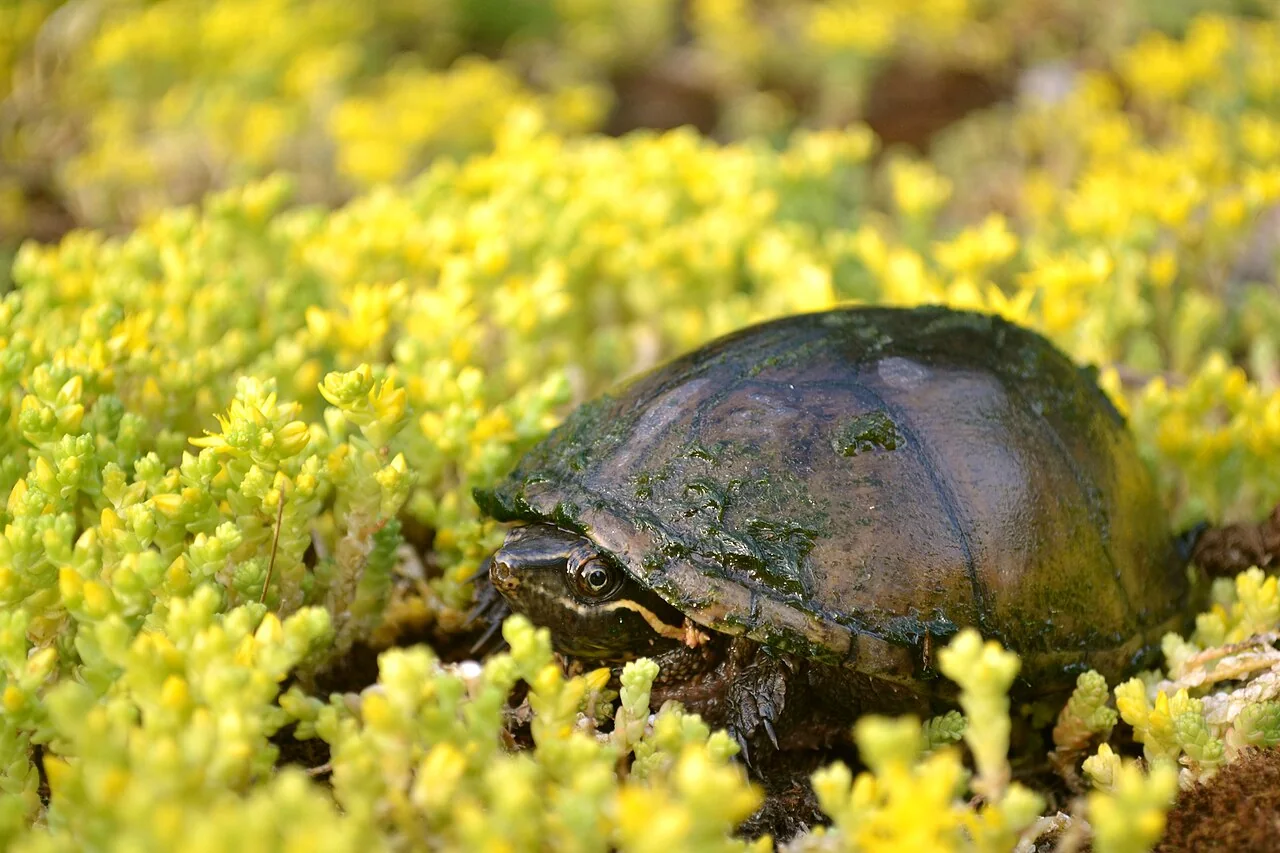
Scientific name
Sternotherus odoratus
Other names: Kinosternon odoratum
The common musk turtle is a freshwater kinosternid. The Reptile Database retains the name Sternotherus odoratus; Kinosternon odoratum is a former combination. [1] Its small shell does not remove the need to plan a properly equipped aquarium.
Origin
Eastern and central North America, with Canadian and American populations; calm water and vegetated areas are important. [1][2]
- Aquatic
- Structured route
- Long commitment
Documentary overview: identity checked; natural observations and captive practices attributed separately. Undocumented limits remain explicit.
At a glance
| SIZE | 10–12,7 cm ADW adult reference point [2]. |
|---|---|
| LIFESPAN | Several decades Captive record 54,8 years [2]. |
| LIFESTYLE | Bottom and surface Aquatic environment [2]. |
Adult size
Approximately 10–12,7 cm in the adults described by Animal Diversity Web; body length presented in the context of the shell, without the tail. [2]
Lifespan
ADW reports a captive record of 54,8 years, not a guaranteed average expectancy. A commitment of several decades must therefore be planned. [2]
Lifestyle
Aquatic, often active at dusk and seeking resources near the bottom. [2]
Housing
REHOMING SETUP
≈ 122 × 61 × 61 cm — RSPCA Brighton reference point, overall dimensions [3].
The RSPCA Brighton centre requires approximately 122 × 61 × 61 cm for its rehoming: setup dimensions, not mandatory water depth. [3]
Care parameters
WATER
24–27 °C — Active keeping, clinical source [4].
PLATFORM
29–32 °C — Basking reference point [4].
Humidity
Tested water — No air percentage proposed; dry access necessary [4].
Water, active keeping
24–27 °C according to Tree of Life Exotics [4] Measure in the water with a probe independent of the heater setting.
Basking platform
29–32 °C according to the same clinic [4] The turtle must be able to leave the water completely and reach a less-warm zone.
Water quality
Ammonia and nitrites: target 0 in the clinical profile [4] Clarity does not replace testing.
Water — the guide’s night-time limit
RVC gives water not falling below 20 °C at night in its routine keeping guide. [5] Scope: captive water; RVC Common Musk Turtle profile. A reported limit is neither a target nor an established physiological threshold.
Feeding
VARIED AQUATIC MENU
Formulated food and invertebrates, with plants according to consumption; meals in water [3].
Recognise without disturbing
The two pale lines on each side of the head and the more pronounced keel in juveniles are described by the RSPCA. [3] To retain usable identification, photograph the top and sides during a necessary check, with a scale. A colour difference over the years is insufficient to rename the animal or assign it a new variety.
Adult size, lifespan and lifestyle
Approximately 10–12,7 cm in the adults described by Animal Diversity Web; body length presented in the context of the shell, without the tail. [2]
ADW reports a captive record of 54,8 years, not a guaranteed average expectancy. A commitment of several decades must therefore be planned. [2]
Aquatic, often active at dusk and seeking resources near the bottom. [2]
Organising movement in the water
ADW describes a turtle that walks extensively along the bottom but can also climb and bask out of water. [2] The setup must therefore be read as a route: shelter, rest near the surface and a dry exit linked without traps. Observing several complete movements after a change is more informative than a photograph of the decoration. Heavy elements must remain stable when the animal pushes them.
Filtration and cleaning
The RSPCA recommends continuous filtration and not replacing all filter media together, to preserve their bacterial population. [3] Recording the date and actual content of each intervention links a water change to variation in test results. A running filter does not, by itself, establish correct operation: also check visible flow and absence of obstruction.
Heat and light: two measurements
The clinic distinguishes water temperature from dry-site temperature and provides for UVB. [4] The number displayed on a heater does not describe the platform. Recording both locations, lamp model and actual distance makes checks repeatable. Basking-point temperature must not be targeted everywhere: a choice between several conditions is part of the setup.
Feeding without turning the water into a food store
The Brighton centre uses a varied menu including formulated foods, invertebrates and a plant component; meals are offered in water. [3] Distributing selected foods across the week avoids confusing diversity with accumulation in one meal. Removing what remains accessible after feeding also helps establish what was actually consumed rather than simply disappearing behind the decor.
Breeding and season
Eggs are laid on land, and ADW describes an effect of incubation temperature on sex. [2] This biological finding is not a protocol to reproduce with a domestic thermostat. A breeding project first requires an appropriate laying site and a plan for juveniles. Searching for a laying place must be observed even without a commercial project.
Behaviour and precautions
Musk secretion and biting can accompany a stressful situation; Tree of Life recommends limiting handling. [4] Daily observation can occur through the glass, before opening and during meals. A lasting swimming change, difficulty returning to the surface or unusual food refusal warrants professional advice, without choosing treatment from a single image.
Building comparable records
Keep shell length, weight obtained under similar conditions, meals and water measurements in one history. An isolated measurement does not show whether growth is steady. For adoption, ask for documented captive provenance and previous habits; do not take an animal from the wild or release one that becomes inconvenient. The profile does not constitute verification of local keeping obligations.
Checklist
- Test the route to the surface.
- Check water and platform separately.
- Prepare filter maintenance.
Observations to record
- Shell
- Meals
- Water
- Behaviour
The app provides individual animal records. Check which features are available for your animal in the released version.
Related guides
Original guides in French
Sources
Document-based overview; not a substitute for veterinary advice.
- The Reptile Database — Sternotherus odoratus
Source accessed - University of Michigan, Animal Diversity Web — Sternotherus odoratus
Source accessed - RSPCA Brighton — Musk Turtle Rehoming Package
Source accessed - Tree of Life Exotic Pet Medical Center — Common Musk Turtle Care
Source accessed - Musk turtle care — reviewed December 2024
Source accessed