
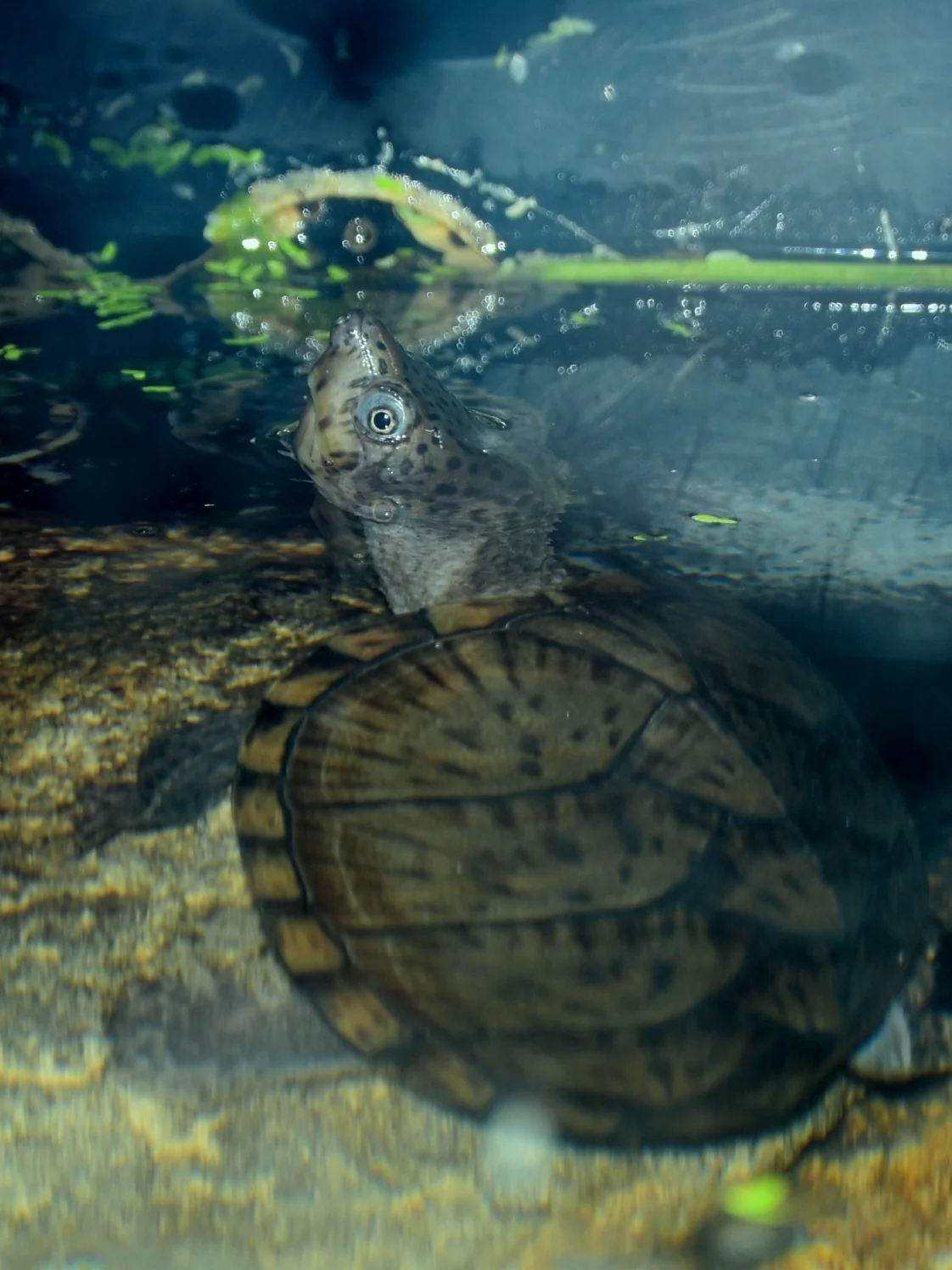
Scientific name
Sternotherus carinatus
Other names: Kinosternon carinatum
Sternotherus carinatus has a shell with a strong median keel. The current name and former combination Kinosternon carinatum appear in NCBI Taxonomy. [1] Its striking profile must not obscure its aquatic movement and space needs.
Origin
Southern United States, particularly eastern Texas and neighbouring basins. Herps of Texas describes it in slow-moving watercourses and swamps. [2]
- Pronounced keel
- Aquatic
- Individual keeping
Documentary overview: identity checked; natural observations and captive practices attributed separately. Undocumented limits remain explicit.
At a glance
| SIZE | 10–15 cm Straight carapace length, specialist guide [3]. |
|---|---|
| LIFESPAN | ≈ 20 years Captivity; reported maximum 29 years [4]. |
| LIFESTYLE | Aquatic Basking out of water [2]. |
Adult size
The Herpeton keeping guide gives generally 10–15 cm straight carapace length; this is not an absolute maximum. [3]
Lifespan
Animal Diversity Web gives approximately 20 years in captivity and a reported maximum of 29 years. These are reference points attributed to that overview, not a guaranteed individual expectancy. [4]
Lifestyle
Aquatic and mainly diurnal, with basking on rocks or wood. [2]
Housing
REFERENCE AREA
100 × 50 cm — Minimum proposed by Herpeton for an adult [3].
Herpeton proposes at least 100 × 50 cm floor area for an adult, more if possible, with underwater structure and a dry platform. [3]
Care parameters
WATER
22–26 °C — Specialist guide [3].
PLATFORM
30–32 °C — Basking surface [3].
Humidity
Water and dry zone — No universal air-humidity target [3].
Water, active keeping
22–26 °C according to Herpeton [3] Specialist keeping reference point, not a physiological threshold.
Heating surface
30–32 °C according to Herpeton [3] Measure on the platform, without applying this temperature to the whole aquarium.
Humid air
No universal value retained Water, dry access and ventilation must be described separately.
Water — the guide’s night-time limit
The RVC musk-turtle guide, which includes the razor-backed musk turtle, gives water not falling below 20 °C at night. [6] Scope: captive water; RVC multispecies guide explicitly including Razor-backed. A reported limit is neither a target nor an established physiological threshold.
Feeding
DIETARY DIVERSITY
Opportunistic natural diet; the prey list does not constitute a captive ration [2].
One keel, several characteristics
Herps of Texas also describes a small plastron, two barbels beneath the chin and webbed feet. [2] Sound identification combines several views and provenance; it does not rely only on a shell peak. The name of a related species on an old invoice must be clarified before its parameters are automatically reused.
Adult size, lifespan and lifestyle
The Herpeton keeping guide gives generally 10–15 cm straight carapace length; this is not an absolute maximum. [3]
Animal Diversity Web gives approximately 20 years in captivity and a reported maximum of 29 years. These are reference points attributed to that overview, not a guaranteed individual expectancy. [4]
Aquatic and mainly diurnal, with basking on rocks or wood. [2]
An aquarium planned in three dimensions
The reference setup includes supports, submerged wood and a dry exit. [3] These are different functions: hiding, moving, resting and leaving the water. To assess decor, follow the turtle from bottom to platform. Avoid a passage it could leave only by reversing blindly; also keep an open area for observing swimming.
Accessible water and maintenance
The Herpeton recommendation relies on a mature biological filter, accessible mechanical filtration and monitoring nitrogenous waste. [3] During design, plan removal of soiling behind every piece. If cleaning requires all decor to be dismantled, doing it regularly becomes difficult. Actual water volume, not the tank’s commercial volume, must appear in the setup record.
Measure before correcting
The thermal reference points above are attributed to a specialist guide. [3] Before changing a setpoint, check where, when and with which device the measurement was taken. A difference between thermostat and probe may result from different positions. The useful progression is to map the tank, then observe which zones are chosen; a single value does not describe that choice.
An opportunistic diet
The Texas overview mentions insects, crustaceans, molluscs, animal matter and aquatic vegetation. [2] This natural diversity does not provide a domestic percentage ration. Preparing a repeatable menu with a professional allows quantities offered and consumed to be compared. A convenient food is not automatically complete, and acceptance of an ingredient does not prove that it can become the sole food.
Laying and differences in context
Herps of Texas places nesting mainly in May and June within its regional context. [2] This season does not become an imposed date for an animal under artificial lighting in another country. The distinction between observed mating, laying, fertilised eggs and hatchings must remain visible in notes. No annual output or automatic domestic incubation is proposed here.
Separation and observation
The Herpeton guide recommends individual keeping to limit biting and harassment. [3] An animal stationary near another does not demonstrate lasting compatibility. If several turtles are already kept, the project must provide actual separation options and individual attribution of meals. For this species as for others, visual checks of swimming and shell condition avoid unnecessary handling.
Preparing the commitment
Adult size, electricity consumption, veterinary access and equipment replacement must be anticipated together. Availability of a juvenile proves neither captive origin nor compliance of its sale. Ask for traceable documents, keep the full scientific name and check applicable rules before acquisition. No wild collection or release is part of the project described in this profile.
Dietary supplements: distinguish the situations
Canobie Lake Veterinary Hospital lists whole snails and cuttlebone as calcium sources. [5]
Scope: captivity; Canobie Lake Veterinary Hospital’s Razorback Musk Turtle profile. Account for diet composition and setup; no universal dosage is set by this overview.
Checklist
- Prepare supports leading to the surface.
- Test filtration and platforms.
- Document provenance.
Observations to record
- Shell
- Water
- Meals
- Swimming
The app provides individual animal records. Check which features are available for your animal in the released version.
Related guides
Original guides in French
Sources
Document-based overview; not a substitute for veterinary advice.
- NCBI Taxonomy — Sternotherus carinatus
Source accessed - Herps of Texas — Sternotherus carinatus
Source accessed - Herpeton Academy — Razor-Backed Musk Turtle
Source accessed - University of Michigan, Animal Diversity Web — Sternotherus carinatus
Source accessed - Caring for Your Razorback Musk Turtle
Source accessed - Musk turtle care — reviewed December 2024
Source accessed