
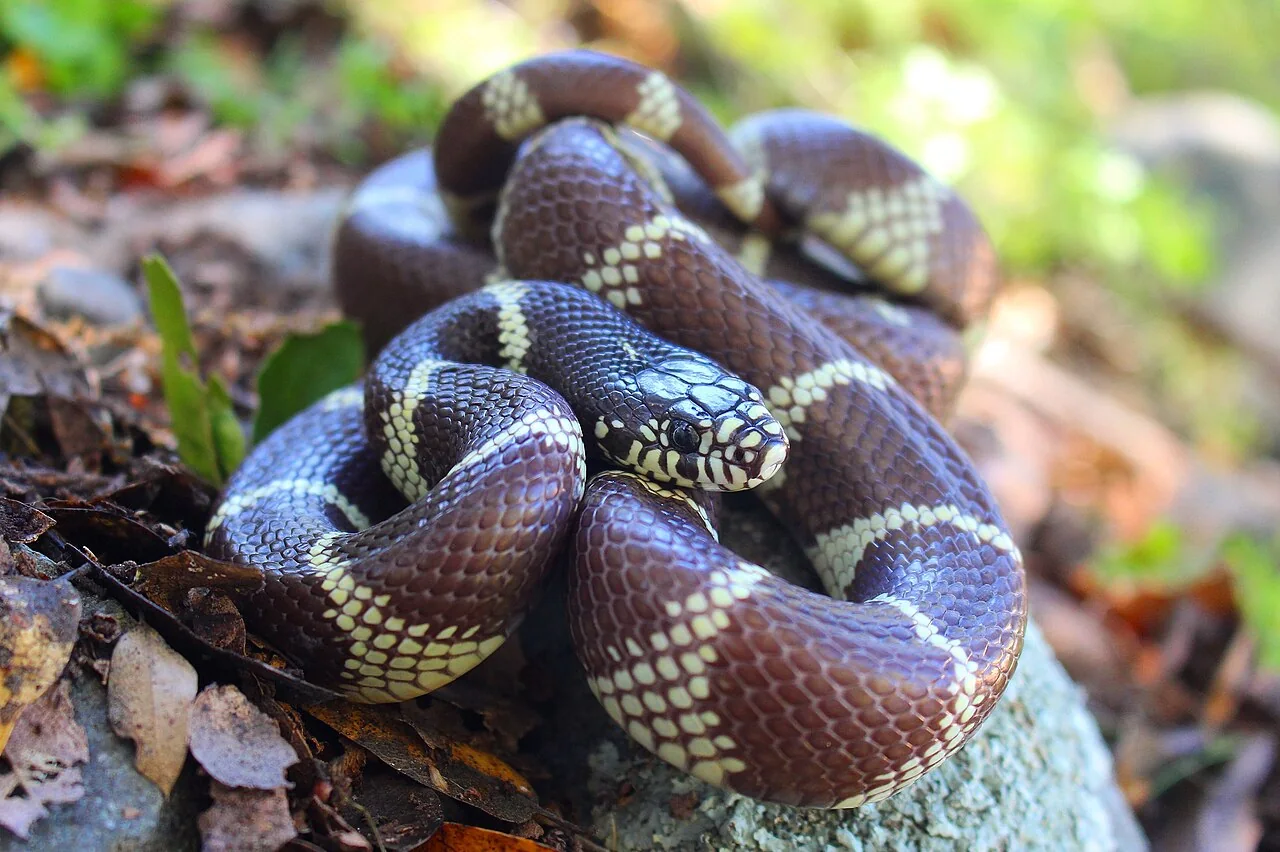
Scientific name
Lampropeltis californiae
Lampropeltis californiae is the Californian species; it should not be confused with other kingsnakes in the pet trade. [1]
Origin
Western United States and northwestern Mexico. [1]
- Constrictor
- Explorer
- Snake-eating
At a glance
| ADULT SIZE | Rarely more than ≈ 122 cm Rarely exceeds this length according to Oakland. [2] |
|---|---|
| LIFESPAN | More than 20 years possible More than 20 years in captivity. [2] |
| LIFESTYLE | Daytime or dusk Activity varies with heat. [2] |
Adult size
Oakland Zoo states that length rarely exceeds 4 feet, or around 122 cm; this is not an absolute maximum. [2]
Adult weight
No adult range by sex and length is sufficiently documented in the selected sources; no target mass is proposed.
Lifespan
More than 20 years are possible in captivity according to Oakland Zoo, compared with an estimated 10–15 years in the wild. [2]
Lifestyle
Active by day in cool weather, more at dusk when it is hot. [2]
Beginner with guidance
A first project with guidance is possible with strictly individual housing, reliable closures and feeding records. Snake-eating behaviour requires particular vigilance. Editorial assessment. [2][4]
Housing
INDIVIDUAL HOUSING
From ≈ 122 × 61 × 61 cm — Clinical minimum, to be increased according to body size. [4]
Clinical minimum: around 122 × 61 × 61 cm, to be increased. Individual housing. [4]
Care parameters
HEATING ZONE
≈ 29–31 °C — 85–88 °F in the clinical care sheet. [4]
AMBIENT AIR · DAY
≈ 27–29 °C — 80–85 °F; at least around 21 °C at night under this protocol. [4]
Humidity
35–60 % — Clinical reference, with adjustment during shedding. [4]
Heating zone
Around 29–31 °C. [4] Rounded conversion of 85–88 °F, a clinical reference.
Daytime ambient air
Around 27–29 °C. [4] Conversion of 80–85 °F; avoid uniform heating.
Night
At least around 21 °C in this care sheet. [4] Conversion of 70 °F; a reference from the selected protocol.
Humidity
35–60 %, with adjustment during shedding. [4] Measure in the habitat, not just in the room.
Feeding
A GENERALIST PREDATOR
Dead rodents; documented frequency by life stage, to be individualised. [4]
Habitat and behaviour
Oakland describes varied habitats, including rocky and scrubby areas. Activity shifts from daytime towards dusk as temperatures rise. [2]
Paper initially, then aspen or reptile bark; exclude pine and cedar. Provide shelters and reliable closures. [4]
Lighting and water
Low-level UVB without a published UVI target; clean water and a stable container that allows bathing. [4]
The output printed on a tube is not a measurement of what reaches the animal. Recording the model, installation date and available distance in the terrarium’s records allows the settings to be discussed with a professional.
Feeding by life stage
Dead rodents: hatchlings every 5–7 days; young animals from 6 months to 2 years, 7–10 days; adults, 14–18 days. Clinical references to be adapted. [4]
The snake-eating behaviour documented by Oakland rules out cohabitation and does not recommend collecting any wild prey. [2] No universal ration formula is adopted.
Reproduction: general cycle
The species lays eggs. Oakland Zoo describes a seasonal cycle and hatching that varies with temperature. [2] An account of reproduction in the wild does not, by itself, provide incubator settings or justify cooling a pet animal.
Before any project, have the parents’ identity and condition checked, and plan egg monitoring and hatchling enclosures. The parameters shown for an adult’s everyday care do not serve as a breeding protocol.
Health and observation
Annual health check and parasite screening according to the clinic. [4] Tail vibration or musk can signal defensive behaviour. [2]
Record unusual breathing, an injury or repeated food refusals to seek advice, without concluding for yourself that the animal has a disease. A general care sheet does not replace examination of the animal.
A useful log
Separate food offered from food accepted; record prey, date, shedding and weight using the same unit. Describing the time of activity helps observe the effects of furnishings or ambient temperature.
The proposed experience level is editorial. It does not remove the need to set up the enclosure beforehand or have access to a veterinarian familiar with reptiles. Missing values remain visible so that a lack of data does not become a certainty.
Checklist
- Plan one animal per enclosure.
- Obtain a sourced parameter plan.
- Check doors and cables.
Observations to record
- Meals
- Sheds
- Weight
- Activity
The app provides individual animal records. Check which features are available for your animal in the released version.
Related guides
Original guides in French
Sources
Document-based overview; not a substitute for veterinary advice.
- The Reptile Database — Lampropeltis californiae
Source accessed - Oakland Zoo — California kingsnake
Source accessed - Wiseman et al., 2019 — Feeding ecology of the California kingsnake
Source accessed - The Exotic Pet Vets — California kingsnake (Lampropeltis californiae)
Source accessed