
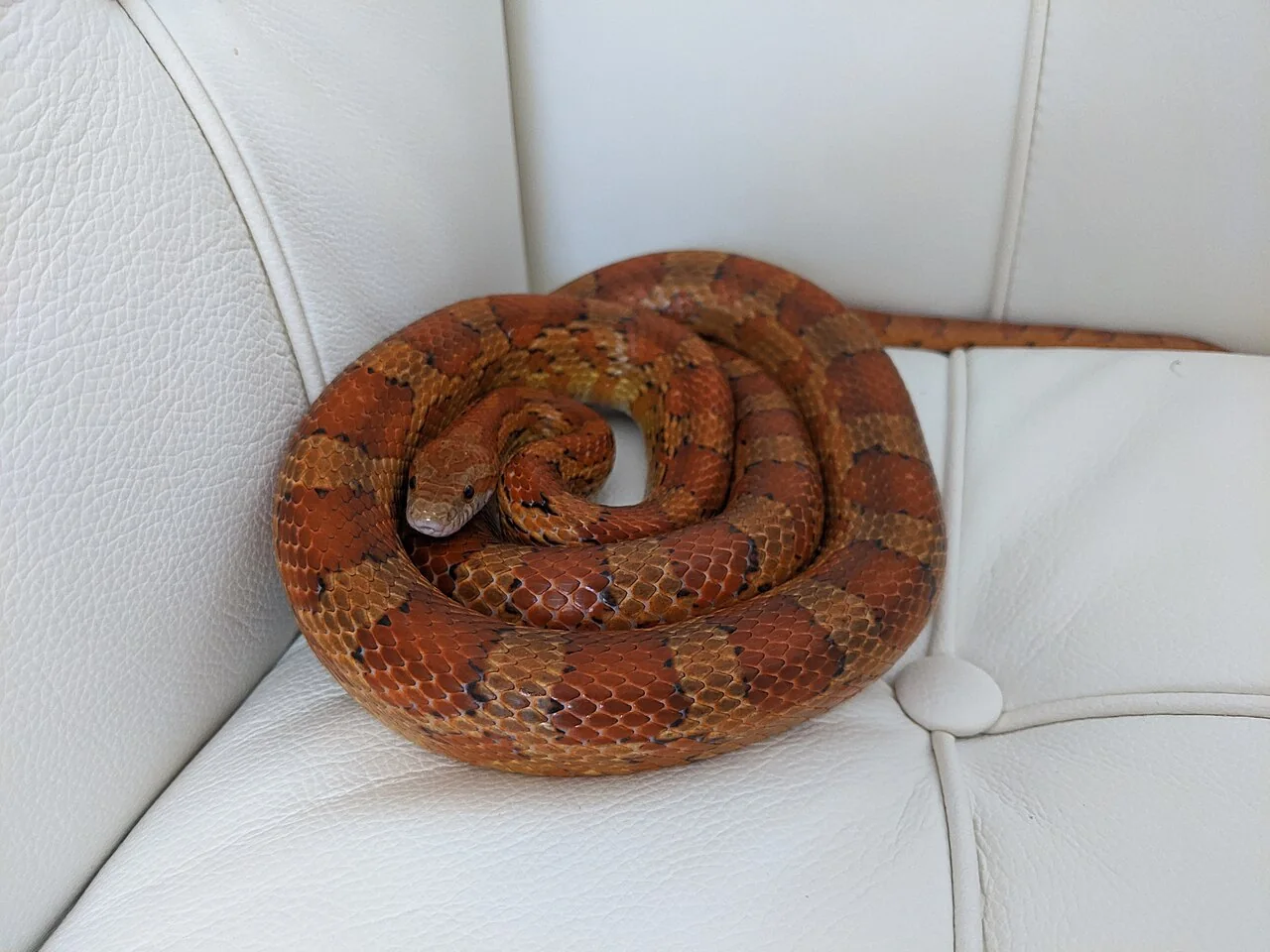
Scientific name
Pantherophis guttatus
Pantherophis guttatus is the current name for the corn snake, formerly often presented as Elaphe guttata. [1]
Origin
Eastern and southeastern United States. [1]
- Terrestrial
- Climber
- Crepuscular
At a glance
| ADULT SIZE | Up to ≈ 150 cm Total length according to the RSPCA. [2] |
|---|---|
| LIFESPAN | 10 to 15 years A captivity reference, not a ceiling. [2] |
| LIFESTYLE | Ground-dwelling and a climber Movement on the ground and among branches. [2] |
Adult size
Up to around 150 cm in total length in the RSPCA care sheet; individuals vary. [2]
Adult weight
No adult range by sex and body size is sufficiently documented in the selected sources. The isolated average value from Animal Diversity Web is not an individual target weight. [5]
Lifespan
10–15 years in captivity according to the RSPCA care sheet, without treating this as a biological ceiling. [2]
Lifestyle
Mainly terrestrial, but able to climb; most active at dawn and dusk. [2]
Beginner with guidance
A species that can be considered with initial guidance, provided secure housing, opportunities to explore and reliable measurements are planned. This level remains an editorial assessment. [3][4]
Housing
STRETCHING OUT AND EXPLORING
Length ≥ the snake’s length — Length ≥ snake; width and height ≥ one third of its length. [2]
The RSPCA uses the snake’s length as the minimum vivarium length; width and height should each be at least one third of that length. Add shelters and opportunities to explore. [2]
Care parameters
WARM SPOT · DAY
28–30 °C — RSPCA framework; see the additional details. [3]
COOL AREA · DAY
20–24 °C — RSPCA framework; see the additional details. [3]
NIGHT
16–20 °C — RSPCA framework; see the additional details. [3]
Humidity
40–50 % — RSPCA framework; the difference from the RVC is explained in the profile. [3][4]
Daytime warm spot
28–30 °C. [3] RSPCA reference at the animal’s level; heating must be thermostatically controlled and inaccessible.
Daytime cool area
20–24 °C. [3] Two separate measurement points, rather than a terrarium average.
Night
16–20 °C according to the RSPCA. [3] A routine husbandry reference; no breeding cooling protocol is provided.
Humidity
40–50 % under the RSPCA protocol. [3] The RVC suggests 50–60 % under a different protocol; do not confuse the two frameworks. [4]
Feeding
APPROPRIATELY SIZED PREY
Thawed rodents; hatchlings every 5–6 days according to the RSPCA, adults every 1–2 weeks according to the RVC. [3][4]
Complete habitat
The RVC suggests a minimum of approximately 122 × 61 × 61 cm, but the enclosure must also let the snake stretch out. Stable branches and shelters at both the warm and cool ends make the space usable. [4]
The RSPCA recommends one animal per enclosure, with shelters at ground level and higher up. It recommends a soil mixture suitable for reptiles rather than sand alone. [3]
Lighting and water
The RVC recommends low-level UVB lighting for 12 hours and lamp replacement according to its specifications. Clean water should always be available in a container large enough for immersion, and replaced daily. [4]
The RSPCA specifies a UVI ranging from 1 at the exposed spot to zero in the shade; some morphs, particularly albinos, need a lower maximum of 0,7. [3]
Feeding by life stage
Thawed rodents sized to suit the snake. The RVC generally places adult meals every 1–2 weeks, depending on weight. [4] For hatchlings, the RSPCA describes a small mouse every 5–6 days; its size rule is prey slightly wider than the body. [3]
Commercial sizes such as ‘pinkie’, ‘fuzzy’ or ‘adult’ do not replace checking the actual prey item. Recording accepted meals and changes in body condition helps with discussing adjustments without inventing a universal percentage.
Reproduction: from laying to hatching
The species lays eggs; Animal Diversity Web describes laying in a sheltered, damp site, with no subsequent parental care. [5] Eggs and hatchlings require arrangements separate from the everyday terrarium.
No cooling schedule or incubator setting is inferred from routine husbandry temperatures. Breeding conditions depend on the project and require a documented protocol before any introduction.
Health and useful care practices
Blisters, unusual droppings, retained eye caps or altered activity: seek advice. [3] The RVC recommends an annual health check and handwashing. [4]
Interpreting the reference values and keeping records for your animal
The cover uses the RSPCA framework. The RVC specifies a warmer night and higher humidity: these differences are visible in the sources and are not averaged here. [3][4]
Record the time and location of measurements, accepted meals, body mass, sheds and changes to the enclosure furnishings. Photographing an abnormality and keeping records helps communicate precise facts; the log does not provide a diagnosis or turn an empty field into a normal result.
Checklist
- Check cable openings.
- Label the warm and cool probes.
- Prepare a feeding and shedding log.
Observations to record
- Meals
- Weight
- Sheds
- Exploration
The app provides individual animal records. Check which features are available for your animal in the released version.
Related guides
Related guides
Original guides in French
Sources
Document-based overview; not a substitute for veterinary advice.
- The Reptile Database — Pantherophis guttatus
Source accessed - RSPCA — Corn snake care : température, humidité, UVB et entretien
Source accessed - RSPCA — How to care for a corn snake
Source accessed - Royal Veterinary College — Corn snake care, fiche 2024
Source accessed - University of Michigan, Animal Diversity Web — Pantherophis guttatus
Source accessed