
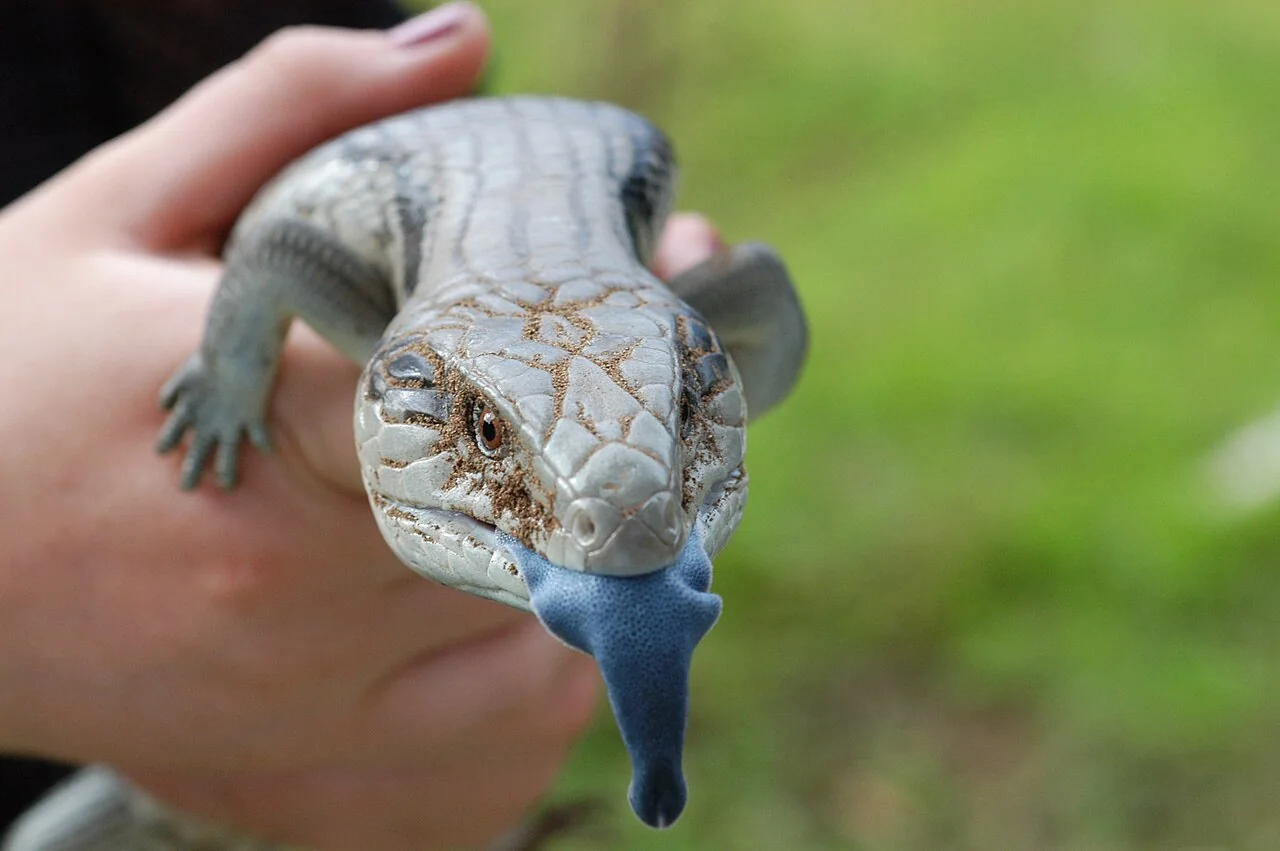
Scientific name
Tiliqua scincoides
Tiliqua scincoides comprises several subspecies. The trade name “blue-tongued skink” also covers other species, including Tiliqua gigas: their needs are not interchangeable. [2][3]
Origin
T. s. scincoides lives in southeastern Australia, T. s. intermedia in northern Australia, and T. s. chimaerea on the Tanimbar and Babar islands. [2] The museum describes open habitats with grasses and ground litter for the eastern form. [5]
- Terrestrial
- Diurnal
- Omnivorous
- Burrowing
- Individual housing
At a glance
Depending on the subspecies: Australia or the Tanimbar and Babar islands. [2] Terrestrial and diurnal; the eastern form uses shelters on the ground. [5]
| ADULT SIZE | Up to ≈ 60 cm Total length, eastern form [5]. |
|---|---|
| LIFESPAN | 20 years or more Reported captive individuals [5]. |
| LIFESTYLE | Terrestrial and diurnal Shelters on the ground [5]. |
Adult size
The eastern form reaches almost 60 cm in total length, including approximately 36 cm of head and body according to the Australian Museum; do not generalise this to all Tiliqua. [5]
Adult weight
No adult reference range sufficiently precise for the subspecies is available in the selected sources; monitor the individual’s mass and body shape.
Lifespan
The Australian Museum reports captive individuals that lived for 20 years, potentially longer. [5]
Lifestyle
Diurnal and terrestrial; it basks in the morning and then searches for food on the ground, using shelters under litter, rocks or logs. [5]
Experienced keeper
Editorial assessment: requires a large floor area, a monitored omnivorous diet and, above all, reliable identification. Humidity cannot be chosen before the subspecies is identified. [1][2][3]
Housing
GROUND TO EXPLORE
120 × 75 × 75 cm — General RSPCA minimum; length × depth × height [1].
The general RSPCA care sheet gives 120 × 75 × 75 cm, length × depth × height, for one adult housed alone. Adapt this framework to the subspecies and the animal’s size. [1]
Care parameters
TEMPERATURES
Depending on the subspecies — General framework detailed in the profile [1][2].
Humidity
Depending on the subspecies — Northern: 40–60 %; not a universal value [4].
Day — general framework
Warm 30–32 °C; cool 22–25 °C [1] The RSPCA guide covers blue-tongued skinks; it does not validate conditions for every subspecies individually. Clarify the plan with a specialist.
Night — general framework
20–22 °C [1] Reference from the same general care sheet; lights off.
UVB — general framework
UVI 3–5 in the warm area → 0 in shade; 12 h/12 h [1] Exposure at the animal’s level, with shelters.
Humidity
Subspecies to be confirmed [1][4] South Pasadena gives 40–60 % for the Northern, T. s. intermedia; this figure does not apply to every form.
Feeding
PLANT AND ANIMAL FOODS
Omnivorous diet; juveniles daily, adults every 2–3 days according to Long Island [3].
Habitat, substrate and water
Provide shelters at both ends, substrate that permits burrowing and stable furnishings. The RSPCA describes suitable deep substrate and recommends individual housing. [1] Long Island notes the value of a heavy, shallow dish with an easy exit; remove soiling and leftover food daily. [3]
General recommendations do not replace identification. Ask for the subspecies name and the lineage’s provenance, keep this information with the animal’s documents and have the husbandry conditions confirmed before the permanent setup is installed. [2][3]
Feeding juveniles and adults
The Long Island guide, which explicitly includes T. scincoides among several Tiliqua, suggests a daily meal for juveniles and one meal every two to three days for adults. Combine varied plant foods with suitable animal foods; monitor body condition rather than applying a universal percentage to every lineage. [3]
Keep fruit occasional. South Pasadena recommends a varied diet and supplements coordinated with the diet and lighting. The schedule and products should be adjusted with the veterinarian; no vitamin or medication dose is inferred from this profile. [4]
Behaviour and handling
The blue tongue, hissing and an open mouth can be defensive displays. A frightened animal may bite; avoid grabbing it abruptly and support its body. In the wild, individuals spend most of the year alone, and breeding encounters can be aggressive. [5]
Birth of live young
The Australian Museum describes embryos developing inside the female and young that are independent after birth. There is therefore no clutch of eggs to place artificially in an incubator for this species. [5]
Seasonal dates observed in Australia are not a calendar to reproduce automatically in a European home. No cooling or breeding-weight threshold is prescribed here. Plan separation and monitoring of the young, as well as access to veterinary care, before starting a project.
Monitoring and warning signs
Respiratory discharge, open-mouth breathing, tremors, a weak jaw, retained shed or weight loss warrant a consultation. [4] Recording enclosure measurements and the exact type of food helps put these signs in context.
Check water, mobility, weight-bearing and access to shelters every day. Note food intake and stools; keep weight measurements and a photograph of body shape taken under comparable conditions. An average value from another Tiliqua species must not become a growth target.
Checklist
Observations to record
- Identity and subspecies
- Weight and body shape
- Plant/animal food meals
- Stools and sheds
- Temperatures and humidity
- Observed births
The app provides individual animal records. Check which features are available for your animal in the released version.
Related guides
Original guides in French
Sources
Document-based overview; not a substitute for veterinary advice.
- RSPCA — Caring for your Blue Tongue Skink (guide général)
Source accessed - The Reptile Database — Tiliqua scincoides
Source accessed - Long Island Bird & Exotics Veterinary Clinic — Blue-Tongued Skink Care Guide (plusieurs Tiliqua)
Source accessed - South Pasadena Animal Hospital — Blue Tongue Skink Care (Northern et Indonesian distingués)
Source accessed - Australian Museum — Eastern Blue-tongue Lizard
Source accessed