
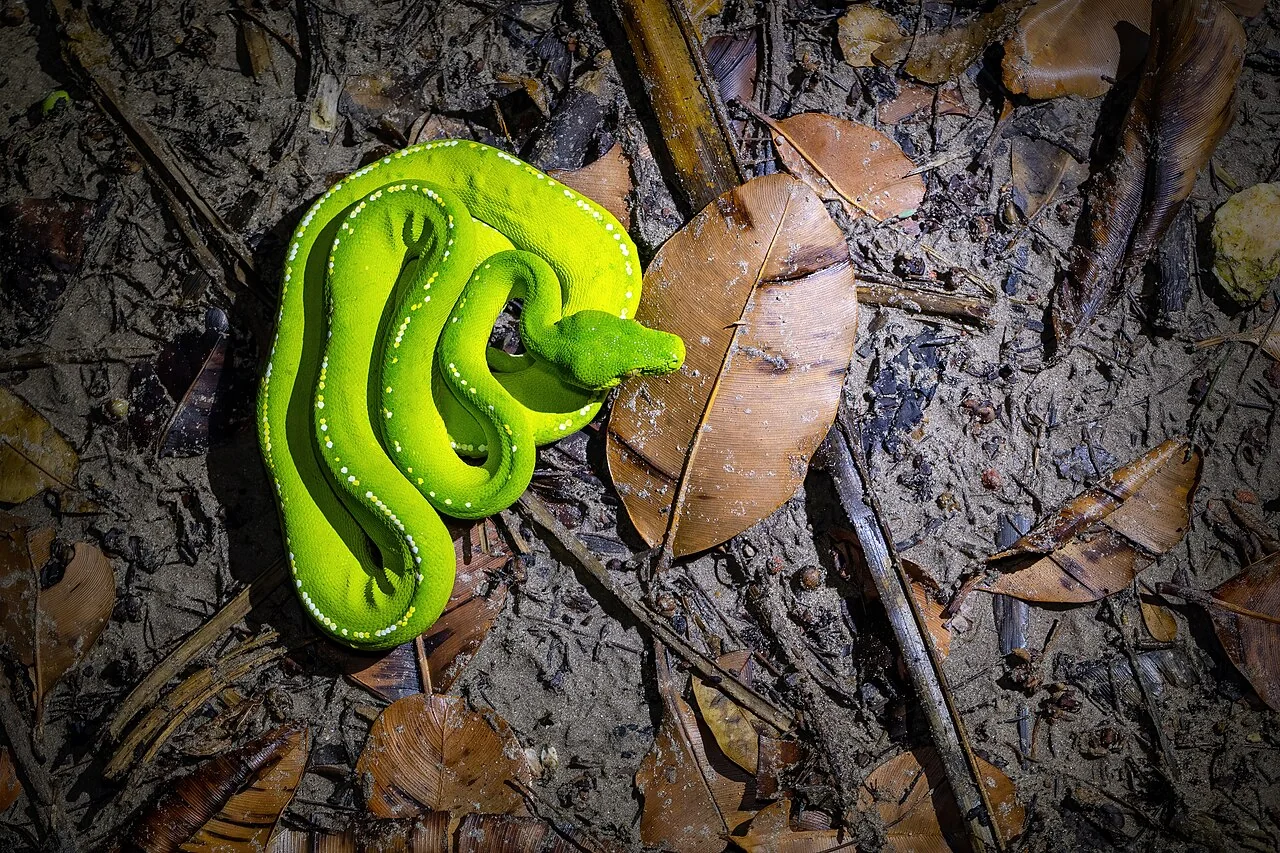
Scientific name
Morelia viridis
Other names: Chondropython viridis
Morelia viridis belongs to the group of arboreal green pythons. Taxonomy distinguishes Morelia azurea; an old trade name is therefore not enough to confirm identity. [1]
Origin
New Guinea, the Aru Islands and northeastern Cape York. [1]
- Arboreal
- Constrictor
- Perches
At a glance
| ADULT SIZE | ≈ 1,5 m Length published by the Smithsonian. [2] |
|---|---|
| LIFESPAN | Up to 20 years Maximum cited in captivity. [2] |
| LIFESTYLE | In trees Resting and hunting on branches. [2] |
Adult size
Up to around 1,5 m according to the Smithsonian. [2]
Adult weight
No adult range by sex and provenance is sufficiently documented in the selected sources. Individual monitoring takes precedence over a generic target weight.
Lifespan
Up to 20 years in captivity at the Smithsonian; this stated ceiling is not an average. [2]
Lifestyle
Mostly in trees; adults active at night. [2]
Expert
Arboreal husbandry and simultaneous monitoring of perches, ventilation and humidity require a well-controlled enclosure. Editorial assessment. [3][4]
Housing
USABLE PERCHES
From 90 × 60 × 60 cm — ReptiFiles starting point, to be enlarged to allow stretching. [3]
ReptiFiles suggests space that allows full stretching and solid perches at several levels. [3]
Care parameters
WARM PERCH · DAY
27–30 °C — Measured by a probe on the branch, according to ReptiFiles [3].
COOL AREA · DAY
21–26 °C — Measurement in shade; night at 20–22 °C in this reference [3].
Humidity
40–70 % — Variation between humidification and drying, with ventilation [3].
Warm perch
27–30 °C. [3] Probe placed on the perch in this reference.
Cool area
21–26 °C. [3] Measurement in shade among the furnishings.
Humidity
40–70 %, with fluctuations. [3] Also record the drying phase.
Night
20–22 °C. [3] Note the overnight minimum.
Feeding
AN APPROPRIATE DIET
Thawed rodents; 7–10 days for juveniles, around two weeks for adults in the clinical care sheet. References to be contextualised. [4]
Complete arboreal habitat
The clinic recommends horizontal branches and vegetation that provides cover. The snake must be able to choose its position without being permanently exposed. [4] The initial ReptiFiles minimum does not remove the need to allow full stretching and enlarge the enclosure for adult body size. [3]
The Smithsonian describes the posture coiled on a branch and the prehensile tail. These adaptations explain why empty height alone is not a functional arboreal setup. [2]
Heat, UVB and humidity
The cover follows the ReptiFiles setup: record temperatures on occupied perches and allow alternating humidification and drying. [3] Chicago Exotics publishes another, warmer thermal framework; these protocols are not merged. [4]
The clinic considers a low level of UVB useful. The source does not set a measured UVI: document the lamp, mesh, distance and shaded areas rather than inventing an equivalence between commercial output and exposure. [4]
Substrate and water
ReptiFiles recommends moisture-retaining ground, regular removal of soiling and clean water replaced daily. Misting does not replace the water container. [3]
For records, note periods when the substrate and branches dry. A humidity reading taken immediately after spraying does not represent the whole day; keeping the reading time makes comparisons useful.
Feeding and frequency
The Smithsonian feeds mice and rats to its animals. [2] Chicago Exotics describes thawed rodents, meals every 7–10 days for juveniles and hatchlings, and around every two weeks for adults. This clinical rhythm still needs adjustment to body size and condition. [4]
Older ‘green tree python’ care sheets sometimes include localities now classified differently. Keep provenance records and have the individual’s feeding plan clarified; no universal prey percentage is proposed.
Breeding and limitations
The species lays eggs. [1] The Smithsonian describes the female coiled around her clutch and incubation observed over several weeks. [2] These observations do not constitute complete incubator settings, and hatchlings’ needs are not inferred from adults’ needs.
Breeding is not a compulsory stage of husbandry. A project requires separate monitoring of parents, eggs and young, as well as enclosures ready before laying.
Health and daily care
The clinic warns about temperature errors and regurgitation. [4] Record any change in posture, feeding, breathing or shedding, then communicate observations to the veterinarian without concluding there is a single cause.
Photograph perches and their positions, and record accepted meals, weight, sheds and cleaning. A probe map is particularly useful for distinguishing terrarium air from the branch actually used. This log complements observation and does not turn an attractive appearance into proof of good conditions.
Checklist
- Check closures and supports.
- Identify every measurement zone.
- Keep provenance data.
Observations to record
- Meals
- Weight
- Sheds
- Temperatures
The app provides individual animal records. Check which features are available for your animal in the released version.
Related guides
Original guides in French
Sources
Document-based overview; not a substitute for veterinary advice.
- The Reptile Database — Morelia viridis
Source accessed - Smithsonian’s National Zoo — Green tree python
Source accessed - ReptiFiles — Green Tree Python Care Sheet
Source accessed - Chicago Exotics — Green tree python care
Source accessed