
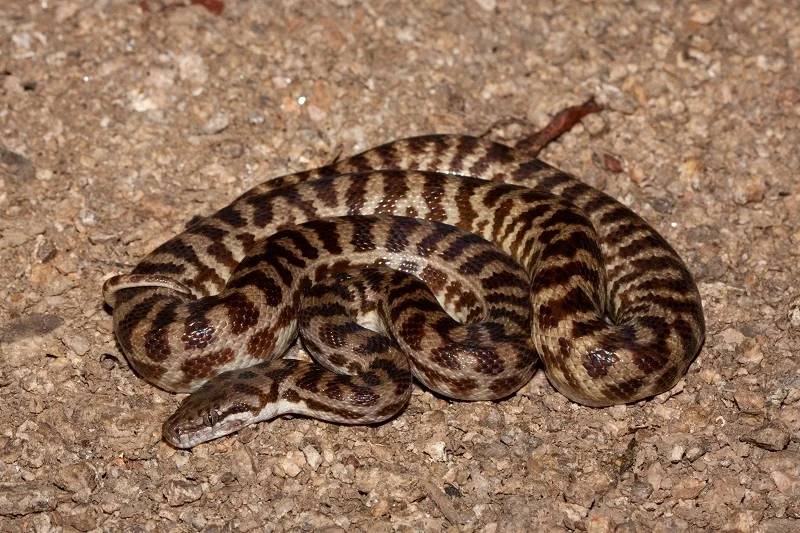
Scientific name
Antaresia maculosa
Antaresia maculosa does not refer to the New Guinea populations now assigned to Antaresia papuensis. [1]
Origin
Eastern Queensland and New South Wales, Australia. [1]
- Small python
- Contrasting spots
- Climber
At a glance
| ADULT SIZE | Up to 130 cm Total length reported by Animal Diversity Web [3]. |
|---|---|
| LIFESPAN | 15–30 years Antaresia group reference, not a species-specific average [4]. |
| LIFESTYLE | Ground and branches Partial use of trees documented [1]. |
Adult size
Up to around 130 cm in total length according to Animal Diversity Web. [3]
Lifespan
15–30 years in the Antaresia veterinary table; a mean specific to A. maculosa is not established. [4]
Lifestyle
Partly arboreal. [1]
Housing
ACCESSIBLE SHELTERS
Space to be sized — The veterinary care sheet sets no enclosure volume. Provide shelters and strong supports [2].
Strong branches, shelters and ventilation according to veterinarians. [2]
Care parameters
GRADIENT · LOWER LIMIT
26 °C — Antaresia veterinary table; air/surface not specified [4].
GRADIENT · UPPER LIMIT
32 °C — Limit of the same gradient; warm surface not specified [4].
Humidity
50–70 % — Range from the veterinary table explicitly including A. maculosa [4].
Gradient
26–32 °C. [4] Table shared across Antaresia; air/surface not specified.
Heating spot
Surface not established here. Record support temperature separately.
Humidity
50–70 %. [4] Veterinary reference shared across the genus.
Night
Individualised value to be clarified. Record actual minimums.
Feeding
AN APPROPRIATE DIET
Suitable, fully thawed rodents. [2]
Feeding
Suitable, fully thawed rodents. [2]
Behaviour and precautions
The large dark spots retain their contrast in adults. Total size must not be confused with the snout–vent measurement used in taxonomy. [1][3]
Useful records
Record mass, accepted or refused meals, sheds and probe locations. A measurement benefits from being accompanied by its time and zone. Compare observations over time; an unusual change warrants veterinary advice.
An enclosure that can be checked daily
This veterinary care sheet explicitly includes Antaresia maculosa. It provides for branches, hides and a stable water container, as well as heating control. Shelters do not prevent retaining practical access for maintenance. [5]
Prey is offered whole and dead. The cited reference is weekly for juveniles and every two to three weeks for adults; it still needs adaptation to body condition, prey and the individual, without creating a universal automatic reminder. [5]
Checklist
- Check closures and supports.
- Identify every measurement zone.
- Keep provenance data.
Observations to record
- Meals
- Weight
- Sheds
- Temperatures
The app provides individual animal records. Check which features are available for your animal in the released version.
Related guides
Original guides in French
Sources
Document-based overview; not a substitute for veterinary advice.
- The Reptile Database — Antaresia maculosa
Source accessed - The Unusual Pet Vets — Antaresia Species Caresheet
Source accessed - University of Michigan, Animal Diversity Web — Antaresia
Source accessed - Doneley et al. — Reptile Medicine and Surgery in Clinical Practice, tableau 1.5, p. 7–8
Source accessed - North Shore Veterinary Specialist & Emergency Centre — Antaresia Python Care 2025
Source accessed