
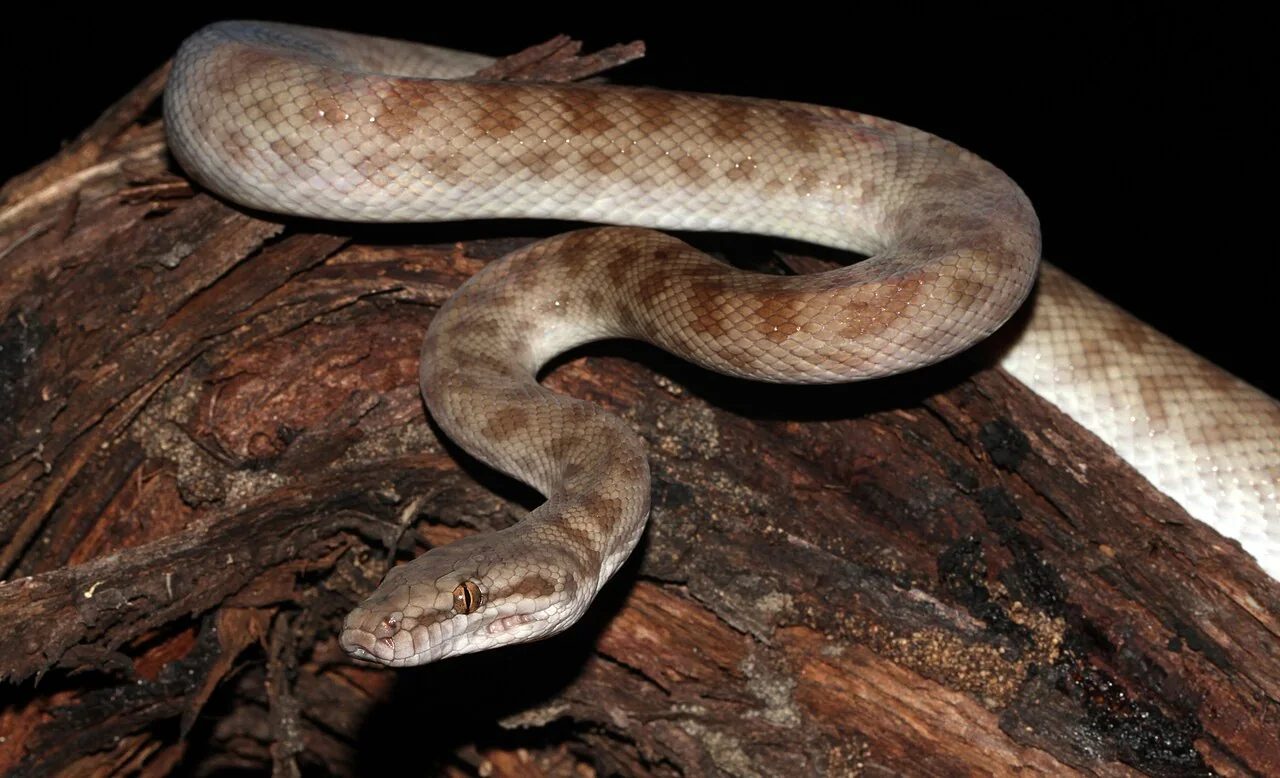
Scientific name
Antaresia childreni
Other names: Antaresia stimsoni
Antaresia childreni now includes the former Antaresia stimsoni in the classification followed by the Reptile Database. [1]
Origin
Australia, particularly the Northern Territory, Queensland and Western Australia. [1]
- Small python
- Shelters
- Climber
At a glance
| ADULT SIZE | ≈ 1 m Approximate scale from a university source. [3] |
|---|---|
| LIFESPAN | 25,7 years Maximum recorded in captivity. [4] |
| LIFESTYLE | Ground and branches Partly arboreal. [1] |
Adult size
Around 1 m according to Animal Diversity Web. [3]
Adult weight
AnAge reports 384 g as an adult reference mass, without a range by sex or population. This documentary data point is neither an average for all adults nor a feeding target. [4]
Lifespan
AnAge documents a maximum of 25,7 years in captivity; this record does not describe an average. [4]
Lifestyle
Partly arboreal. [1]
Beginner with guidance
Distinguishing juvenile and adult, securing housing and monitoring meals requires guidance. Editorial level. [2]
Housing
SHELTERS AND BRANCHES
Space to be sized — Dimensions to be adapted; shelters and branches. [2]
Ventilated individual vivarium, shelters and branches; dimensions to be adapted to body size. [2]
Care parameters
JUVENILE < 1 YEAR · GRADIENT
25–34 °C — Clinical juvenile framework, continuous heating. [2]
ADULT · HEATING SPOT
33–38 °C — Adult cool side: 16–20 °C under this protocol. [2]
NIGHT · WARM-SIDE AIR
≥ 20 °C over prolonged periods — Avoid a prolonged drop below 20 °C on the warm side; maintain the life-stage-specific gradient. [2]
Humidity
50–70 % — Veterinary reference shared by the explicitly listed Antaresia species [5].
Juvenile under one year
25–34 °C, gradient for juveniles < 1 year. [2] The care sheet recommends continuous heating at this stage; this does not mean a uniform temperature.
Adult: heating zone
33–38 °C. [2] Reference from the Antaresia document, which distinguishes this spot from the cool zone.
Adult: cool zone
16–20 °C. [2] Do not apply this adult framework to a hatchling.
Night: warm-side air
Must not remain below 20 °C for prolonged periods. [2] The adult cool zone at 16–20 °C does not describe the whole vivarium’s night temperature; retain the gradient and the juvenile-specific framework.
Humidity
50–70 % in the archived veterinary table. [5] Antaresia group value; source reread on 9 October, not presented as a new measurement.
Feeding
AN APPROPRIATE DIET
Thawed rodents; different rhythms for juveniles and adults, detailed in the profile. [2]
Identity and habitat
The Reptile Database treats Antaresia stimsoni as a synonym of Antaresia childreni. Keeping this former name on provenance documents avoids confusing a name change with a change of animal. [1]
Ventilated individual housing, shelters and stable branches; no accessible adhesive. The clinic sets no universal enclosure volume. [2]
Heat and light
The clinic distinguishes juveniles and adults; do not recombine their gradients. At night, warm-side air must not remain below 20 °C for prolonged periods: the adult cool zone at 16–20 °C therefore does not apply to the whole vivarium. A juvenile under one year retains its 25–34 °C gradient with continuous heating. It suggests 12 hours of light in summer, 10 in winter. [2]
Their care sheet provides no usable species-specific UVI target. Air temperature and the heated spot’s temperature must remain identified in the records. Missing UVB data do not demonstrate a lack of benefit: have the equipment clarified before installation.
Substrate and water
Paper can be used for observation; prevent substrate ingestion. Clean water remains accessible in a stable container. [2]
Recording the material used, the change date and any soiling makes comparison easier after rearrangement. The aim is to understand what changed, without automatically attributing food refusal to the latest intervention.
Feeding by life stage
Suitable mice or rats, fully thawed: juveniles every 7–10 days, adults every 1–3 weeks according to condition. Antaresia framework including childreni. [2]
Animal Diversity Web describes a wild diet in childreni that includes small mammals, amphibians and lizards. This inventory does not replace a captive feeding plan and does not recommend collecting any wild prey. [3]
Reproduction: laying and brooding
The species lays eggs. [1] The university synthesis describes, at Antaresia level, a female that broods followed by independent young; reproduction draws on maternal body reserves. [3]
AnAge lists incubation of 55 days without describing the associated settings: this number is not used as a recipe. [4] Plan a complete protocol and professional monitoring before any breeding attempt.
Health and records
Prevent overheating and life-stage errors. [2] Weight loss, injury or unusual breathing are observations to communicate to the veterinarian.
Record mass with its date, life stage, accepted meals, sheds and areas visited. AnAge’s maximum lifespan and reference mass do not describe an obligatory trajectory: follow the real animal, not a curve invented from these two figures. [4]
Checklist
- Check closures and supports.
- Identify every measurement zone.
- Keep provenance data.
Observations to record
- Meals
- Weight
- Sheds
- Temperatures
The app provides individual animal records. Check which features are available for your animal in the released version.
Related guides
Original guides in French
Sources
Document-based overview; not a substitute for veterinary advice.
- The Reptile Database — Antaresia childreni
Source accessed - The Unusual Pet Vets — Antaresia Species Caresheet
Source accessed - University of Michigan, Animal Diversity Web — Antaresia
Source accessed - AnAge — Antaresia childreni
Source accessed - Doneley et al. — Reptile Medicine and Surgery in Clinical Practice, tableau 1.5, p. 7–8
Source accessed