
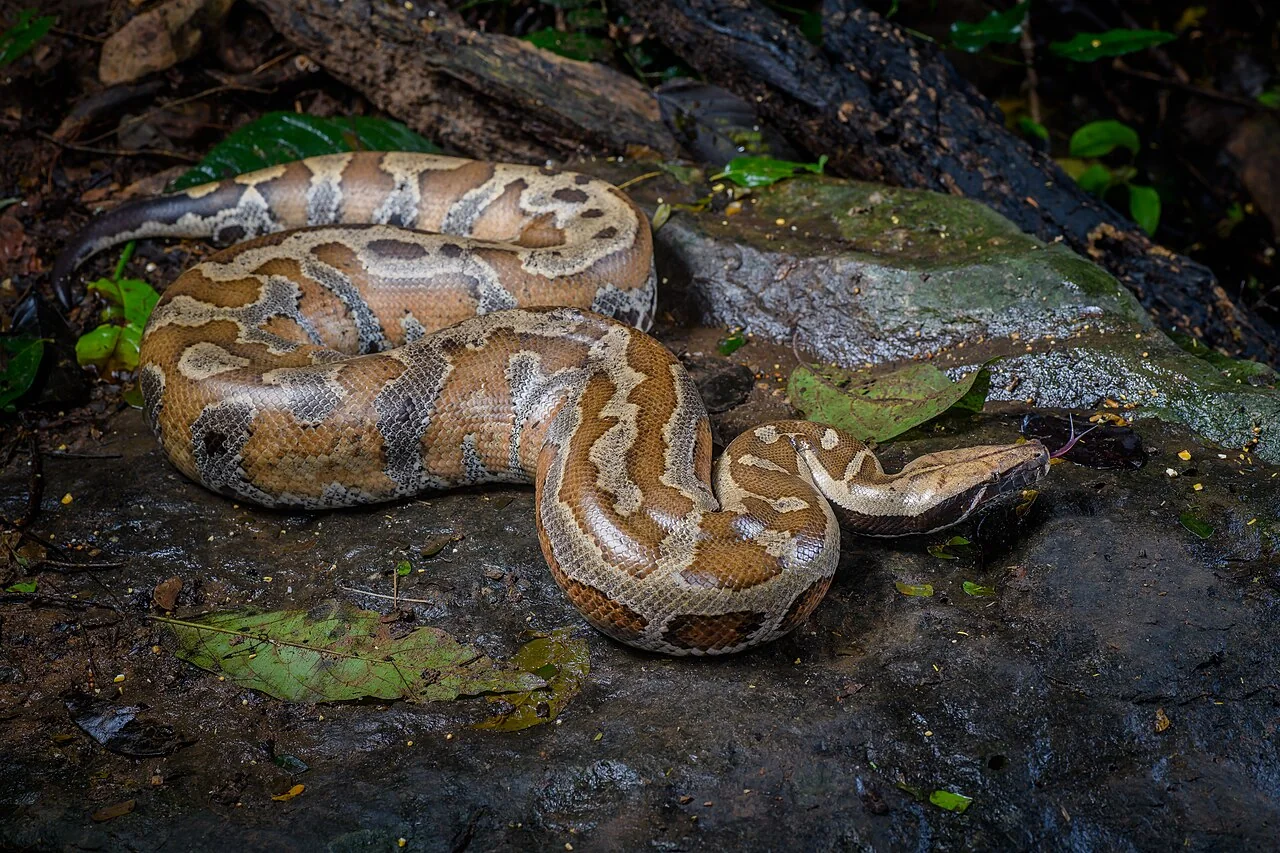
Scientific name
Python brongersmai
Other names: Python curtus brongersmai
The blood python is a species distinct from the other short-tailed pythons. Its robust body makes monitoring meals and body condition particularly useful, beyond its reputation for a good appetite. [1][5]
Origin
South-East Asia, particularly Sumatra and the Malay Peninsula; its distribution must not be confused with that of the Borneo python. [1]
- Short-tailed python
- Terrestrial
- Feeding monitoring
SVL measurements from a historical sample; attributed husbandry frameworks; grouped statistics not assigned to this species alone.
At a glance
| ADULT SIZE | 132–144 cm SVL Sample averages, tail excluded [2]. |
|---|---|
| LIFESPAN | Not established No average retained. |
| LIFESTYLE | Robust body Short-tailed group [1]. |
Adult size
Wild sample cited by Keogh and colleagues: averages of 132,4 cm SVL in males and 143,9 cm in females; tail excluded. [2]
Lifespan
No sufficiently documented species-specific average lifespan retained.
Lifestyle
A heavily built python; observation and interventions adapted to the individual. [2][5]
Housing
A SUITABLE HABITAT
Ground shelters — Routes and access adapted to the animal’s build.
Provide usable floor area, shelters and maintenance access compatible with adult build.
Care parameters
WARM SPOT · DAY
30 °C if needed — Heating for some adults at TBC [3].
COOL AREA · DAY
27–29 °C ambient — Conversion of 80–84 °F [3].
Humidity
Approximately 60 % — Keeper’s reference point for the group [4].
Daytime ambient temperature
Approximately 27–29 °C Rounded conversion of the 80–84 °F used by The Blood Cell for the three species. [3]
Additional heating
30 °C in some cases 86 °F offered to some adults in the breeding setup, not a mandatory setting for all. [3]
Humidity
Approximately 60 %, a keeper’s framework Average practical value, with ventilation checks; no constantly waterlogged ground. [4]
Feeding
MONITORED FEEDING
Suitable rodents; monitor body condition [5].
Identify the species before the colour
Python brongersmai is accepted by The Reptile Database, which retains Python curtus brongersmai as a former combination. [1] The study by Keogh, Barker and Shine distinguishes the three taxa historically grouped under Python curtus. [2] Red colour or a morph name does not replace this identification. Keeping species, colour selection and stated provenance separate avoids duplicates. During purchase, ask for the parents’ names and available documents, without turning a trade label into proof of locality.
Adult size, lifespan and lifestyle
Wild sample cited by Keogh and colleagues: averages of 132,4 cm SVL in males and 143,9 cm in females; tail excluded. [2]
No sufficiently documented species-specific average lifespan retained.
A heavily built python; observation and interventions adapted to the individual. [2][5]
Reading build correctly
The taxonomic study reports averages of 132,4 cm in males and 143,9 cm in females in snout–vent length for a previously studied wild sample. [2] The tail is therefore excluded; these values cannot be directly compared with adverts giving total length. Heavy build also does not provide a universal target weight. To prepare housing, record the individual’s dimensions and provide openings that allow it to be moved without trapping its body against the frame.
Setting up an inspectable environment
Before arrival, check closures and shelter stability using a written procedure. Easy access to water and substrate reduces movement imposed on the snake during maintenance. The CITES overview emphasises the importance of records and checking facilities when captive birth is declared. [6] For a private keeper, retaining feeding and provenance history from the outset is a practical extension of this traceability. A clean setup at transfer does not, by itself, demonstrate the animal’s origin.
Heating: do not confuse the tropics with overheating
The Blood Cell describes keeping the three species at 80–84 °F, or approximately 27–29 °C; some adults have an area at 86 °F, or 30 °C. [3] This captive account does not prove a universal optimal temperature. Documenting it as such avoids increasing heat solely because the snake comes from the tropics. Measuring every accessible zone, dating settings and retaining probe locations allows activity changes to be interpreted without altering several variables at once.
Humidity and substrate maintenance
The Blood Cell gives approximately 60 % average humidity in its breeding setup and clearly distinguishes air humidity from a constantly wet cage. [4] The value must be accompanied by measurement context. After adding water, record when surfaces become dry again and whether condensation persists. An overturned container is not a regulation method. Check areas beneath shelters, where substrate appearance may differ from what is visible at the front, and record every change before concluding that the entire housing is too dry.
Feeding and body shape
The Blood Cell uses rats, adapts meals to age and body condition and warns against excessive portions in these robust snakes. [5] This experience is useful for building a monitoring routine, without automatically copying another collection’s timetable. Record prey actually swallowed, its presentation and date, then compare weighings under similar conditions. A strong appetite is insufficient to justify an additional ration. Seek advice when refusal accompanies deterioration in general condition.
Laying and the breeding project
The species is oviparous. [1] The Barkers describe females coiled around their eggs in their specialist article. [7] The CITES manual groups some statistics for the three short-tailed species: we do not present them as an expected brongersmai clutch. [6] A project requires separate records for parents, the clutch and juveniles. Neither a published average duration nor a season abroad alone provides an incubation or cooling recipe to apply.
Precautions and monitoring changes
The specialist authors describe a sometimes intense feeding response. [5] Organising tools and openings before intervening avoids confusing maintenance with prey delivery. The log can track sheds, meals, defecations, posture and setup measurements. Do not infer constipation solely from the interval between two stools: describe observed signs and history to the veterinarian. Weighing frequency must allow useful comparison without multiplying handling; monitoring serves to understand the individual, not achieve a growth record.
Checklist
- Confirm species and provenance.
- Distinguish total length from snout–vent length.
- Check ventilation before increasing humidity.
Observations to record
- Manual log of prey and refusals.
- Dated weight, body-shape and shedding records.
- Localised thermal and humidity measurements.
The app provides individual animal records. Check which features are available for your animal in the released version.
Related guides
Original guides in French
Sources
Document-based overview; not a substitute for veterinary advice.
- The Reptile Database — Python brongersmai
Source accessed - Keogh, Barker et Shine, 2001 — Systematics and biogeography of the Python curtus group
Source accessed - The Blood Cell — Heating, expérience d’élevage
Source accessed - The Blood Cell — Humidity, expérience d’élevage
Source accessed - The Blood Cell — Feeding, expérience d’élevage
Source accessed - CITES / TRAFFIC — Inspection Manual, 2013, pages 46–47
Source accessed - Dave et Tracy Barker — The Blood Python, Reptiles Magazine, 2011
Source accessed