
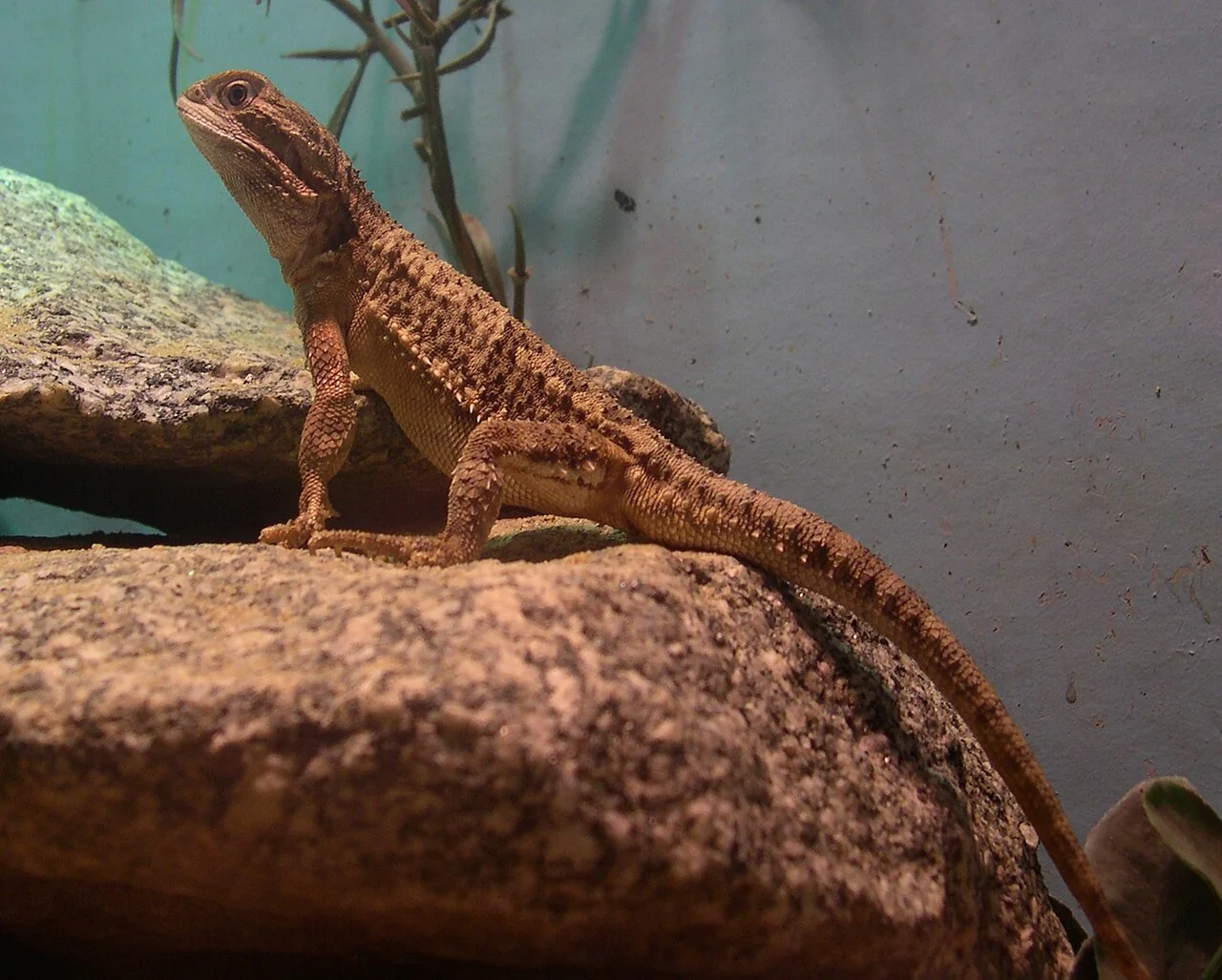
Scientific name
Pogona henrylawsoni
Other names: Pogona brevis · Pogona rankini
This small diurnal agamid from Queensland is a distinct species. “Rankin” is a common name; Pogona brevis is a synonym confirmed by the Western Australian Museum catalogue [1][4].
Origin
Central Queensland, Australia; the type locality is west of Richmond [1].
- Diurnal
- Terrestrial
- Omnivorous
At a glance
A small agamid from Queensland; Pogona brevis is a synonym and “rankini” an old informal name [1][4].
| ADULT SIZE | ≈ 30 cm Total; approximately 13 cm snout to vent according to BGSU [2]. |
|---|---|
| ACTIVITY | Diurnal A species distinct from P. vitticeps [1][2]. |
| DIET | Omnivorous Insects and plants [2][3]. |
Adult size
BGSU gives approximately 30 cm total length and 13 cm snout to vent; the two measurements must not be confused [2].
Lifespan
BGSU states 10–15 years as an average lifespan, without a detailed demographic series; this husbandry estimate is not a demonstrated record [2].
Lifestyle
Diurnal, uses the ground and basking supports; the university profile associates it with a semi-desert transition zone [2].
Housing
ARRANGING ITS HABITAT
Ground, light and shelters — Small dimensions in older guides not retained as a validated minimum [2][3].
A lit terrestrial setup with exposed supports and shelters; the small dimensions of older guides are not retained as a validated minimum [2][3].
Care parameters
PUBLISHED AMBIENT CONDITIONS
26–29 °C — BGSU reference point; heating to clarify separately [2].
Humidity
20–40 % — Maritime Geckos reference point, drawn from its experience [3].
Published ambient conditions
26–29 °C [2] Reference point from the university profile, distinct from the heated support.
Heating
To clarify by measurement The sources describe the basking point without a sufficiently precise method for a single instruction [2][3].
Captive humidity
20–40 % [3] Range stated by Maritime Geckos, without a controlled trial.
Night — this guide’s limit
Reptile One states not to fall below 16 °C at night; this limit is not a target temperature. [5] Scope: captivity; lower bound given by Reptile One. A reported limit is neither a target nor an established physiological threshold.
Feeding
FEEDING AND MONITORING
Suitable insects and identifiable plants; check intake and consider supplements alongside lighting [2][3].
A naming history to clarify
Ryan Ellis’s catalogue explains why Pogona brevis was placed in synonymy: the henrylawsoni type specimen, once considered lost, had in fact been re-registered [4]. The Reptile Database also distinguishes “rankini”, an old informal name, from a validly described species [1]. An invoice using an old name is therefore insufficient to create a new species. Keeping photographs of the parents and the history remains useful, particularly given the captive hybridisation reported by the database.
Adult size, lifespan and lifestyle
BGSU gives approximately 30 cm total length and 13 cm snout to vent; the two measurements must not be confused [2].
BGSU states 10–15 years as an average lifespan, without a detailed demographic series; this husbandry estimate is not a demonstrated record [2].
Diurnal, uses the ground and basking supports; the university profile associates it with a semi-desert transition zone [2].
Organising an active ground area
The BGSU profile combines a shelter, wood and basking lighting; Maritime Geckos recommends shelters in several thermal zones [2][3]. These functions matter more than a commercial volume presented alone. Mapping movement between food, rest and exposure allows a check that elements do not block walking. Supports must remain stable and accessible. No sufficiently supported recent numerical minimum is proposed here from the small setups described in these documents.
Lighting and temperatures: two linked questions
BGSU gives ambient conditions of 26–29 °C, while the two guides describe basking points using different wording [2][3]. Without a comparable measurement method, combining them into one range would be artificial. Maritime Geckos explicitly mentions UVB [3]. Its provision must be planned alongside retreats outside exposure. To document the setup, record lamp model, actual distance, intervening mesh and the surface accessible to the animal, then check measurements.
Humidity and access to water
The 20–40 % range comes from an identified keeper, who presents the profile as basic and drawn from personal experience [3]. It does not describe a study of natural microhabitats. BGSU provides for a shallow dish [2]. Observing water use and substrate condition therefore complements a central reading. A brief rise after maintenance and a constantly waterlogged area are not equivalent; recording context avoids a misdirected automatic correction.
Insects, plants and supplements
The two practical sources describe mixed feeding, with prey and plants [2][3]. They do not validate a universal nutritional proportion by age. Presenting foods in an identifiable form helps check what is actually consumed, particularly by a juvenile selecting insects. Removing uneaten prey is among the precautions mentioned by BGSU [2]. The calcium and vitamin programme must account for the entire menu and lighting, without blindly multiplying products.
Cohabitation: contradictory recommendations
BGSU mentions groups containing several males, whereas Maritime Geckos recommends individual keeping outside breeding [2][3]. This discrepancy does not allow cohabitation to be declared risk-free. An individual project avoids having to interpret group interactions from arrival. In any established group setup, separately monitoring access to meals, shelters and exposure is more precise than simply noting that animals remain close or seem calm.
Clutches and juveniles: attributed data
BGSU reports clutches of 5–18 eggs and incubation at 28 °C in its husbandry overview [2]. The document does not provide the detailed results needed to make a complete recipe. Its cooling timetable is not reproduced as a mandatory step. Preparing a laying area and setups for juveniles first requires confirmation of the breeding animals’ identities, maturity and condition. Growth differences must remain individually observable.
What monitoring can verify
A small species does not automatically become easy to keep in a small enclosure. The sources consulted primarily provide robust taxonomy and husbandry practices, with fewer experimental data on captive climate [1][2][3][4]. Photographing the setup and keeping measurements allows someone assisting to understand an appetite or activity change. An unknown age cannot be calculated from length. Persistent weakness or weight loss warrants an examination, without waiting for a supposed shedding deadline.
Checklist
- Keep the animal’s identity and provenance.
- Prepare exposed zones and refuges where measurements can be taken.
- Monitor meals, weight and behaviour individually.
Observations to record
- Meals
- Weight
- Sheds
- Temperature
- Humidity
- Behaviour
The app provides individual animal records. Check which features are available for your animal in the released version.
Related guides
Original guides in French
Sources
Document-based overview; not a substitute for veterinary advice.
- The Reptile Database — Pogona henrylawsoni
Source accessed - BGSU Herpetarium — Rankin’s Dragon
Source accessed - Maritime Geckos — Rankin’s Dragon care sheet
Source accessed - Ellis (2019) — An annotated type catalogue of the dragon lizards in the Western Australian Museum
Source accessed - Black Soil Bearded Dragon — Pogona henrylawsoni
Source accessed