
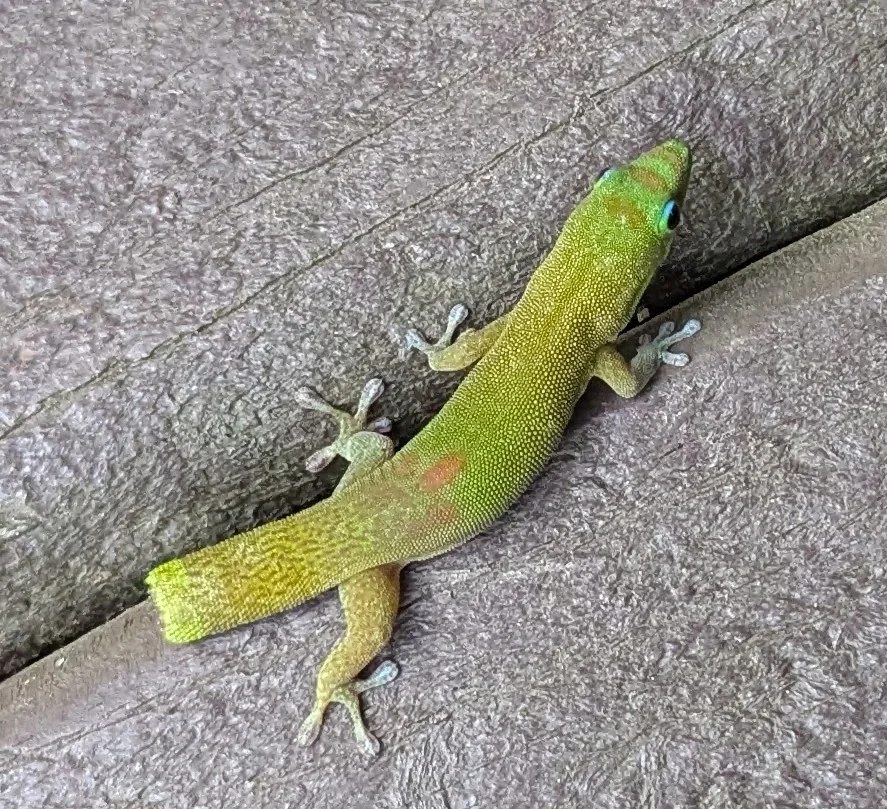
Scientific name
Phelsuma laticauda
Other names: Pachydactylus laticauda
This small diurnal gecko has a neck speckled with yellow and a broad tail. The subspecies laticauda and angularis belong to a single species profile here [1][3].
Origin
Madagascar and neighbouring islands; introduced populations, particularly in Hawaii and Moorea, are not part of its native range [1].
- Arboreal
- Diurnal
- Omnivorous
At a glance
A small diurnal gecko from Madagascar and neighbouring islands; introduced populations are distinguished from its native range [1][3].
| ADULT SIZE | 10–13 cm Total length, nominate form [3]. |
|---|---|
| ACTIVITY | Diurnal Arboreal [3]. |
| DIET | Omnivorous Prey and a fruit component [2][3]. |
Adult size
10–13 cm total length for the nominate form, including the tail, according to IG Phelsuma [3].
Lifespan
AnAge compiles a maximum recorded captive lifespan of 8,7 years; this collection record does not represent an average life expectancy [4].
Lifestyle
Diurnal, a climber; also uses plantations and buildings in some localities [3].
Housing
ARRANGING ITS HABITAT
30 × 30 × 45 cm — Practical minimum for one individual; larger recommended [2].
ReptiFiles gives 30 × 30 × 45 cm for one individual as a practical minimum and recommends larger; this figure does not describe a pair [2].
Care parameters
BASKING PERCH
32 °C — ReptiFiles reference point, on the exposed support [2].
NIGHT
21–25 °C — Published captive reference point [2].
Humidity
40–70 % — Variable ambient average, according to ReptiFiles [2].
Basking perch
32 °C [2] ReptiFiles reference point; probe on the exposed support.
Night
21–25 °C [2] Range from the practical source, to measure after lights-out.
Humidity
40–70 % [2] Average reference point in the middle of the enclosure, with daily variation.
Feeding
FEEDING AND MONITORING
Suitable prey and a preparation for omnivorous geckos; check actual consumption [2].
Recognising the animal and its provenance
The historical name Pachydactylus laticauda appears in the taxonomic database. The nominate form usually has three red dorsal marks, whereas angularis has a more angular pattern. An unusual colour is therefore insufficient to announce a new species or guarantee a locality. Asking for the designation used by the breeder, known parents and date of birth avoids turning a commercial hypothesis into biological data [1][3].
Adult size, lifespan and lifestyle
10–13 cm total length for the nominate form, including the tail, according to IG Phelsuma [3].
AnAge compiles a maximum recorded captive lifespan of 8,7 years; this collection record does not represent an average life expectancy [4].
Diurnal, a climber; also uses plantations and buildings in some localities [3].
Building routes through the height
Peter Krause describes vertical and horizontal bamboo combined with plants and a cork wall. This arrangement provides movement supports as well as visual retreats [3]. To prepare the decor, mentally trace the route between shelter, food and the lit area: an isolated branch in the centre does not fulfil the same function as a continuous network. Also retain an accessible opening for changing containers without pursuing the gecko.
Measuring light and heat
The basking reference point published by ReptiFiles concerns a support on which the animal rests. The source also notes possible burns when the gecko climbs beneath mesh close to a lamp [2]. Checking the highest positions is therefore a priority. Record location, time and measurement method separately; a temperature taken near the ground does not establish that the ceiling is safe.
Water, humidity and maintenance
The published humidity range is an ambient average, not an instruction for permanent saturation [2]. A useful observation is to record humidity before and after misting, alongside the actual condition of the leaves. Deposited water must remain accessible without making supports slippery or food waterlogged. Identifying areas where droppings accumulate beneath perches simplifies targeted maintenance, without routinely dismantling the entire setup.
Feeding and documenting choices
The captive diet described combines prey and a preparation suitable for omnivorous geckos [2]. Krause also reports insects and a fruit component in his husbandry [3]. Old recipes are not reproduced as a balanced ration. Photographing the label of a complete food, its dilution and the supplements used allows the menu to be checked. An empty container may indicate feeding, but also spillage: observing consumption remains valuable.
Behaviour and precautions
Small size and daytime activity facilitate observation without making the animal available for handling at will. ReptiFiles distinguishes keeping one gecko from breeding groups [2]. For an individual project, interactions are thus limited to the animal’s actual needs. During a necessary transfer, prepare the container and close the room before opening the terrarium. An isolated colour observation remains descriptive information; it proves neither good health nor dominance.
Clutches and juveniles
In Krause’s breeding setup, females laid two eggs in leaf axils or open bamboo, at intervals varying with the season. He reports 45–50 days of incubation at 26–28 °C without a night-time drop: this is a result from that setup, not a universal timescale [3]. The taxonomic database notes sex determination influenced by temperature [1]. No protocol intended to produce a particular sex is inferred from that mention alone.
Monitoring and documentary limitations
Keeping laying and shedding dates and hunting observations helps relate a change to its context. Comparing weights under similar conditions is more useful than a figure without a history. AnAge’s lifespan concerns a documented captive maximum, with data quality rated acceptable [4]. It allows neither the age of an adult bought without a history to be established nor its remaining lifespan to be calculated.
Checklist
- Prepare several accessible shelters before arrival.
- Check measurements at locations the animal actually uses.
- Keep origin information and individual observations.
Observations to record
- Meals
- Weight
- Sheds
- Temperature
- Humidity
- Behaviour
The app provides individual animal records. Check which features are available for your animal in the released version.
Related guides
Original guides in French
Sources
Document-based overview; not a substitute for veterinary advice.
- The Reptile Database — Phelsuma laticauda
Source accessed - ReptiFiles — Gold Dust Day Gecko Care
Source accessed - Peter Krause, IG Phelsuma — Phelsuma laticauda
Source accessed - AnAge — Phelsuma laticauda
Source accessed