
Scientific name
Phelsuma klemmeri
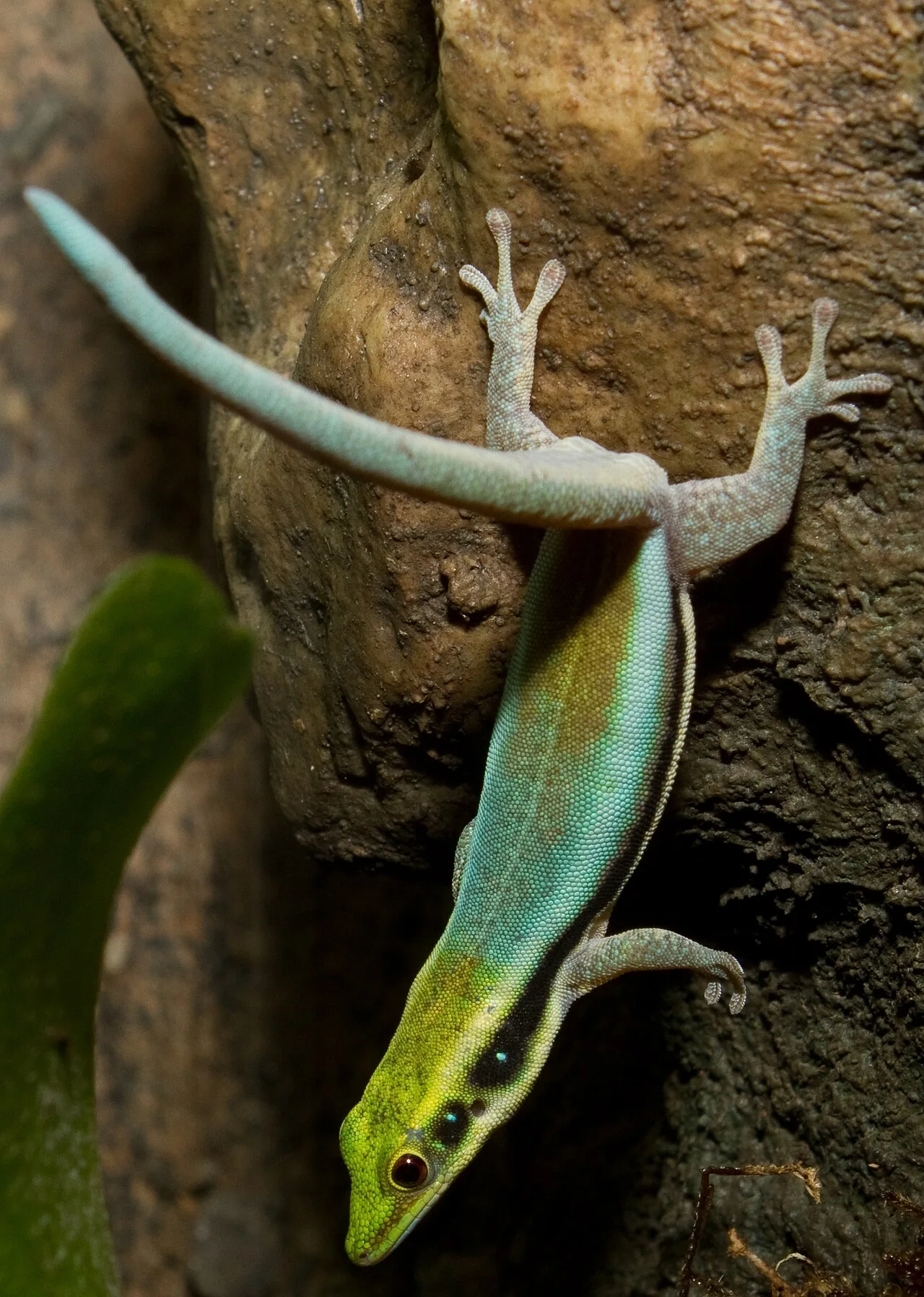
Phelsuma klemmeri is a very small, flattened Malagasy gecko with a yellow head and blue stripes. Its body fits through gaps that a more robust gecko could not pass through [2].
Origin
North-western Madagascar, Sambirano region; the species has been described under this name since 1991 [1].
- Arboreal
- Diurnal
- Omnivorous
At a glance
This small Phelsuma from north-western Madagascar uses bamboo in particular; its flattened outline requires careful closure [1][2][3].
| ADULT SIZE | ≈ 9 cm Including the tail; approximately 4,5 cm snout to vent [3]. |
|---|---|
| ACTIVITY | Diurnal Uses bamboo and neighbouring trees [2][3]. |
| DIET | Omnivorous Captive diet described by DGHT [3]. |
Adult size
Approximately 9 cm including the tail; DGHT gives approximately 4,5 cm from snout to vent [3].
Lifespan
6–8 years stated by the DGHT husbandry profile; no survival series or documented maximum specified [3].
Lifestyle
Diurnal and arboreal, associated particularly with bamboo and neighbouring trees [2][3].
Housing
ARRANGING ITS HABITAT
40 × 40 × 60 cm — DGHT reference point for a pair, without a compatibility guarantee [3].
DGHT proposes 40 × 40 × 60 cm (width × depth × height) for a pair; an association’s reference point, without a guarantee of compatibility [3].
Care parameters
LIT UPPER AREA
30–35 °C — Keeper’s reference point; air/surface method not distinguished [2].
LOWER AREA
22–25 °C — Cool zone in the same setup [2].
Humidity
60–80 % — Ulrike Anders’s practice; ventilation and accessible water [2].
Lit upper area
30–35 °C [2] Values from one breeding setup; the source does not separate air and surface.
Bottom of the terrarium
22–25 °C [2] Cooler zone in the same setup.
Humidity
60–80 % [2] Ulrike Anders’s captive reference point, with ventilation and access to water.
Feeding
FEEDING AND MONITORING
Small prey and suitable fruit-based food; do not reuse old recipes as a balanced ration [2][3].
A distinct small species
The taxonomic database recognises Phelsuma klemmeri with no subspecies listed. The name honours herpetologist Konrad Klemmer [1]. Its very flat outline matters more for the setup than total length alone: sliding doors, cable openings and lid joints must be examined as potential exits. The label “small gecko” therefore does not remove the need to design complete housing, with different supports and safe maintenance access [2].
Adult size, lifespan and lifestyle
Approximately 9 cm including the tail; DGHT gives approximately 4,5 cm from snout to vent [3].
6–8 years stated by the DGHT husbandry profile; no survival series or documented maximum specified [3].
Diurnal and arboreal, associated particularly with bamboo and neighbouring trees [2][3].
Bamboo, foliage and access
DGHT describes a planted terrarium, horizontal and vertical bamboo and good air circulation [3]. Before installation, check the inside of the tubes, their edges and their attachment. A cavity visible during checks is easier to monitor than a shelter that cannot be inspected. Linking several orientations allows the gecko to reach a sheltered area without having to descend to the ground; nevertheless, keep ventilation grilles clear.
Lighting and comparable measurements
The temperatures given here come from Ulrike Anders’s experience, not a universal measurement of the natural environment [2]. DGHT emphasises bright lighting and preventing contact with hot lamps [3]. During trials, record values on the bamboo that is actually accessible. A device placed against glass or directly wetted may give a misleading picture of the microclimate used; recording its location avoids inconsistent comparisons.
Drinking without humid confinement
Anders observes use of droplets as well as a dish [2]. Water presence must be distinguished from the humidity percentage: humid air does not show that the gecko has drunk. For monitoring, look at available surfaces after misting, then at how they change during the day. Persistent condensation across the entire front should prompt a check of ventilation and water additions, rather than another misting out of habit.
Small prey and supplements
The DGHT profile lists several small invertebrates and draws attention to supplementation for juveniles [3]. The captive account also describes a fruit component [2]. Old recipes containing dairy products or honey are not retained as a staple diet. The practical decision is to document what is actually offered: prey species and size, any complete product, and calcium and vitamins already included. Combining them must not be improvised from several profiles.
Cohabitation: contradictory accounts
Assessments of sociability differ. DGHT considers some combinations under supervision, whereas Anders reports failure in her attempts with several males, involving chasing and biting [2][3]. This discrepancy deserves to be retained. A reputation for gentleness does not guarantee an absence of conflict. For an existing group, observe individual access to the best supports and to food; plan separation before an introduction, not after an injury.
Breeding and the pitfalls of openings
Anders mainly describes clutches of two eggs in bamboo and incubation periods varying between seasons [2]. DGHT emphasises that juveniles may require separation before maturity [3]. The flattened body becomes especially important at this stage: an opening that appears closed to adults may allow a hatchling to escape. The data consulted do not justify turning a theoretical hatching date into intervention on an intact egg.
Observe an individual, not a reputation
Identifying each animal through dated photographs helps check that all are being observed, especially in a heavily planted setup. Listing shelters and clutches makes monitoring more concrete than occasional counting alone. The lifespan stated by DGHT remains a husbandry reference point [3]. No robust target adult weight has been retained here; a documented individual trend is better than a value borrowed from another Phelsuma.
Checklist
- Prepare several accessible shelters before arrival.
- Check measurements at locations the animal actually uses.
- Keep origin information and individual observations.
Observations to record
- Meals
- Weight
- Sheds
- Temperature
- Humidity
- Behaviour
The app provides individual animal records. Check which features are available for your animal in the released version.
Related guides
Original guides in French
Sources
Document-based overview; not a substitute for veterinary advice.
- The Reptile Database — Phelsuma klemmeri
Source accessed - Ulrike Anders, IG Phelsuma — Haltungsbericht Phelsuma klemmeri
Source accessed - Johannes Haller, DGHT Suisse — Blauer Bambus-Taggecko
Source accessed