
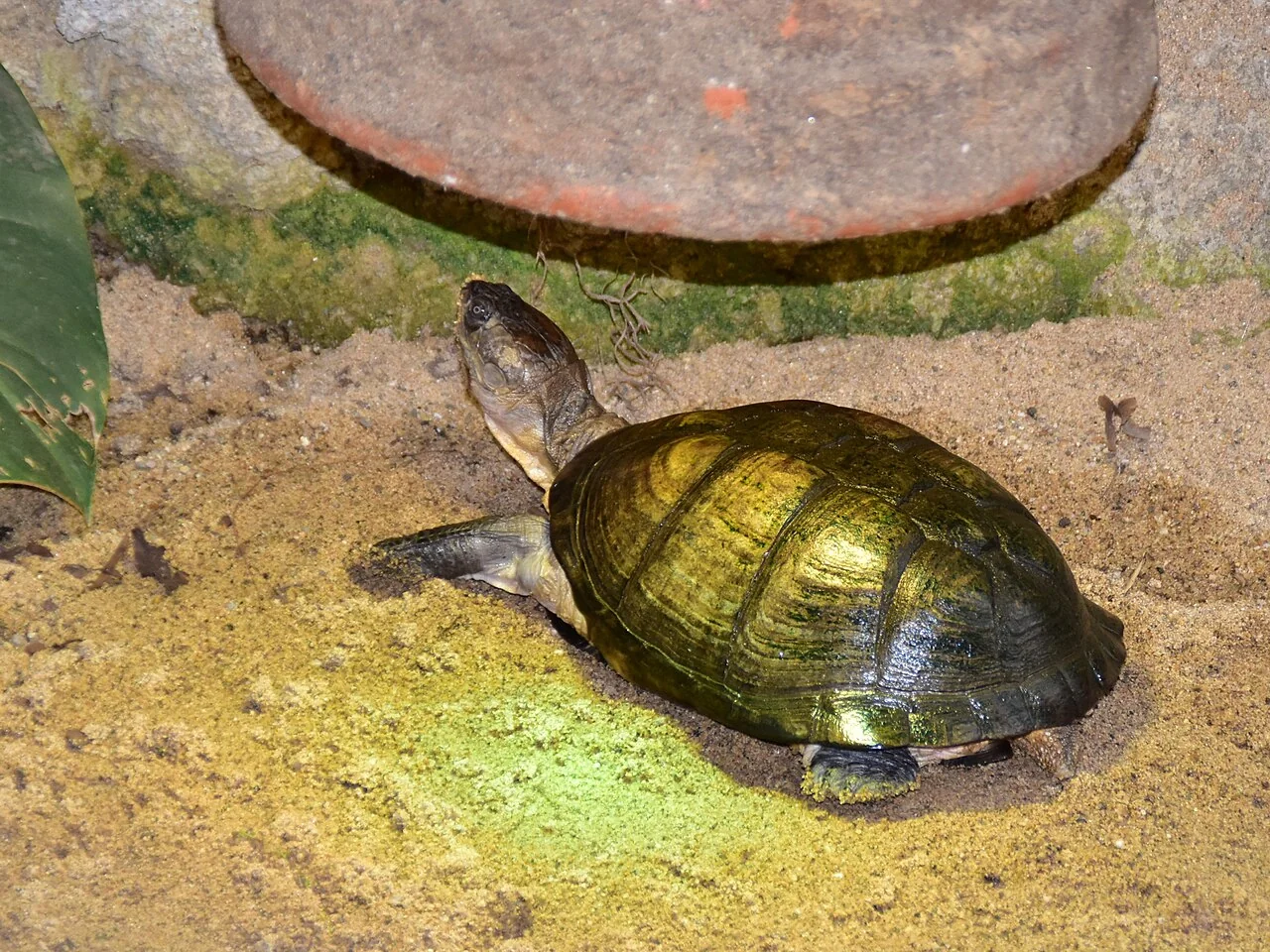
Scientific name
Pelusios castaneus
Pelusios castaneus is a West African aquatic turtle, distinct from the Pelomedusa often sold under a similar common name. The Reptile Database retains this name and recalls several former combinations. [1] Precise identification avoids assigning parameters from another side-necked turtle.
Origin
West and Central Africa, with a distribution extending to Angola. The overview by Bour and colleagues mainly covers ecological observations from southern Nigeria. [2]
- Aquatic
- Large aquarium
- Diet to contextualise
Documentary overview: identity checked; natural observations and captive practices attributed separately. Undocumented limits remain explicit.
At a glance
| SIZE | Up to 28,5 cm Carapace, conservation overview [2]. |
|---|---|
| LIFESPAN | ≈ 25 years Clinical reference point, not guaranteed [3]. |
| LIFESTYLE | Aquatic Varied African environments [2]. |
Adult size
Up to approximately 25–28,5 cm carapace length in the conservation overview; this maximum exceeds the clinical reference point of 20–24 cm. [2][3]
Lifespan
The Lafeber/Penn clinical profile gives approximately 25 years without presenting a monitored cohort. This is a keeping reference point, not a guaranteed duration. [3]
Lifestyle
Aquatic, exploiting varied savanna habitats and some forest areas. [2]
Housing
EQUIPPED AQUARIUM
Adult to anticipate — Filtered water, hides and dry access [3].
The clinical profile provides for a filtered aquarium, hides and emerged surfaces. Volume must anticipate adult carapace size rather than the dimensions of the juvenile sold. [3]
Care parameters
WATER · DAY
26–28 °C — Clinical profile [3].
PLATFORM
32–35 °C — Clinical profile [3].
Humidity
Water and air distinct — No additional universal target retained.
Water, daytime
26–28 °C in the clinical profile [3] Attributed captive recommendation, not average natural temperature.
Water, night-time
At least 24 °C according to that profile [3] Measure at night, without confusing thermostat and actual temperature.
Basking platform
32–35 °C in the clinical profile [3] Keep an easy exit and less-warm zones.
Feeding
DOCUMENTED OMNIVORY
Animal-based emphasis in the field; differing captive recommendations to individualise [2][3].
Name and identifying criteria
Bour and colleagues describe the head’s fine patterns and plastron characteristics in particular. [2] The photographic record must retain several angles, but frequent turning over of the animal is unnecessary for maintaining a log. An identity check on arrival may be enough to avoid years of information attached to the wrong name.
Adult size, lifespan and lifestyle
Up to approximately 25–28,5 cm carapace length in the conservation overview; this maximum exceeds the clinical reference point of 20–24 cm. [2][3]
The Lafeber/Penn clinical profile gives approximately 25 years without presenting a monitored cohort. This is a keeping reference point, not a guaranteed duration. [3]
Aquatic, exploiting varied savanna habitats and some forest areas. [2]
Varied habitats do not mean tolerating everything
The overview shows environmental flexibility, with different uses according to the sites studied. [2] This ability observed in nature does not remove the need to manage a captive setup. An aquarium imposes a closed space where waste and heat accumulate. The relevant question therefore becomes: can the animal choose its zones, and can the keeper maintain those choices over time?
A water area that is actually maintained
The clinical profile emphasises filtration and water changes and recommends tests rather than solely visual assessment. [3] Describing the water route, net volume, bottom access and equipment cleaning makes the setup understandable to another person. Absence of smell is not a chemical measurement. Intervention dates help interpret variation observed after maintenance.
Heating and emerged exit
The proposed thermal ranges come from a 2011 clinical document. [3] They must be identified as such in records. Measuring water temperature and the dry point avoids interpreting one thermometer as validation of the whole setup. The platform must accommodate the entire animal and remain accessible as water level varies between maintenance sessions.
Feeding: flag a discrepancy
The scientific overview describes an omnivore with an animal-based emphasis whose diet varies by site and season. [2] The clinical profile proposes more plant foods for adults. [3] These two descriptions do not justify one proportion imposed without context. The profile therefore retains menu diversity and individual adaptation, keeping this discrepancy visible rather than calculating an artificial average.
Reproduction and laying site
The species is oviparous. [1] Keeping arrangements must distinguish access out of water, dry rest and the needs of a female during laying. The profile proposes neither seasonal stimulation nor incubation temperature: the retained documents alone do not form a complete controlled protocol. Recording observed laying separately from reproductive success avoids presenting eggs as juveniles already obtained.
Cohabitation and signs to pass on
The clinical profile lists aggression between males among possible problems. [3] Providing usable separation is more concrete than assuming a large tank guarantees compatibility. If one animal monopolises an exit or meal, available space is no longer the same for every occupant. Describing these observations with date and context will help a veterinarian; they are insufficient to choose medication independently.
Provenance and long-term monitoring
Keep stated captive origin, transfer documents, carapace length and comparable photographs. The profile does not repeat older regulatory mentions from its sources as though they were current. Check rules in force where the animal is kept before purchase and do not collect from the wild. Release is never a solution to underestimated adult size.
Checklist
- Anticipate adult carapace size.
- Test water and heating.
- Keep provenance.
Observations to record
- Shell
- Meals
- Water
- Interactions
The app provides individual animal records. Check which features are available for your animal in the released version.
Related guides
Original guides in French
Sources
Document-based overview; not a substitute for veterinary advice.
- The Reptile Database — Pelusios castaneus
Source accessed - Bour et al. (2016), IUCN/SSC TFTSG — Pelusios castaneus
Source accessed - LafeberVet / Penn, Latney (2011) — Care of the West African Mud Turtle
Source accessed