
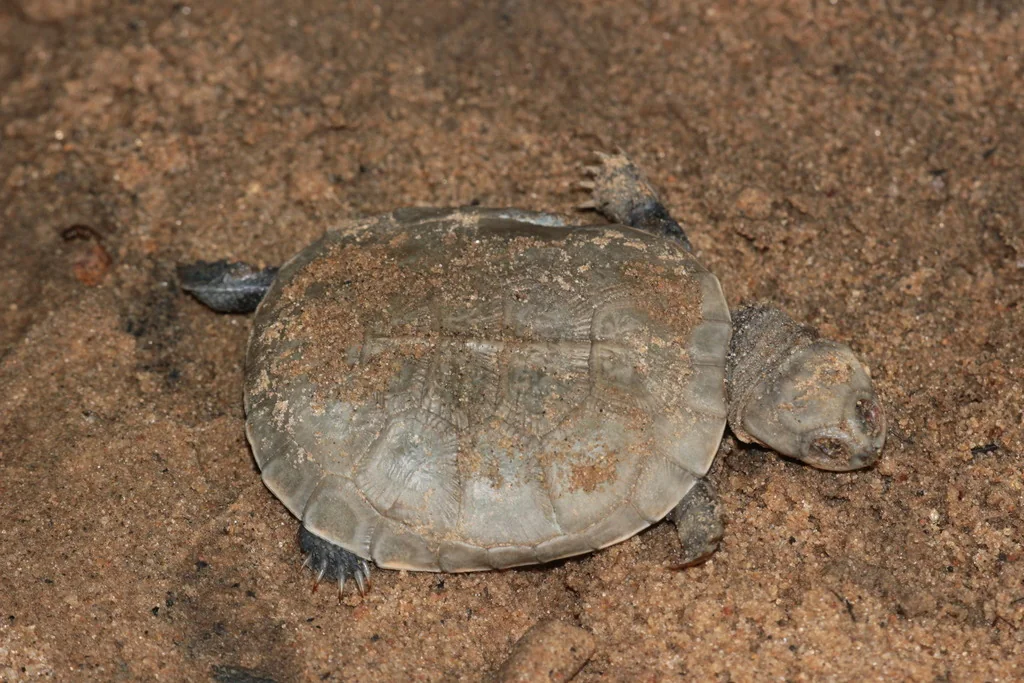
Scientific name
Pelomedusa subrufa
The name Pelomedusa subrufa must be understood in its current strict sense. In 2014, Petzold and colleagues separated several lineages formerly grouped under this label. [1] An old commercial label therefore does not guarantee that the turtle belongs to the species covered here.
Origin
The Reptile Database documents populations in southern Angola, Namibia, Botswana and East Africa, among others, with an introduction to Madagascar. The former pan-African range is not reproduced unchanged. [2]
- Revised complex
- Identification first
- Aquatic
Documentary overview: identity checked; natural observations and captive practices attributed separately. Undocumented limits remain explicit.
At a glance
Populations documented in southern and eastern Africa; a freshwater turtle that folds its head sideways. [2][4]
| SIZE | ≤ 19,7 cm Known maximum SCL in the diagnosis [2]. |
|---|---|
| LIFESPAN | Not established here Strictly species-specific data absent. |
| LIFESTYLE | Fresh water Neck folded sideways [2]. |
Adult size
The diagnosis cited by The Reptile Database gives 19,7 cm as the known maximum straight carapace length and many adults below 14 cm. [2]
Lifespan
No verified captive lifespan exclusively for P. subrufa in the strict sense is retained; commercial figures may concern several species.
Lifestyle
A freshwater turtle in the pleurodire group; the head folds to the side. [2][4]
Housing
BEFORE SETTING UP
Confirm the species — An old label may cover another Pelomedusa [1].
An aquaterrarium with an accessible dry exit, filtration and route to the surface. Dimensions from a commercial protocol are usable only after the group’s identity has been clarified. [4]
Care parameters
PLATFORM
≈ 32 °C — Collective Zilla notice, limited scope [4].
WATER
To individualise — No species-specific value retained.
Humidity
No universal target — Water and emerged access to check separately [4].
Identification
Species within the complex to confirm [1] Keep origin, photographs and any specialist identification.
Commercial basking guidance
≈ 32 °C on the platform in the Zilla profile [4] A collective “sideneck” reference point; not a demonstrated optimum for P. subrufa in the strict sense.
Water
No sufficiently supported species-specific range retained Do not infer water temperature from air temperature in a commercial profile.
Feeding
MENU TO INDIVIDUALISE
Collective advice does not prove a ration specific to P. subrufa in the strict sense [3][4].
Why the name changes the content
The 2014 revision combines molecular data and morphology; some species remain difficult to distinguish externally. [1] The issue is therefore not simply a name translation. An older profile may contain good observations on an animal whose current identity would differ. To establish a turtle’s record, also keep the name used at purchase, without automatically converting it into a certain synonym.
Adult size, lifespan and lifestyle
The diagnosis cited by The Reptile Database gives 19,7 cm as the known maximum straight carapace length and many adults below 14 cm. [2]
No verified captive lifespan exclusively for P. subrufa in the strict sense is retained; commercial figures may concern several species.
A freshwater turtle in the pleurodire group; the head folds to the side. [2][4]
Read older works cautiously
The historical Naturalis presentation still groups several forms and a very broad distribution. [3] It helps explain the history of knowledge, but its large sizes and reproductive data are not transferred directly to the revised species. A museum source does not remove the need to examine its date and the taxonomic concept used.
An aquatic environment with choices
The taxonomic database lists freshwater ponds and swamps. [2] In the setup, this leads to distinguishing the water area, exit, resting places and hides. A turtle must not depend on a single narrow point to breathe or get out. Checking access after every water-level change is a design precaution, without claiming to reproduce every detail of a natural environment.
Filtration and light: clarify the scope
Zilla, with the Madison Area Herpetological Society, recommends filtration, an emerged resting area and UVB lighting for its African side-necked turtles. [4] This husbandry basis remains more general than the current definition of P. subrufa. The record must therefore distinguish what comes from that notice from what has been individualised for the animal. No lamp wattage should be chosen solely from the name on the box.
Feeding and identity
The Zilla notice mentions a menu combining plant matter, invertebrates, fish and turtle foods. [4] Older works often describe a strongly animal-based diet under the collective name Pelomedusa. [3] This information does not justify a universal percentage. For a newly identified animal, keep previous meal records and have the ration adapted gradually rather than turning a food list into an immediate complete change.
Breeding: what is actually established
Oviparity is documented in the taxonomic database. [2] However, this profile does not export spectacular clutches, seasons or incubation durations from older collective overviews to P. subrufa in the strict sense. Documented breeding must allow parent identity and conditions of every clutch to be retrieved. The absence of an average count is more accurate here than a figure borrowed from another lineage.
Behaviour, rest and handling
Zilla emphasises handling-related stress and the possibility of biting. [4] A turtle approaching at feeding time is not necessarily seeking contact. Activity observed through glass, how it leaves the water and shelter choices provide information without picking it up. Accounts of seasonal burrowing in older works do not constitute instructions to induce drying of the tank.
An acquisition to document
Before any decision, ask for captive provenance and the evidence used for identification. If the seller knows only “African turtle”, retain this uncertainty and seek competent identification. A juvenile’s small size does not predict that of an unidentified adult. Also plan maintenance, separation of any companions and a lasting rehoming solution; no wild collection, release or automatic right to keep the animal is proposed here.
Dietary supplements: distinguish the situations
Exotic Pet Vets distinguishes fresh foods requiring supplementation from formulated pellets, for which the profile provides no additional supplementation. [5]
Scope: profile published under Pelomedusa subrufa; check the animal’s identification; no extrapolated dosage. Account for diet composition and setup; no universal dosage is set by this overview.
Checklist
- Confirm taxon and provenance.
- Do not import an old timetable.
- Separate water and air measurements.
Observations to record
- Identity
- Shell
- Water
- Meals
The app provides individual animal records. Check which features are available for your animal in the released version.
Related guides
Original guides in French
Sources
Document-based overview; not a substitute for veterinary advice.
- Petzold et al. (2014) — Revision of African helmeted terrapins
Source accessed - The Reptile Database — Pelomedusa subrufa
Source accessed - Naturalis — Turtles of the World, Pelomedusa subrufa
Source accessed - Zilla et Madison Area Herpetological Society — African Sideneck Turtle
Source accessed - African Side-neck Turtle Care — Pelomedusa subrufa
Source accessed