
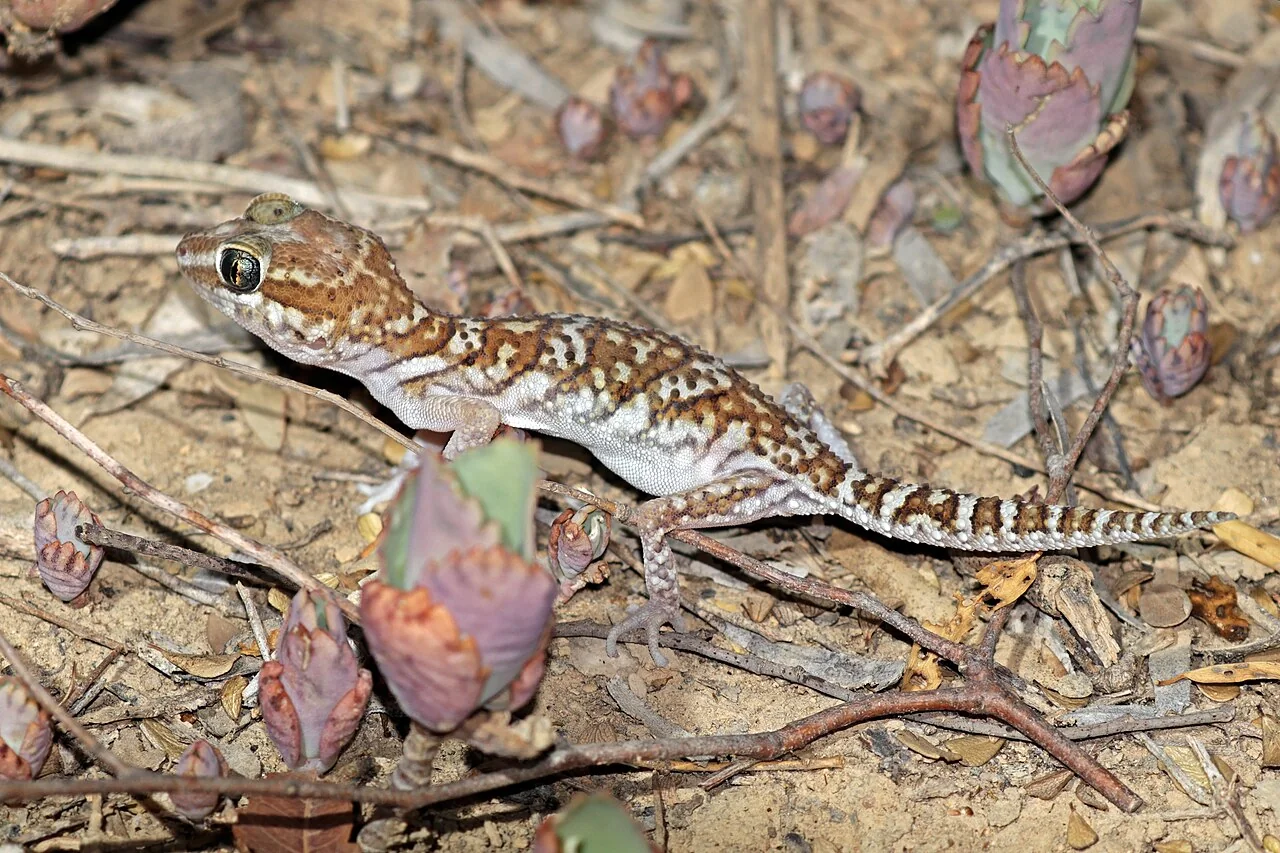
Scientific name
Paroedura picta
Other names: Paroedura pictus · Phyllodactylus pictus
The panther gecko is a small terrestrial gecko from Madagascar. A 2024 study reports a birth without contact with a male, but this case does not turn the species into an obligately parthenogenetic lineage [4].
Origin
Western and southern Madagascar; Tsinjoriake documentation describes it in spiny thickets, leaf litter and on sand [1][2].
- Nocturnal
- Terrestrial
- Insectivorous
At a glance
A terrestrial gecko from Madagascar, also called the panther gecko; a published case of parthenogenesis remains interpreted within its limits [2][4].
| ADULT SIZE | 12–18 cm Total length from the Dragonzoo guide [3]. |
|---|---|
| ACTIVITY | Nocturnal Terrestrial, retreats during the day [2][3]. |
| DIET | Insectivorous Natural diet and captive practice [2][3]. |
Adult size
12–18 cm total length in the Dragonzoo profile; the natural history profile gives up to 9 cm of body length, a distinct measurement [2][3].
Lifespan
Dragonzoo mentions over ten years under good conditions, without presenting a register; average lifespan remains unestablished here [3].
Lifestyle
Terrestrial and nocturnal, seeking retreats during the day [2][3].
Housing
ARRANGING ITS HABITAT
80 × 50 × 50 cm — Dragonzoo reference point; burrowable substrate and locally moist shelters [3].
Dragonzoo proposes 80 × 50 × 50 cm, with a sand and soil or clay mix and locally moist shelters; a commercial reference point, not a universal standard [3].
Care parameters
AIR · DAY
26–30 °C — Dragonzoo reference point [3].
NIGHT
18–22 °C — Attributed practical reference point [3].
Humidity
40–60 % — The guide’s ambient conditions; provide more humid retreats [3].
Daytime air
26–30 °C [3] Range proposed by Dragonzoo; distinct from its localised heating.
Night
18–22 °C [3] Attributed practical reference point.
Humidity
40–60 % [3] The guide’s ambient range, with more humid retreats.
Feeding
FEEDING AND MONITORING
Suitable prey; observe breeding females and juveniles’ intake [3].
A name to connect to the right publications
The current database retains Paroedura picta; Paroedura pictus or Phyllodactylus pictus still appear in older texts [1]. The French name gecko panthère is attested in Malagasy documentation [2]. Captively selected coloration does not necessarily indicate a natural locality. Keeping the scientific name, known parents’ identities and date of birth helps separate verifiable information from aesthetic labels used during a sale.
Adult size, lifespan and lifestyle
12–18 cm total length in the Dragonzoo profile; the natural history profile gives up to 9 cm of body length, a distinct measurement [2][3].
Dragonzoo mentions over ten years under good conditions, without presenting a register; average lifespan remains unestablished here [3].
Terrestrial and nocturnal, seeking retreats during the day [2][3].
Leaf litter, sand and shelters
The Tsinjoriake profile places the species in spiny thickets in the South and South-West [2]. Exclusively vertical decor therefore does not reflect this lifestyle. Several ground-level paths can be created between shelters and feeding points, with stable low features. This is a setup choice based on terrestrial habits. Providing access beneath shelters facilitates waste removal and observation of a possible laying site without having to pursue the gecko.
Measured climate rather than assumed conditions
Dragonzoo distinguishes day, night and a localised heated area; its profile also proposes slightly more humid shelters [3]. The published figures are not meteorological measurements from Madagascar. Before using them, specify whether the sensor measures air, ground or the inside of a hide. The result can change substantially beneath a shelter near the heater. Maintaining several thermal options and checking daily extremes is more informative than a single reading taken in front of the terrarium.
Feeding a small hunter
The insectivorous diet is described in the natural history source [2]. Dragonzoo lists crickets and small cockroaches, with supplements; the breeding study mainly uses crickets in its setup [3][4]. These menus do not demonstrate that a single insect meets every need. Diversifying available prey and retaining information on how they were raised allows the ration to be assessed. For juveniles, observing capture of appropriately sized prey is preferable to simply increasing the number of insects placed in the enclosure.
Ordinary reproduction must not be overlooked
The species usually lays eggs, often in pairs according to the Malagasy documentation [1][2]. Repeated production places demands on the female’s condition. Separating animals does not guarantee an immediate end to all fertile laying, since the 2024 authors also mention sperm retention reported in this species [4]. This distinction matters when interpreting a birth: knowing the entire history of contact with males contributes more than a recent separation date alone.
The parthenogenesis case and its scope
Sokhnenko, Doronin and Böhme describe a female isolated from males since birth, then a juvenile from an incubated egg. They interpret this case as facultative parthenogenesis and specify that genetic evidence would be desirable [4]. It would therefore be excessive to claim certain or usual reproduction without a male. An egg found with an isolated female does not reveal its developmental mechanism. Keeping dates, parentage and conditions remains essential to document a comparable observation.
Incubation and preparation for juveniles
Dragonzoo reports 45–60 days at 27 °C in its practice [3]. The 2024 scientific case uses different conditions; these results are not merged into one recipe. Incubation duration is insufficient to decide on intervention on an egg. A breeding project requires available setups, monitoring of the female and a protocol discussed with an experienced breeder. Early maturity observed in a publication does not constitute a recommended age for breeding an animal.
Monitoring and limits of recipes
The value of monitoring is to connect meals, body shape, weight and clutches without turning every measurement into a target. For a female, distinguishing weight change around a clutch from a lasting trend helps prepare a consultation. The sources consulted provide natural history and some captive experiences, but no comparison of all substrates, lighting systems or feeding frequencies. The retained values therefore remain attributed to their authors and must be examined alongside the actual setup.
Checklist
- Keep the scientific name and documented origin.
- Check access to shelters, water and food.
- Measure the gradient before placing the animal in the setup.
Observations to record
- Meals
- Weight
- Sheds
- Temperature
- Humidity
- Behaviour
The app provides individual animal records. Check which features are available for your animal in the released version.
Related guides
Original guides in French
Sources
Document-based overview; not a substitute for veterinary advice.
- The Reptile Database — Paroedura picta
Source accessed - MERITE / PGM-E 2014 — Richesse biologique de la NAP Tsinjoriake, fiche Paroedura picta
Source accessed - J. Strötzel et N. Strauß, Dragonzoo — Madagaskar-Großkopfgeckos
Source accessed - Sokhnenko, Doronin et Böhme 2024 — Parthenogenetic reproduction in Paroedura picta, dépôt auteur
Source accessed