
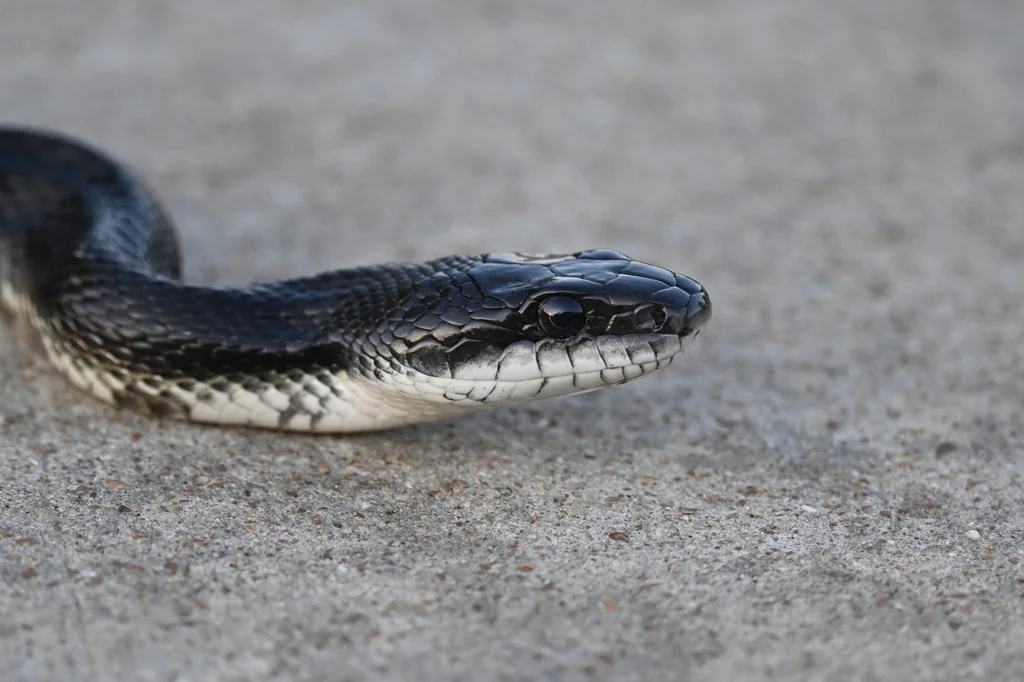
Scientific name
Pantherophis obsoletus
Other names: Coluber obsoletus · Elaphe obsoleta
Pantherophis obsoletus here denotes the western ratsnake recognised by The Reptile Database. Coluber obsoletus and Elaphe obsoleta are former names; publications under the latter may concern a broader group. [1] This large climber therefore requires precise identification before a photograph, provenance or reproductive observation is reused.
Origin
Central United States, mainly west of the Mississippi in the reference retained; boundaries of some contact populations remain complex. [1][2]
- Large climber
- Identity to check
- Oviparous
Documentary overview: identity checked; natural observations and captive practices attributed separately. Undocumented limits remain explicit.
At a glance
| SIZE | 107–183 cm Missouri adult reference point [2]. |
|---|---|
| LIFESPAN | 15 years and more Specialist captive reference point [4]. |
| LIFESTYLE | Ground and trees Variable activity [3]. |
Adult size
107–183 cm for adults presented by the Missouri Department of Conservation. The page does not formally specify TL/SVL convention; some individuals exceed this range. [2]
Lifespan
ReptiFiles mentions 15 years or more in captivity: an attributed husbandry reference point, not a demographic average or guaranteed duration. [4]
Lifestyle
Uses ground and trees; daytime or night-time activity according to season and heat. [3]
Housing
SPECIALIST REFERENCE POINT
≈ 183 × 91 × 91 cm — An average adult; adapt to build [4].
ReptiFiles proposes approximately 183 × 91 × 91 cm for an average adult, with more height if possible. Adapt to actual length. [4]
Care parameters
HEATING
29–32 °C — ReptiFiles [4].
COOL
22–25 °C — ReptiFiles [4].
Humidity
50–70 % — ReptiFiles air reference point, with differentiated shelters [4].
Heating zone
29–32 °C [4] ReptiFiles reference point; localised measurement, distinct from air on the cool side.
Cool area
22–25 °C [4] Maintain a choice of accessible temperatures.
Air humidity
50–70 % according to ReptiFiles [4] Also record location and time; an average does not describe shelters.
Feeding
SUITABLE PREY
A captive menu to organise; natural observations of small vertebrates and eggs [3].
An identity not reducible to black coloration
Missouri describes grey, blotched juveniles that often become much darker. It also notes contact with the central ratsnake in the south-east of that state. [2] Uniform adult colour is therefore insufficient for identification. For a captive animal, keep the name used at transfer and stated origin; a species correction must remain explainable, without assigning a precise locality from appearance alone.
Adult size, lifespan and lifestyle
107–183 cm for adults presented by the Missouri Department of Conservation. The page does not formally specify TL/SVL convention; some individuals exceed this range. [2]
ReptiFiles mentions 15 years or more in captivity: an attributed husbandry reference point, not a demographic average or guaranteed duration. [4]
Uses ground and trees; daytime or night-time activity according to season and heat. [3]
Understand the landscape before the decor
The Kansas atlas mainly reports woodland and rocky hillsides; towards the western limit, wooded river corridors play an important role. [3] This combination of refuges and passages suggests a continuous setup rather than a large empty space. Tracing a route between ground, branches and hides allows a check that the terrarium’s stated height is actually usable by the entire body.
Building for a large climber
An isolated decorative branch does not fulfil the same function as a stable network. Distribute supports, leave room to turn around and check fixings for the anticipated adult size. Also check access to ceiling, doors and cables: an added support may make a formerly out-of-reach opening accessible. Cleaning access must remain possible without abruptly moving the animal or dismantling its entire setup.
Read temperatures as a map
The values above come from a specialist guide, not a trial determining a universal optimum. [4] Measure the heated branch and opposite refuge separately, then check what changes after lights-out and on a hot day in the room. Guard and thermostat-control the heating. A localised high reading does not mean the same thing as a rise throughout the setup; retaining a moderate-temperature refuge is a function to check, not merely a number to display.
Feeding and searching behaviour
The Kansas observations concern small vertebrates and eggs; they particularly show nest-searching in trees. [3] This natural menu is not a collection list to reproduce. For captive keeping, provide suitable captive-bred prey and a menu discussed with a professional. Recording what is actually swallowed and monitoring body condition allows portions to be revised without turning every emergence from a hide into a request for food.
Oviparous and seasonal reproduction
In Kansas regional data, clutches are laid in sheltered places, particularly decomposed wood or moist soil; summer dates do not apply to every captive setup. [3] Prepare a laying site accessible for observation and distinguish mating, laying, viability and hatching. No cooling, annual juvenile count or automatic incubation duration is prescribed here: the parents must be known and a plan available for every juvenile.
Observe without provoking defence
Tail vibration, a bite or an odorous secretion may accompany a perceived threat in this species. [2] This is neither a game nor a character test. Limit intervention to what is necessary and allow retreat. Emergence frequency, resting positions and movement are easier to compare when observations occur from a distance and at similar times.
Preparing for long-term keeping
Adult build must be anticipated before acquisition: furnishings, maintenance access, transport and housing during absences. Ask for documented captive origin; do not collect or release. An older reference on the eastern ratsnake is insufficient to describe this western animal. Keeping this limitation visible is more useful than adding biological detail from the wrong population.
Checklist
- Keep provenance.
- Secure elevated routes.
- Measure both sides of the terrarium.
Observations to record
- Meals
- Weight
- Sheds
- Activity
The app provides individual animal records. Check which features are available for your animal in the released version.
Related guides
Original guides in French
Sources
Document-based overview; not a substitute for veterinary advice.
- The Reptile Database — Pantherophis obsoletus
Source accessed - Missouri Department of Conservation — Western Ratsnake
Source accessed - Kansas Herpetofaunal Atlas / CNAH — Western Ratsnake
Source accessed - ReptiFiles — Black Ratsnake Care Sheet
Source accessed