
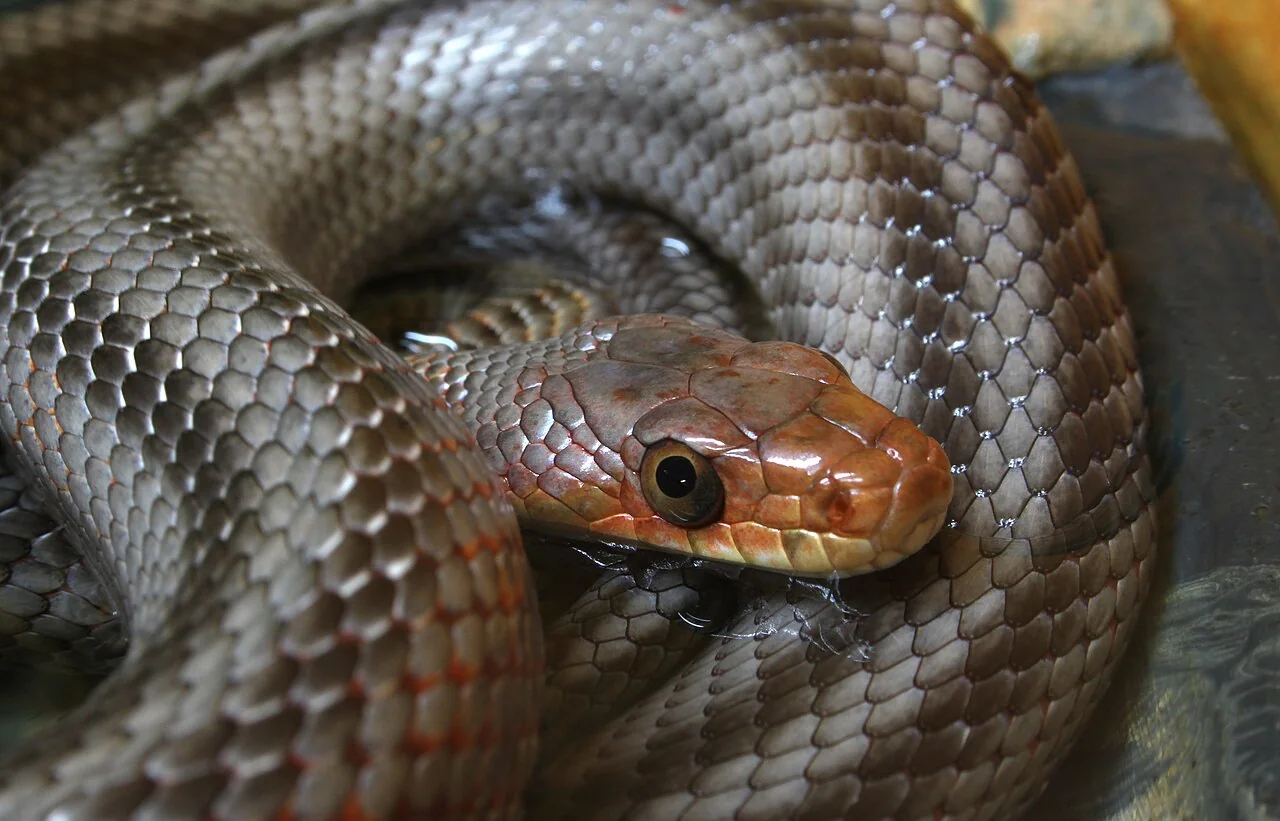
Scientific name
Pantherophis bairdi
Other names: Coluber bairdi · Elaphe bairdi · Elaphe obsoleta bairdi
Baird’s ratsnake is recognised as a full species, formerly named Elaphe bairdi and, earlier still, Elaphe obsoleta bairdi. [1] Its secretiveness in the wild calls for distinguishing a few solid observations from the many terrarium recipes circulated under its name.
Origin
Central and western Texas, then north-eastern Mexico, particularly Coahuila, Nuevo León and Tamaulipas. [1]
- Texas and Mexico
- Climber
- Oviparous
Documentary overview: identity checked; natural observations and captive practices attributed separately. Undocumented limits remain explicit.
At a glance
| SIZE | 120–150 cm Total length; specialist guide [4]. |
|---|---|
| LIFESPAN | 15–20 years estimated Captive estimate, not a record [4]. |
| LIFESTYLE | Raised terrain and height Natural observations [2][3]. |
Adult size
120–150 cm total length in the specialist Interaquaristik profile, with individual variation; this commercial range does not constitute a population study. [4]
Lifespan
Interaquaristik cautiously proposes 15–20 years in captivity; no demographic series or documented record accompanies this figure. [4]
Lifestyle
Uses wooded and rocky terrain, with attested climbing ability. [2][3]
Housing
SPECIALIST REFERENCE POINT
150 × 70 × 100 cm — One adult; adjust to its length [4].
Interaquaristik recommends approximately 150 × 70 × 100 cm for a single adult, to increase according to build; an attributed specialist reference point. [4]
Care parameters
HEATING
29–32 °C — Specialist guide [4].
COOL
21–24 °C — Specialist guide [4].
Humidity
45–60 % — Specialist reference point with a localised moist refuge [4].
Localised heating
29–32 °C [4] Specialist commercial recommendation; do not heat the enclosure uniformly.
Cool side
21–24 °C [4] Measure the accessible refuge, not only the thermostat setpoint.
Humidity
45–60 % and a locally moist refuge [4] Do not confuse air humidity with waterlogged ground.
Feeding
SUITABLE RODENTS
Fully thawed prey in the cited practice [4].
Keep the correct names
The taxonomic reference also lists Coluber bairdi and does not treat bairdi as a mere colour form of obsoletus. It notes their close relationship and discussions of their contact. [1] A captive lineage must therefore retain its identity and breeding history. “Texas” alone remains too broad to reconstruct provenance. Documenting known parents prevents a label change from silently turning uncertain ancestry into a purportedly pure strain.
Adult size, lifespan and lifestyle
120–150 cm total length in the specialist Interaquaristik profile, with individual variation; this commercial range does not constitute a population study. [4]
Interaquaristik cautiously proposes 15–20 years in captivity; no demographic series or documented record accompanies this figure. [4]
Uses wooded and rocky terrain, with attested climbing ability. [2][3]
Mountains and wooded canyons
In Big Bend National Park, the National Park Service places this ratsnake in the Chisos above approximately 1 220 m, among wooded terrain, rocky canyons, grasslands and scrub. [2] This local finding does not describe its entire range. It nevertheless shows why an image of bare desert is reductive. For the setup, consider shelters, routes and shaded areas rather than selecting stones solely for appearance.
A real example of hunting at height
A note published in 2011 describes an individual in La Sepultura cave, Tamaulipas, at an altitude of 597 m. Coiled against a wall 2 m above the ground, it attempted to catch bats; the animals were identified photographically. [3] This is an observation, not a proportion of the entire species’ diet. It documents use of height without justifying bats as captive food.
Arranging a maintainable terrarium
Provide linked supports, hides accessible for checking and an area where the animal can move without getting trapped. A heavy stone on loose substrate must be immobilised before the snake is installed. Test door access after every added branch. Usable volume is what the body can traverse; great height cluttered with unstable surfaces does not automatically become quality space.
Measuring microclimates
The parameters proposed here come from the same specialist profile and remain identified as such. [4] Before arrival, check several positions and times, including night. A probe suspended in the centre does not directly describe a heated support or hide. Photographing sensor placement allows measurements to be repeated after cleaning. Guard hot elements and use a thermostat without treating its setpoint alone as a measurement of the animal.
Feeding with awareness of data limits
The National Park Service mentions small mammals, birds and lizards among natural prey. [2] Interaquaristik uses fully thawed rodents in captivity. [4] The two pieces of information serve different purposes: ecology on one hand, husbandry practice on the other. Organise portions according to build and body condition, then check ingestion. The profile sets neither a universal weight percentage nor a mandatory weekly meal.
Breeding: what is established
Oviparity is confirmed by The Reptile Database. [1] The selected sources do not allow a complete verified breeding protocol to be proposed: optimal parental age, cooling and incubation are therefore not artificially quantified. Before any project, clarify the breeding animals’ identities and plan laying, monitored incubation and juvenile housing. Separating courtship, mating and laying in notes avoids treating the first observation as successful breeding.
Temperament, provenance and monitoring
The park describes a generally slow-moving snake nevertheless capable of hissing and striking if threatened. [2] This description does not guarantee every individual’s reaction. Limit unnecessary handling, compare appetite, sheds and movement, and seek specialist advice for a persistent change. Prioritise documented captive provenance, without capture or release; local obligations must be checked before acquisition.
Checklist
- Document the lineage.
- Fix heavy supports.
- Test shelters before arrival.
Observations to record
- Meals
- Weight
- Sheds
- Shelters
The app provides individual animal records. Check which features are available for your animal in the released version.
Related guides
Original guides in French
Sources
Document-based overview; not a substitute for veterinary advice.
- The Reptile Database — Pantherophis bairdi
Source accessed - National Park Service — Big Bend, Snakes
Source accessed - García-Padilla et al. (2011) — Pantherophis bairdi, diet and foraging behavior
Source accessed - Interaquaristik — Bairds Kletternatter
Source accessed