
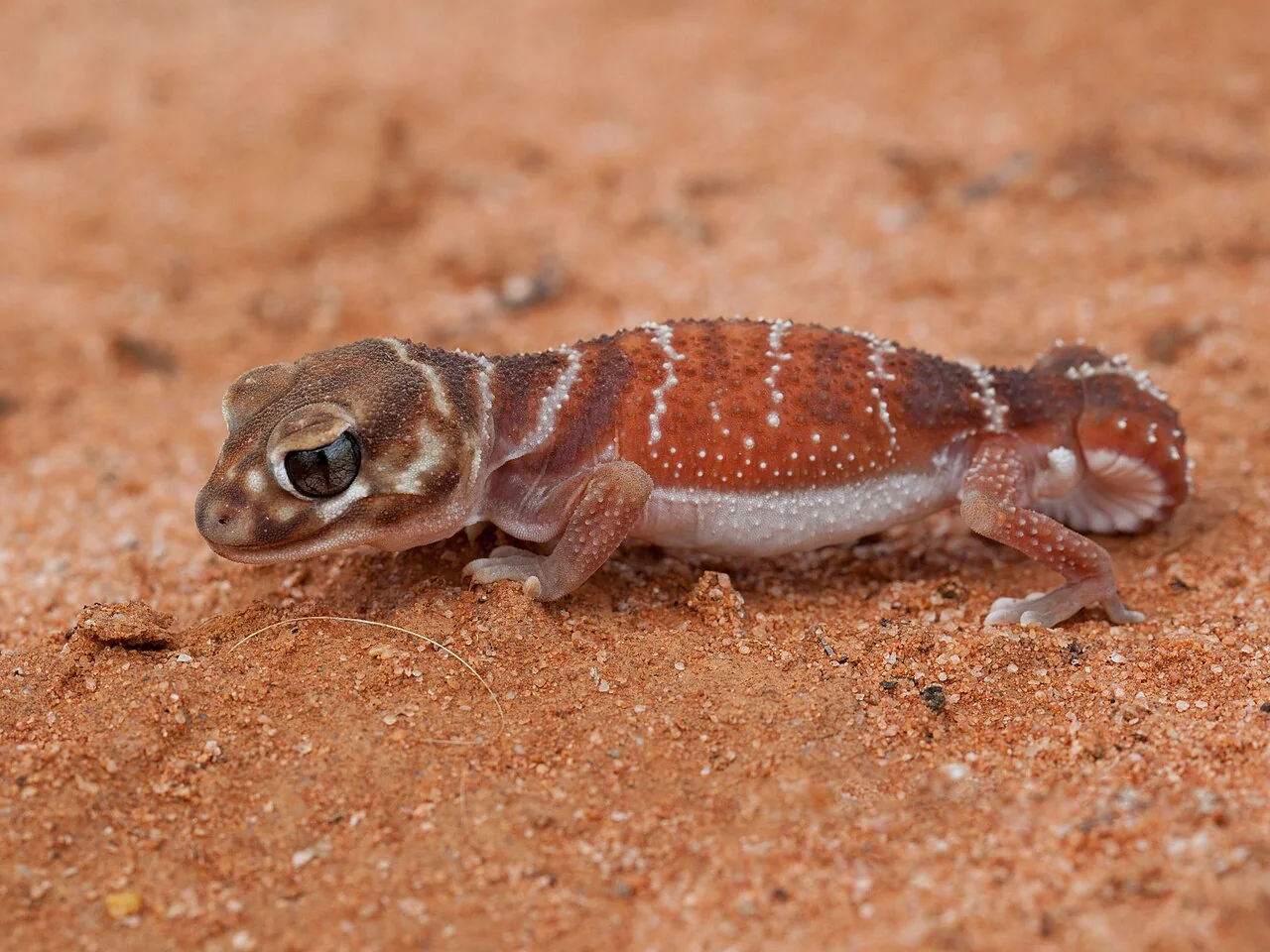
Scientific name
Nephrurus levis
Other names: Nephrurus laevis · Nephrurus platyurus
A tail ending in a small knob distinguishes this terrestrial Australian gecko. Its arid origin does not mean that it spends its days exposed on burning ground: underground retreats are essential [2].
Origin
Arid and semi-arid Australian regions west of the Great Dividing Range; the three recognised subspecies do not have exactly the same distribution [1].
- Nocturnal
- Burrowing
- Australia
At a glance
A nocturnal, burrowing Australian gecko; the profile distinguishes populations and husbandry reference points from experimental data [1][2][3][4].
| ADULT SIZE | ♀ ≈ 14 cm; ♂ ≤ 10 cm Total according to IGA; variation between populations [2]. |
|---|---|
| ACTIVITY | Nocturnal Terrestrial and burrowing [2][3]. |
| DIET | Insectivorous Suitable prey; avoid excess [2]. |
Adult size
Approximately 14 cm total length in females and up to 10 cm in males in the IGA profile; variation noted between populations [2].
Lifespan
No specifically documented lifespan with an individual history has been verified; durations given for the whole genus are not transferred here.
Lifestyle
Terrestrial, nocturnal and burrowing; retreats into shelters during the day [2][3].
Housing
ARRANGING ITS HABITAT
Burrowable ground — Sand and a local moist refuge; no universal minimum retained [2][3].
A setup giving access to burrowable substrate and a moist refuge; the small enclosures historically described do not constitute a recommendation for permanent dimensions here [2][3].
Care parameters
WARM ZONE
32–33 °C — IGA captive reference point [2].
COOL AREA
25–26 °C — Reference point from the same breeding setup [2].
Humidity
Humid shelter — Slightly moist sand beneath the shelter; no numerical ambient value [3].
Warm zone
32–33 °C [2] IGA reference point; retain a distinct cooler area.
Cool area
25–26 °C [2] Attributed captive reference point, not a constant natural temperature.
Humidity
Local moist refuge [3] Slightly moist sand beneath the shelter; no ambient percentage imposed.
Feeding
FEEDING AND MONITORING
Varied prey suited to the animal; monitor body condition and avoid overfeeding [2].
Species, subspecies and identification
The Reptile Database distinguishes levis, occidentalis and pilbarensis at subspecies rank [1]. Differences in pattern and tail must not be reduced to a colour name chosen by a seller. Keeping the parents’ identities, when available, allows an assignment to be discussed. A photograph alone does not demonstrate locality. The older names laevis and platyurus remain useful for finding publications without creating new profiles for the same species.
Adult size, lifespan and lifestyle
Approximately 14 cm total length in females and up to 10 cm in males in the IGA profile; variation noted between populations [2].
No specifically documented lifespan with an individual history has been verified; durations given for the whole genus are not transferred here.
Terrestrial, nocturnal and burrowing; retreats into shelters during the day [2][3].
The substrate is part of behaviour
Steve Sykes explicitly lists N. levis among species digging tunnels in slightly moist sand [3]. Usable depth and the material’s stability therefore matter more than a merely decorative layer. Provide an area where the shelter can be inspected without collapsing the whole setup. This practical proposal addresses the need to reconcile burrowing and maintenance. Heating must be assessed even inside retreats, since a cool surface does not guarantee that the area beneath is also cool.
Heat and local moisture
The IGA profile proposes a daytime gradient and a night-time drop [2]. These reference points must not turn the entire enclosure into a warm zone. Sykes recommends local moistening beneath the shelter for this species, distinguishing smooth-skinned Nephrurus from several rougher-skinned species [3]. The distinction matters: a recipe intended for amyae does not automatically transfer to levis. Checking sand cohesion, condensation and drying time provides information that complements the thermometer.
Feeding and body condition
IGA mainly uses crickets and cockroaches fed before being offered, with a warning against overfeeding [2]. The tail must be observed alongside the trunk and weight trends, without assigning it an invented visual threshold. A highly favoured food is not necessarily a balanced staple. To make the menu verifiable, record prey actually consumed and supplementation products. Frequency should be discussed according to the individual’s age and condition rather than copied from a breeding group.
Handling and defence
Tail loss under stress is described for N. levis by Sykes [3]. Gripping it must therefore be avoided, even if its shape seems to offer a convenient hold. Preparing a transfer container and allowing the animal to enter it reduces improvised movement. A regrown tail is not a lineage characteristic. An initial photograph distinguishes a feature already present from a recent change, without using every difference in shape as a sign of illness.
Breeding: what research contributes
Annable’s thesis directly studies N. levis and U. milii, particularly their eggs and the costs of embryonic development [4]. It describes differences linked to arid and more humid environments, which prevents the two species from being treated as interchangeable. Experimental incubation data are not reproduced here as a domestic recipe. A project must document substrate, temperature, variations and parents; a hatching date alone is insufficient to explain success or failure.
Clutches, juveniles and cautious choices
Oviparous reproduction is confirmed by the taxonomic database [1]. IGA describes clutches of two eggs, but its advice on cooling and temperature-based sex determination is not adopted as universal prescriptions [2]. These would require specific validation and assessment of the breeding animals’ condition. Planning juvenile housing before mating allows individual monitoring of first food intake. An absence of robust data must not be filled with another Australian gecko’s protocol.
Monitoring burrows without destroying them
Photographing entrances and recording emergence times helps understand use of the substrate. A tunnel abandoned after cleaning may simply indicate a structural change. Assessment must link activity, feeding, shedding and body condition. Comparative studies provide useful mechanisms, while captive guides describe keeping experiences. Neither category alone provides a lifespan guarantee. The parameters in this profile are therefore presented with their origins and limitations.
Checklist
- Check the animal’s identity and retain its provenance.
- Install and measure the refuges before arrival.
- Plan individual monitoring of meals, sheds and movement.
Observations to record
- Meals
- Weight
- Sheds
- Temperature
- Humidity
- Behaviour
The app provides individual animal records. Check which features are available for your animal in the released version.
Related guides
Original guides in French
Sources
Document-based overview; not a substitute for veterinary advice.
- The Reptile Database — Nephrurus levis
Source accessed - Italian Gekko Association — Scheda allevamento Nephrurus levis
Source accessed - Steve Sykes — Knob-Tailed Gecko Care Sheet
Source accessed - Terry J. Annable 2004 — Reproductive Biology of Nephrurus and Underwoodisaurus Geckos, résumé de thèse
Source accessed